
Choosing between two websites, or deciding whether your site is keeping up with a competitor, used to mean comparing rankings and backlinks. That is no longer enough. Buyers now ask AI assistants which vendor to shortlist, which tool to trust, and which company to call. The sites that get named, summarized, and cited in those answers often differ from the sites that rank first on a traditional results page.
This pillar guide shows you how to compare two websites across both traditional SEO and AI search visibility, in a way that produces evidence you can act on. You will learn what to measure, how to set up a fair comparison, how to score the results, and how to turn the gaps into a prioritized plan. If you want to run the checks side by side without building your own tooling, you can use the competitor scanner on Anavya AI Labs to start.
For background on how the three levels of website analysis differ, read our guide on GEO Scan vs GEO Audit vs GEO Monitoring. This article focuses on the comparison itself.
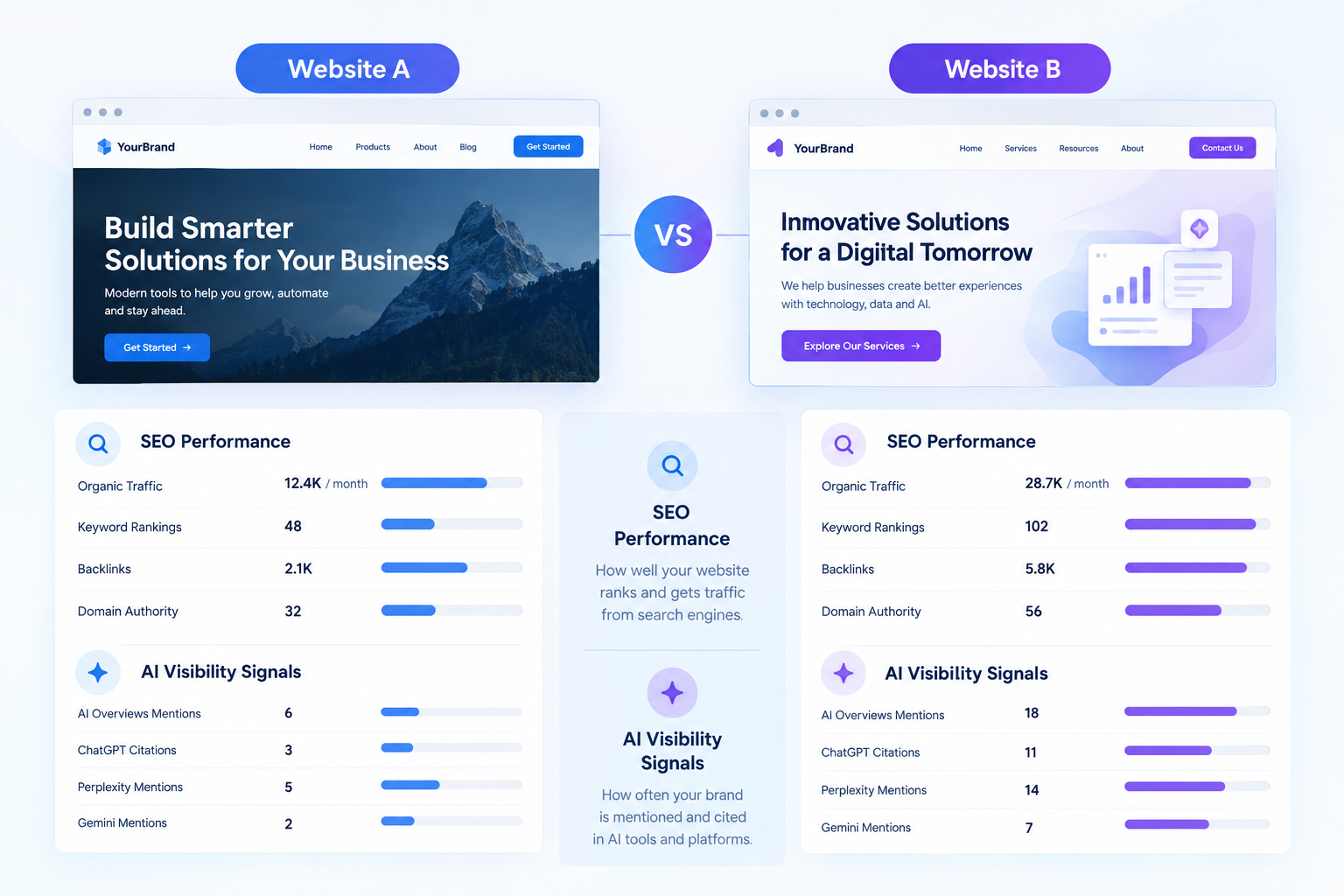
A balanced comparison examines both traditional search signals and AI visibility signals for each site.
What "SEO" and "AI Visibility" Mean in a Comparison
Search engine optimization (SEO) covers how well a website can be crawled, understood, and ranked by traditional search engines. It includes technical health, on-page relevance, content quality, site performance, and the authority that other sites give you through links.
AI visibility describes how often, and how accurately, a brand appears in answers generated by AI systems such as ChatGPT, Claude, Perplexity, and Google's AI features. It depends on several things: whether AI crawlers can access your content, whether your pages state facts clearly enough to be extracted, whether your brand is consistently described across the web, and whether your content is credible enough to be cited.
The two are related but not identical. A site can rank well and still be rarely mentioned in AI answers, because AI systems often synthesize from several sources and favor content that is direct, well structured, and easy to verify. A site can also be mentioned by AI assistants without ranking highly for the same queries. Comparing both gives you a more complete picture of where each site stands.
A useful way to think about the difference:
| Dimension | Traditional SEO question | AI visibility question |
|---|---|---|
| Discovery | Can search engines crawl and index the pages? | Can AI crawlers access the pages they need? |
| Relevance | Does the page match the search intent? | Does the page answer the question directly enough to be used in a generated answer? |
| Authority | Who links to this site, and how strong are those links? | Is the brand described consistently and credibly across the web? |
| Structure | Are titles, headings, and metadata clear? | Are facts, definitions, and entities easy to extract? |
| Outcome | Where does the page rank for target queries? | Is the brand named, summarized, or cited in AI answers? |
Step 1: Define the Comparison Before You Measure
Most comparisons go wrong before any data is collected. The two most common mistakes are comparing unlike things and changing the rules partway through.
Choose the right two sites. A fair comparison is between sites that compete for the same buyers and the same queries. Comparing a global enterprise with a small local business tells you little. If you are comparing your site with a competitor, choose the competitor that wins deals you want to win, not just the one with the biggest brand.
Define the scope. Decide which pages count. For most businesses, the comparison should include the homepage, the main product or service pages, the top three to five content pages, and any pages that target commercial queries. Compare equivalent pages where possible. A product page on one site should be compared with the product page on the other, not with a blog post.
Set the time window and keep it fixed. Record the date of every measurement. AI answers and rankings change over time, so a comparison run on Monday and a second run on Friday are not directly comparable unless you rerun both sites under the same conditions.
Write down the rules. Before you start, document the queries you will test, the AI assistants you will check, the scoring weights, and the pages in scope. Keep this document with the results so anyone can repeat the analysis.
Step 2: Build a Query Set
A comparison of AI visibility depends on the questions you ask. Build a query set of 20 to 40 questions that real buyers would ask. Mix the types:
- Category questions: "What are the best tools for monitoring website SEO?"
- Comparison questions: "Which is better for small businesses, tool A or tool B?"
- Problem questions: "How do I find out why my website is not showing up in AI answers?"
- Brand questions: "What does [company] do?" and "Is [company] reliable?"
Use the same query set for both sites. Include branded queries for each company, because they reveal how AI systems describe each brand, which is often more important than ranking position.
Also build a parallel list of traditional search queries that match the same intent. This lets you compare rankings and AI mentions side by side for the same underlying needs.
Step 3: Measure Traditional SEO Signals
For each site, collect the following signals. Use the same tool and settings for both sites so the results are comparable.
Technical health. Check crawl errors, broken internal links, redirect chains, duplicate titles, missing meta descriptions, and indexing status. A site with many crawl errors is at a disadvantage regardless of content quality.
On-page structure. Compare title tags, meta descriptions, heading hierarchy, and the presence of one clear H1 per page. Note whether each page's primary topic is stated early.
Content depth and freshness. Compare word count where it matters, but prioritize usefulness over length. Check the publication and update dates. A competitor that updates its core pages every quarter may be signaling ongoing investment.
Performance. Compare Core Web Vitals field data where available, and page weight on key templates. Slow pages reduce crawl efficiency and conversion, and can weaken rankings for competitive queries.
Authority. Compare the number and quality of referring domains, not just the raw count of backlinks. A few links from respected, relevant sites often matter more than thousands of low-quality links.
Keyword footprint. Compare which queries each site ranks for in the top ten results, and where the gaps are. The gaps show you which topics the other site owns.
Step 4: Measure AI Visibility Signals
AI visibility requires a different set of checks. These are the signals that most often separate a site that AI systems cite from one they overlook.
AI crawler access
AI systems depend on crawlers, and some sites block them without realizing it. Check your robots.txt file for rules affecting the main AI user agents, such as GPTBot (OpenAI), ClaudeBot (Anthropic), PerplexityBot (Perplexity), and Google-Extended (Google's AI training controls). A rule that blocks these agents may be intentional, but it should be a deliberate decision, not an accident inherited from an old template.
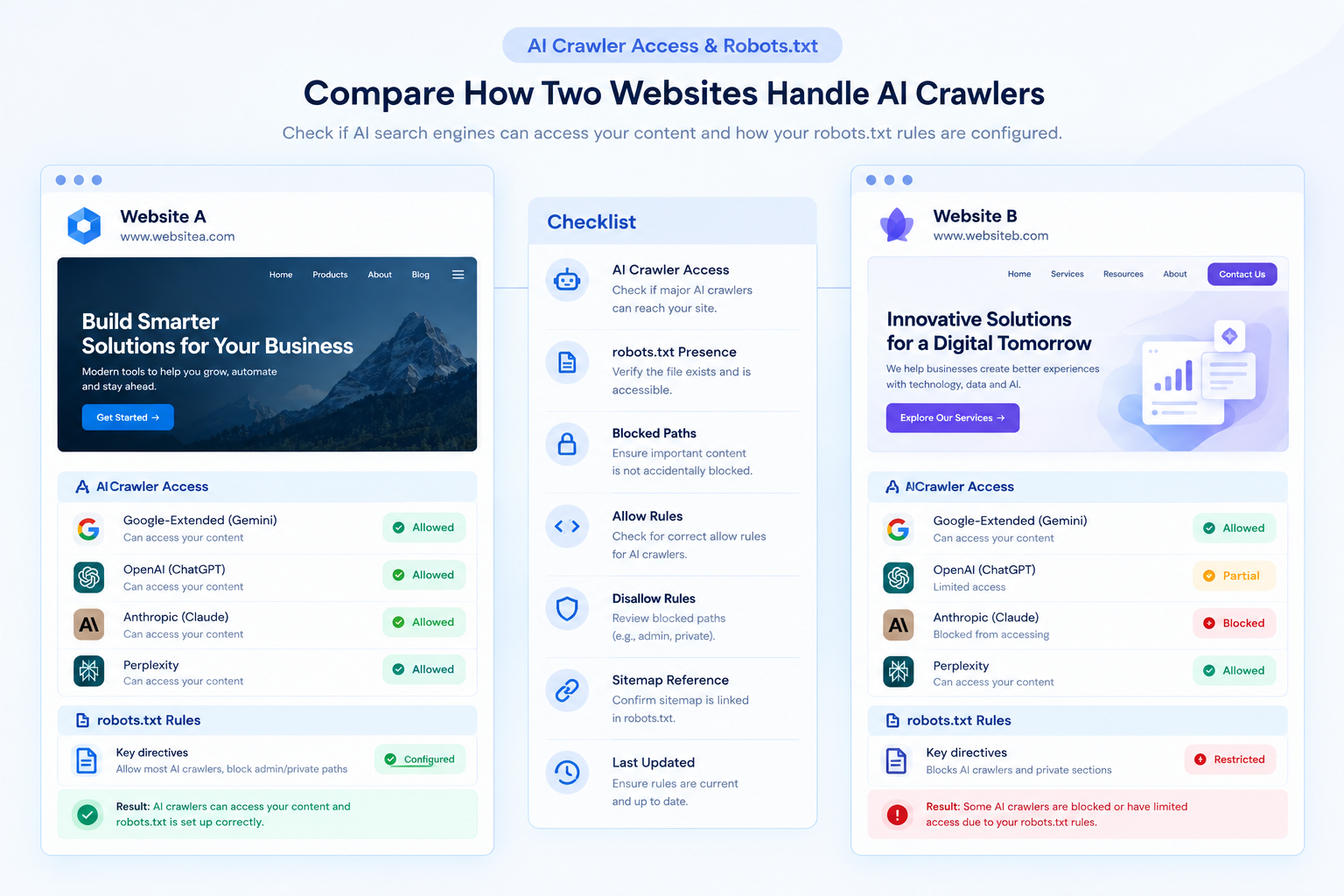
Compare which AI crawlers each site allows, and confirm that important pages are not blocked by accident.
The following script fetches basic on-page data for two sites and checks AI crawler access against each robots.txt file. It is a starting point, not a complete audit, and it only sees the HTML that the server returns, so sites that depend heavily on JavaScript may need a rendered crawl instead.
import requests
from bs4 import BeautifulSoup
from urllib.robotparser import RobotFileParser

AI_BOTS = ["GPTBot", "ClaudeBot", "PerplexityBot", "Google-Extended"]
HEADERS = {"User-Agent": "site-comparison-check/1.0"}


def page_snapshot(url):
    response = requests.get(url, headers=HEADERS, timeout=15)
    soup = BeautifulSoup(response.text, "html.parser")

    title = soup.title.string.strip() if soup.title and soup.title.string else ""
    meta = soup.find("meta", attrs={"name": "description"})
    description = meta["content"].strip() if meta and meta.get("content") else ""
    text = soup.get_text(" ", strip=True)

    return {
        "url": url,
        "status": response.status_code,
        "title": title,
        "title_length": len(title),
        "has_meta_description": bool(description),
        "h1_count": len(soup.find_all("h1")),
        "json_ld_blocks": len(soup.find_all("script", attrs={"type": "application/ld+json"})),
        "word_count": len(text.split()),
    }


def ai_crawler_access(base_url):
    parser = RobotFileParser()
    parser.set_url(f"{base_url.rstrip('/')}/robots.txt")
    parser.read()
    return {bot: parser.can_fetch(bot, base_url) for bot in AI_BOTS}


if __name__ == "__main__":
    sites = ["https://www.example-a.com", "https://www.example-b.com"]
    for site in sites:
        print(page_snapshot(site))
        print(ai_crawler_access(site))
        print("-" * 40)
Run the script against your own two sites, and add error handling before using it on a schedule. Save the output with the date, so you can compare the same checks over time.
Entity clarity
AI systems need to know what a company is, what it offers, and who it serves. Compare whether each site clearly states its name, category, location if relevant, and core offerings on the homepage and in the About page. Check whether organization and product structured data (JSON-LD) is present and accurate. Look at whether the brand is described consistently across its own site, its profiles on major platforms, and third-party directories.
Inconsistency is a common problem. If one site calls itself a "marketing platform" in one place and an "analytics tool" in another, AI systems have less confidence in how to describe it.
Citable content
AI systems tend to cite content that answers a question directly and can be verified. Compare how each site handles definitions, data, and explanations. A page that opens with a clear, specific answer, supports it with evidence, and states its scope is easier to cite than a page that circles around the topic for several paragraphs.
Check whether key claims are attributed, whether statistics have sources and dates, and whether the author and organization are identified. Pages with named authors, clear credentials, and visible update dates generally give AI systems and readers more reason to trust them.
Mentions and descriptions
Run your query set through the AI assistants you care about and record three things for each brand: whether it is mentioned, whether it is cited with a link, and how it is described. Descriptions matter. A brand described accurately and positively in the context you want is in a stronger position than one mentioned only in passing or described incorrectly.
Record the results in a simple table, with one row per query and one column per brand for each assistant. Note the date and the exact wording of the query. Because AI answers vary between runs, repeat each query at least twice and record the pattern rather than a single answer.
Step 5: Score Both Sites Using the Same Rubric
Raw data becomes useful when it is scored consistently. The rubric below weights the categories by how much they tend to matter for most businesses. Adjust the weights to fit your market, but apply the same weights to both sites.
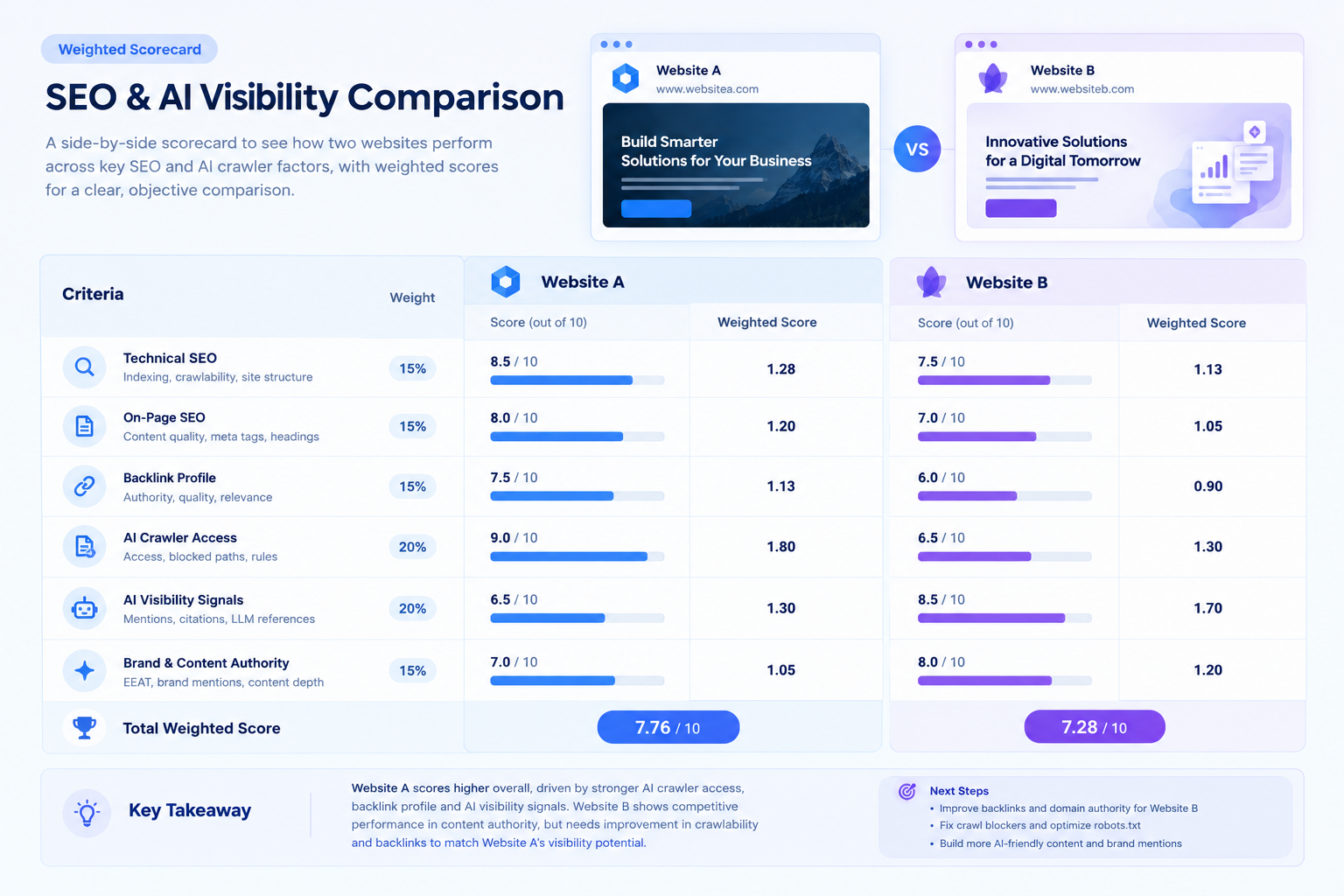
A weighted scorecard keeps the comparison consistent and makes the gaps easy to see.
| Category | Weight | What to assess |
|---|---|---|
| Technical SEO | 15 | Crawlability, indexing, redirects, errors, structure |
| On-page relevance | 10 | Titles, headings, intent match, topic clarity |
| Content depth and freshness | 15 | Usefulness, coverage, update frequency |
| Authority | 15 | Quality and relevance of referring domains |
| Performance | 5 | Page speed and stability on key templates |
| AI crawler access | 10 | Whether AI crawlers can reach important pages |
| Entity clarity and structured data | 10 | Consistent identity, accurate schema, clear offerings |
| Citable content | 10 | Direct answers, attributed claims, named authors |
| AI mentions and descriptions | 10 | Frequency, accuracy, and quality of mentions across the query set |
Score each category from 0 to 10, multiply by the weight, and sum the results to produce a total out of 100. Write a short note beside each score explaining the evidence. A score without evidence is hard to defend and hard to act on.
Be careful with the scores you assign. Reviewers often score the site they know best more generously. Where possible, have two people score independently and compare notes, and resolve disagreements by returning to the evidence.
Step 6: Interpret the Gaps
A total score is useful, but the category-level differences are where the action is. Look for three patterns.
Where you lead. These are your advantages. Protect them. If you have stronger citable content but weaker authority, your strategy should preserve the content quality while building links and mentions.
Where you trail. These are the gaps most worth closing, especially if they affect commercial queries. A competitor that is consistently described accurately in AI answers, while your brand is described vaguely or not at all, has a real visibility problem even if your rankings look fine.
Where you are both weak. These are opportunities. If neither site has clear structured data or citable definitions, the first to publish them gains a relative advantage.
Avoid trying to close every gap at once. Prioritize by two factors: how much the gap affects revenue-linked queries, and how much effort it takes to close. Quick technical fixes, such as unblocking an AI crawler by mistake or fixing duplicate titles, often produce the fastest improvements. Content and authority work takes longer but compounds over time.
A practical example
Consider two project management software companies, both selling to small teams. Company A ranks well for its core keywords, has a clean site, and publishes frequent guides. Company B ranks slightly lower but is mentioned in AI answers far more often for comparison queries.
The comparison showed that Company B had published a clear comparison page with a direct summary, a comparison table, and named authors, and that it was listed consistently in several software directories. Company A's guides were thorough but did not state their conclusions early, and its company description differed between its homepage and its directory profiles.
The action plan for Company A was not to publish more content. It was to rewrite the key guides to state the answer in the first paragraph, make the company description consistent across the web, and add a comparison page for the queries where AI assistants were recommending its competitor. Over the following quarter, its AI mentions for those queries increased, while its existing rankings held steady.
The lesson is that the gap was not about effort or quality in general. It was about the specific signals AI systems use to choose which sources to cite.
Step 7: Turn the Comparison Into an Action Plan
A comparison is only valuable if it changes what you do. Convert the findings into a short, prioritized list with owners and deadlines.
Use this structure for each action:
- The gap: what the comparison showed, with the evidence
- The change: what specifically will be different
- The owner: who is responsible
- The measure: how you will know it worked
- The timeline: when you will check again
For example: "Competitor's product pages state pricing tiers and feature limits in plain text, while ours are in images. Owner: product marketing. Change: move pricing and feature limits into text on the three main product pages. Measure: AI mentions for pricing queries, reviewed at 30 days. Timeline: complete within six weeks."
Limit the plan to the five to eight highest-impact actions. A long list with no owners is a document, not a plan.
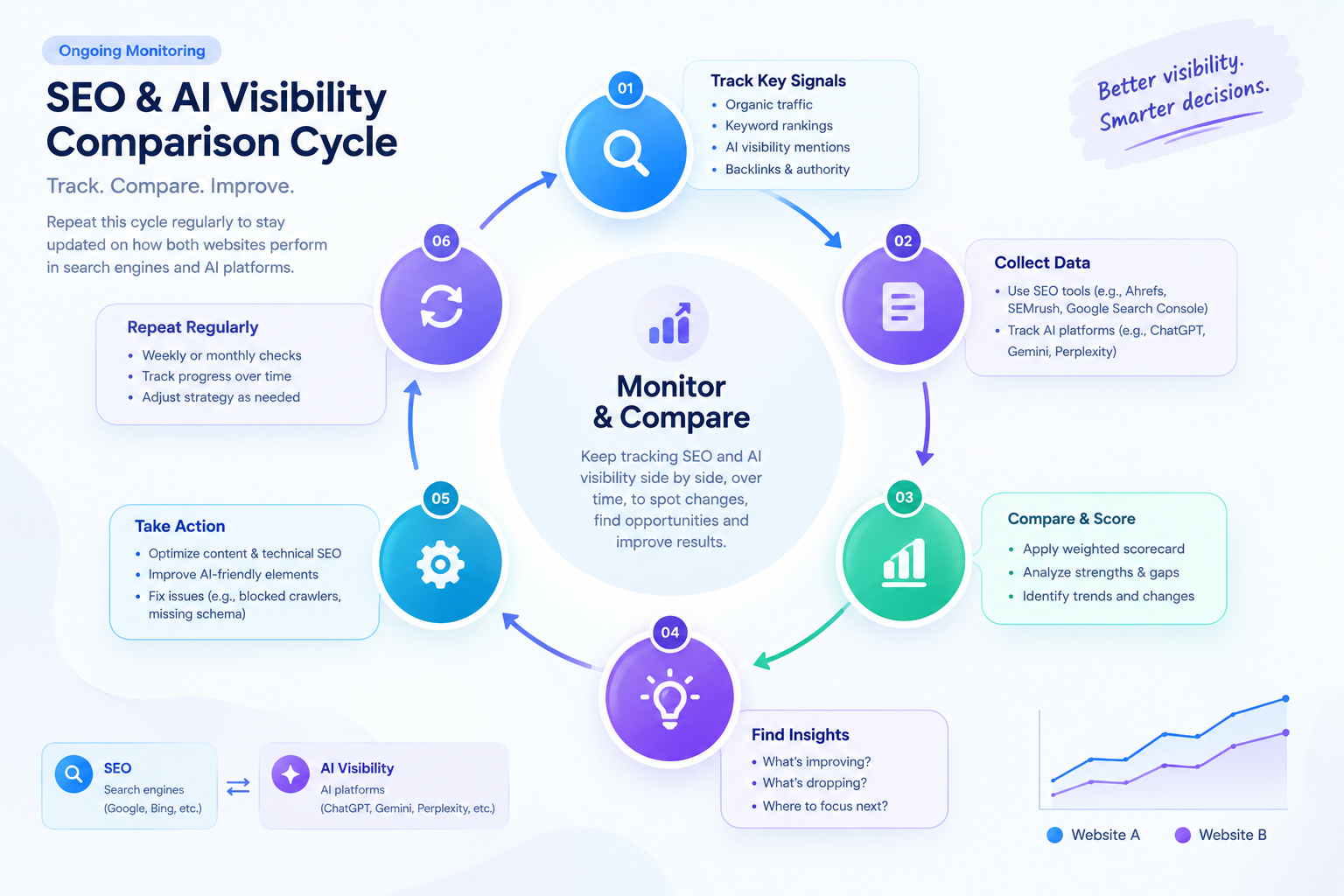
Comparisons should be repeated on a schedule so that changes in either site are visible.
Step 8: Repeat the Comparison on a Schedule
A one-time comparison gives you a snapshot. A repeated comparison shows direction. Both competitors and AI systems change, so a monthly or quarterly review is a reasonable baseline for most businesses. Highly competitive markets may need more frequent checks on their core query set.
When you repeat the analysis, do not change the methodology unless you have a clear reason. If you add a query, a page, or an assistant, record the change and recalculate the baseline for both sites. Otherwise, you may mistake a change in method for a change in performance.
Track the trend lines rather than single data points. AI answers in particular can fluctuate between runs, so a single month's change is less informative than a sustained pattern over three or four measurements.
For ongoing monitoring at scale, the GEO monitoring approach described in the GEO Scan vs GEO Audit vs GEO Monitoring article explains how to combine periodic scans with deeper audits.
Common Mistakes to Avoid
Comparing homepages only. The homepage rarely decides a commercial search or an AI recommendation. Compare the pages that actually answer buyer questions.
Using different tools or settings for each site. Differences in crawl depth, JavaScript rendering, or data sources can make one site look better purely because of how it was measured.
Treating AI answers as fixed. AI responses vary by model, location, phrasing, and time. Repeat your queries and record patterns, not single screenshots.
Confusing mentions with recommendations. A brand that is listed among ten options is in a different position from one that is recommended for a specific need. Record the context, not just the presence.
Ignoring accuracy. A competitor may be mentioned often, but if AI systems describe its product incorrectly, that is a risk to the competitor and an opening for you. Accuracy matters as much as frequency.
Scoring without evidence. Every score should link to a note, a screenshot, a data export, or a logged test. Without evidence, the comparison becomes an opinion.
Chasing every metric. A comparison with 60 metrics is harder to act on than one with 15 well-chosen ones. Focus on the signals that connect to the queries and pages that matter for revenue.
Frequently Asked Questions
How long does a comparison take? A focused comparison of two sites, with a 20 to 30 question query set and a standard scorecard, can usually be completed in one to two working days. A deeper audit with rendered crawls, link analysis, and manual review of AI answers takes longer.
Do I need paid tools to do this? No, but paid tools make the work faster and more repeatable. You can start with free tools for crawling, search console data, and manual testing of AI assistants, then add dedicated tools as your needs grow.
How often do AI answers change? They can change with model updates, new content on the web, and normal variation between runs. This is why repeated testing and trend tracking are more reliable than one-time checks.
Can I see which sites AI assistants cite for my queries? Some AI assistants display sources or links for their answers, and this varies by product and query. Record any sources that appear, and treat the list as a signal of which sites the assistant is drawing on.
Should I block AI crawlers to protect my content? That is a business decision with trade-offs. Blocking crawlers may reduce the chance of your content being used or cited in AI answers. Make the decision deliberately, document it, and review it periodically.
What if my competitor is much larger than I am? Compare yourself with competitors you can realistically outperform on specific queries, and focus on the signals where small improvements have a visible effect, such as clear answers, consistent entity information, and accurate structured data.
Does comparing my site with a competitor help with rankings? Indirectly, yes. The comparison reveals topics the competitor covers that you do not, gaps in technical health, and authority differences. Acting on those findings is what improves rankings, not the comparison itself.
Conclusion
Comparing two websites across SEO and AI visibility gives you a clearer view of where you stand than either discipline can provide alone. Traditional rankings show who is found through search. AI visibility shows who is named and trusted in the answers buyers are increasingly reading.
The process is straightforward when it is disciplined. Define the comparison, build a fixed query set, measure both sets of signals with the same tools, score consistently, interpret the gaps, and turn the findings into a short action plan. Then repeat the process on a schedule so you can see whether your changes are working.
If you want to start the side-by-side checks now, you can run them with the competitor scanner on Anavya AI Labs. Use the results from this guide as your scorecard, and focus your first month on the three to five gaps that matter most for your revenue.
Key Takeaways
- Compare two websites on both traditional SEO signals and AI visibility signals, because they overlap but do not match.
- Define the comparison first: choose the right competitor, the pages in scope, the query set, and the time window.
- Check AI crawler access, entity clarity, citable content, and how AI assistants describe each brand.
- Use one scorecard with fixed weights, and back every score with evidence.
- Prioritize gaps by revenue impact and effort, and start with quick technical fixes.
- Repeat the comparison on a schedule using the same method, and track trends rather than single results.


