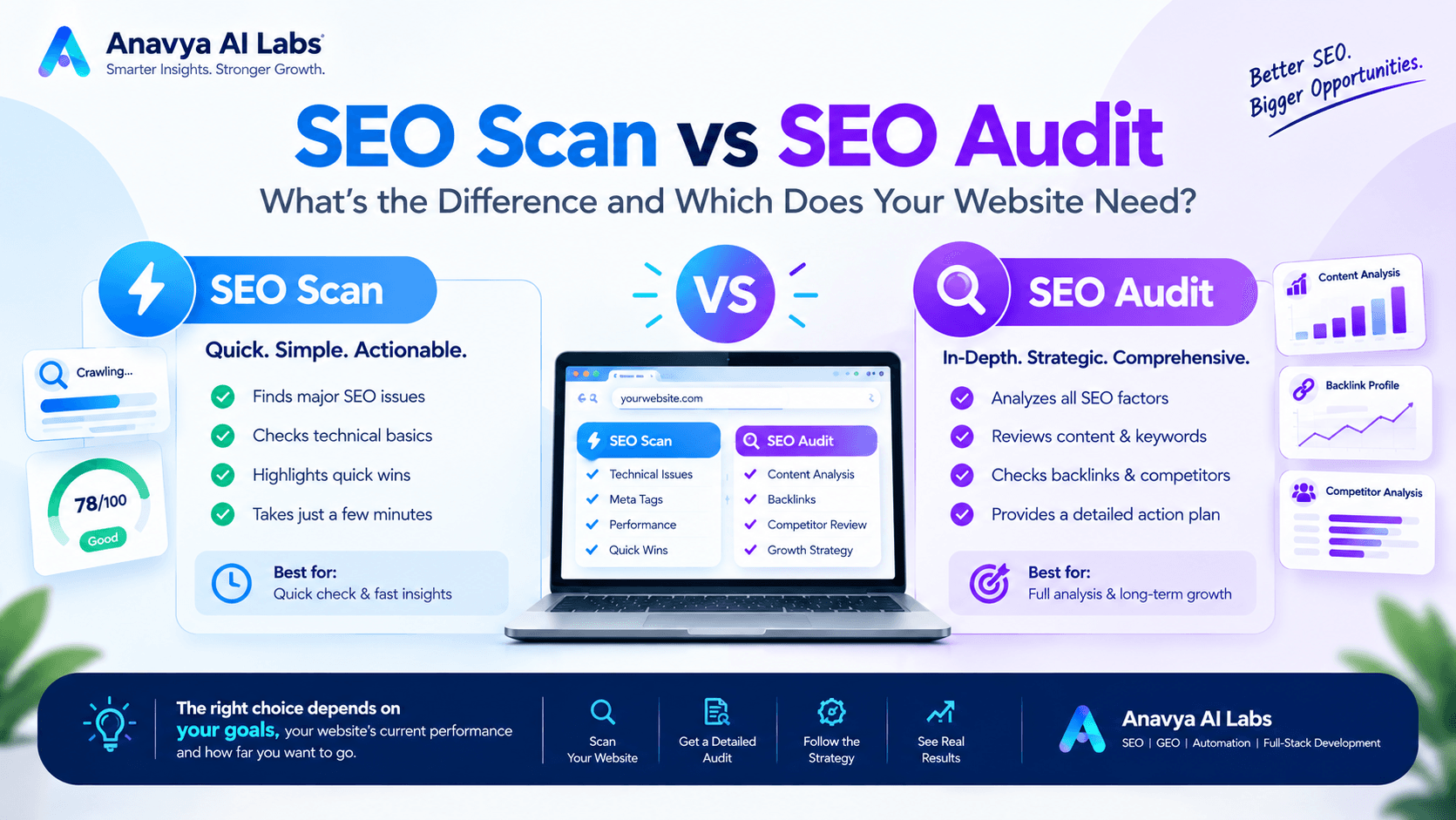
SEO Scan vs SEO Audit: What's the Difference and Which Does Your Website Need?
Most website owners know they should care about SEO, but many don't understand the difference between an SEO scan and an SEO audit. These terms are often used interchangeably, but they're fundamentally different processes that serve different purposes.
An SEO scan is a quick automated check that identifies obvious issues. An SEO audit is a comprehensive analysis by experts who dig deeper, analyze your competitive landscape, and create strategic recommendations.
Using the wrong tool at the wrong time wastes money and delivers poor results. This guide clarifies the differences and shows you exactly which approach your website needs right now.
Why This Distinction Matters in 2026
The SEO landscape has evolved dramatically. In 2026, a basic scan might identify that your site has technical issues, but it won't tell you:
- Whether those issues matter for your specific audience
- How your competitors handle the same situations
- Which fixes will generate the most traffic and revenue
- What your long-term SEO strategy should be
- Why your rankings are declining (if they are)
Conversely, paying for a full audit when you just need to fix obvious problems is wasteful. You need the right tool for your situation.
This guide helps you understand both approaches so you can make informed decisions about your SEO investments.
Image 1: SEO Scan vs SEO Audit Comparison Matrix
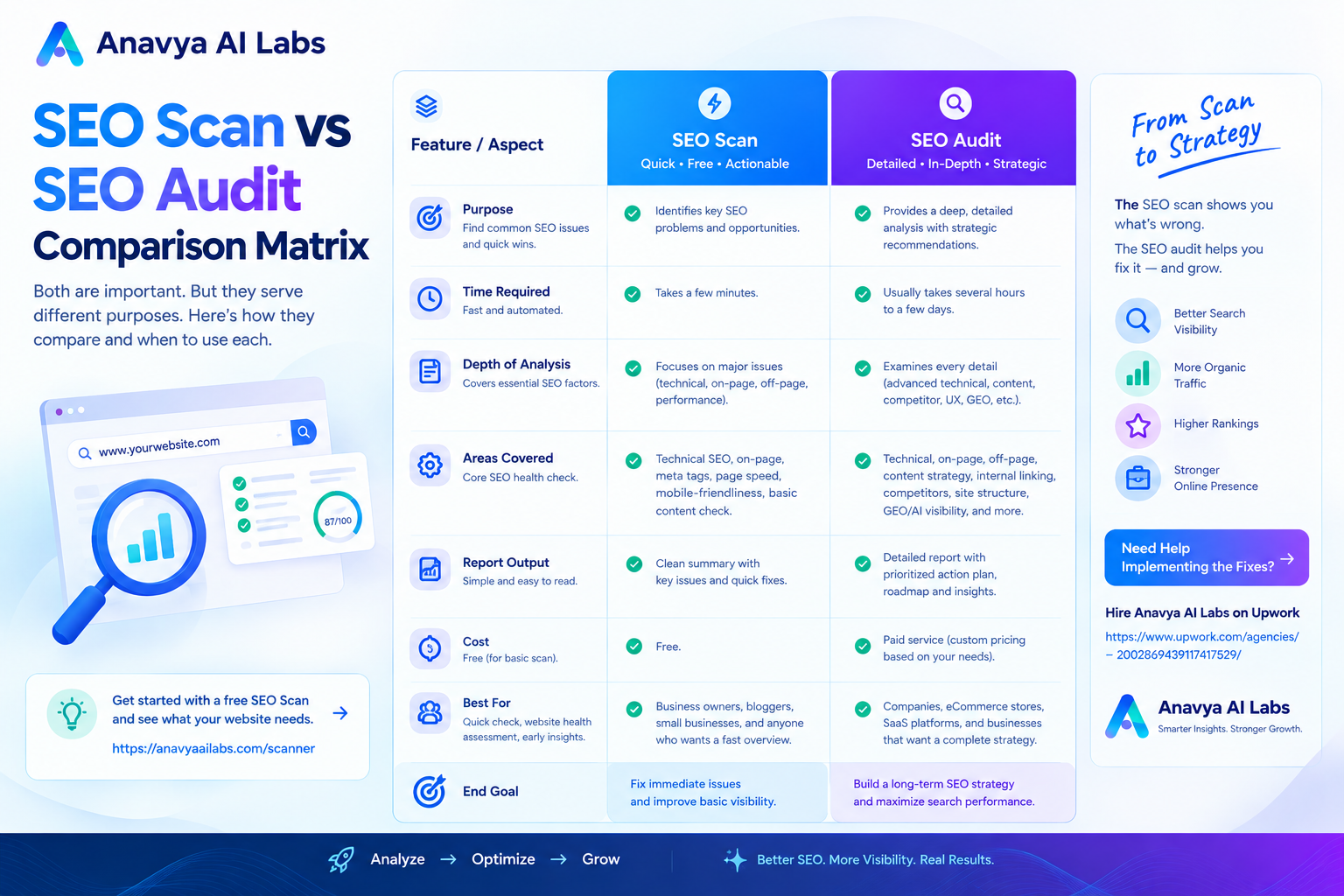
Visual matrix comparing scope, cost, time, depth, and use cases for SEO scans and audits
Section 1: What is an SEO Scan?
Definition & Core Purpose
An SEO scan is an automated, technology-driven assessment of your website's SEO health. It uses software tools to crawl your site, identify technical issues, and report findings in a standardized format.
Think of it like a vehicle's diagnostic scan at an auto shop—the computer identifies error codes, but a human mechanic still needs to interpret them.
Key Characteristics of SEO Scans
Automated Analysis:
- Software crawls your entire site automatically
- No human interpretation during crawl
- Results are consistent and repeatable
- Run on-demand or scheduled (daily, weekly, monthly)
Speed:
- Most scans complete in hours
- Larger sites (10,000+ pages) may take longer
- Results available immediately upon completion
Scope:
- Technical SEO issues
- On-page optimization factors
- Basic competitive comparison
- Content structure problems
Focus Areas:
✓ Broken links and redirects
✓ Missing meta tags and descriptions
✓ Mobile responsiveness issues
✓ Page speed problems
✓ Crawlability and indexation issues
✓ Schema markup implementation
✓ Duplicate content detection
✓ SSL/HTTPS compliance
✓ Keyword rankings (some tools)
Types of SEO Scans
1. Quick Speed Scans
What it checks: Page load time, Core Web Vitals
Tools: Google PageSpeed Insights, GTmetrix
Time: 2-5 minutes per page
Cost: Free (most tools)
Use case: Quick performance checks, troubleshooting speed issues
2. Technical SEO Scans
What it checks: Technical on-page factors, crawlability, structure
Tools: Screaming Frog, SEMrush Site Audit, Ahrefs Site Audit
Time: 30 minutes to 4 hours (depending on site size)
Cost: Free to $500/month
Use case: Identifying technical problems before they impact rankings
3. Competitive Scans
What it checks: Your site vs competitors, keyword gaps, backlink comparisons
Tools: SEMrush, Ahrefs, Moz
Time: Real-time results
Cost: $100-500/month
Use case: Understanding competitive positioning
4. Ranking Scans
What it checks: Current keyword rankings, position changes, visibility trends
Tools: SEMrush, Ahrefs, Google Search Console
Time: Daily automatic updates
Cost: Free to $200/month
Use case: Monitoring performance and tracking changes
What SEO Scans DON'T Tell You
Important: SEO scans have significant limitations:
❌ They don't analyze content quality
❌ They don't evaluate user experience beyond speed
❌ They don't provide strategic recommendations
❌ They don't consider your business goals
❌ They don't analyze competitive strategy
❌ They don't explain WHY issues matter for your site
❌ They don't create actionable implementation plans
❌ They don't provide ongoing strategic guidance
When to Use SEO Scans
SEO scans are perfect when you need to:
- ✓ Check for obvious technical problems monthly
- ✓ Monitor page speed continuously
- ✓ Track keyword rankings over time
- ✓ Get quick feedback on website changes
- ✓ Monitor for indexation issues
- ✓ Quick competitive benchmarking
- ✓ Identify broken links and crawl errors
- ✓ Diagnose specific problems (not strategy)
Price: Usually $0-500/month depending on tools
Time commitment: 1-2 hours monthly (reviewing results)
Expected ROI: Identifies problems, but doesn't solve them
Image 2: SEO Scan Process & Output Dashboard
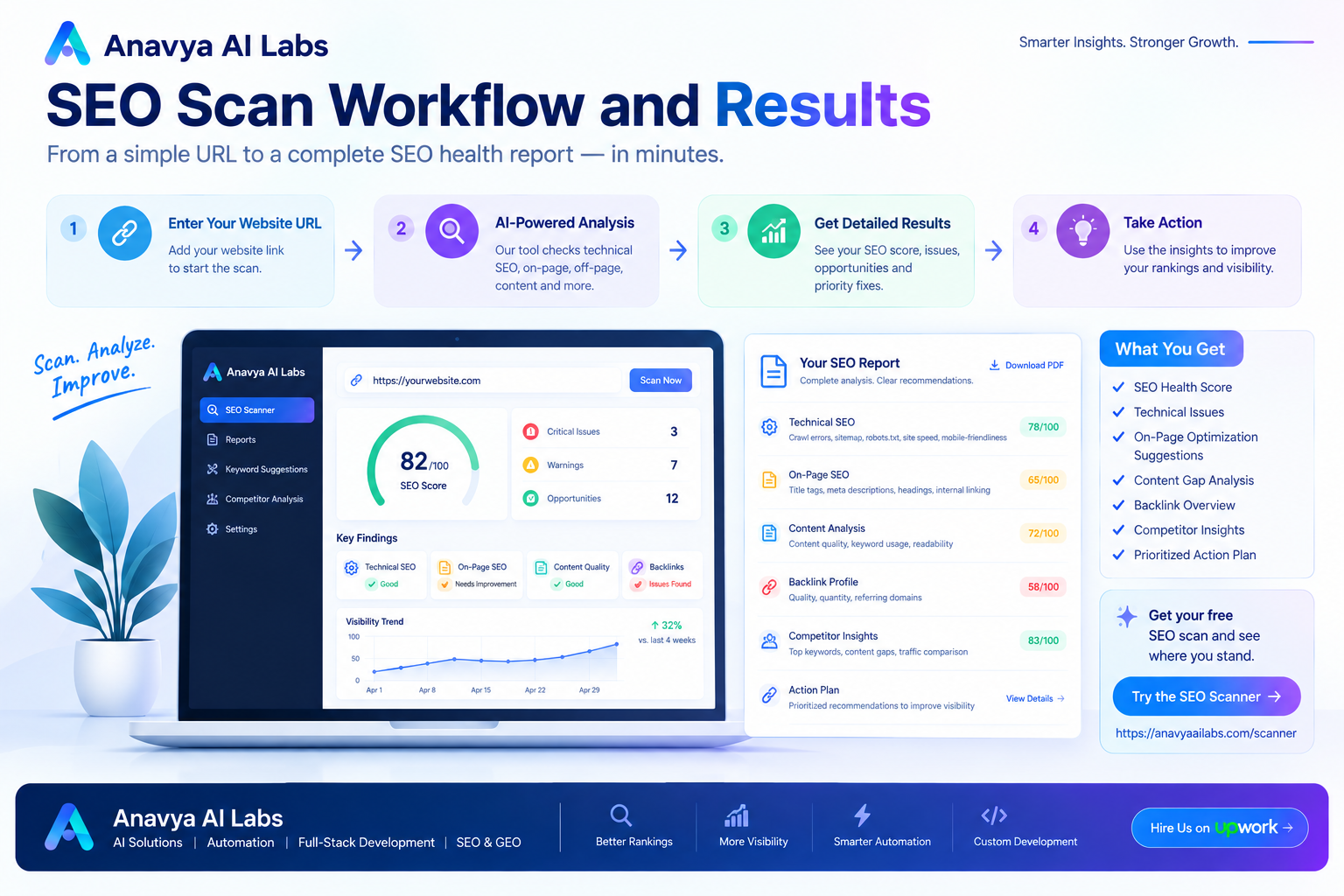
Visual showing how SEO scan tools work, what they analyze, and typical dashboard output
Section 2: What is an SEO Audit?
Definition & Core Purpose
An SEO audit is a comprehensive, strategic analysis of your website's search engine optimization. It combines automated scanning with expert analysis, competitive research, and strategic recommendations tailored to your business goals.
A proper SEO audit answers: "Why is this website not performing better, and what should we do about it?"
Key Characteristics of SEO Audits
Comprehensive Analysis:
- Combines automated tools with expert review
- Analyzes technical, on-page, off-page, and competitive factors
- Considers your specific industry and competitive landscape
- Evaluates content quality and strategic fit
Strategic Focus:
- Aligned with your business goals
- Prioritizes recommendations by impact and effort
- Creates a 3-6 month action roadmap
- Provides implementation guidance
Expert Interpretation:
- Experienced SEO professionals review findings
- Context matters (not all issues affect all sites equally)
- Competitive analysis informs recommendations
- Strategic recommendations, not just problem lists
Scope:
✓ Technical SEO deep dive
✓ Content strategy analysis
✓ Competitive landscape evaluation
✓ Backlink profile review
✓ Brand mentions and entity signals
✓ User experience assessment
✓ Conversion optimization analysis
✓ Industry-specific considerations
✓ Long-term strategic planning
Types of SEO Audits
1. Full Website Audit
Scope: Everything—technical, content, competitive, strategy
Time to complete: 2-4 weeks
Cost: $3,000-15,000
Deliverable: 40-100+ page report with recommendations
Best for: Struggling websites, new SEO programs, major redesigns
2. Technical SEO Audit
Scope: Technical factors only (crawlability, speed, structure, schema)
Time to complete: 1-2 weeks
Cost: $1,500-5,000
Deliverable: Technical issues list with priorities and fixes
Best for: Websites with obvious technical problems
3. Content Audit
Scope: Content quality, relevance, keyword alignment, update needs
Time to complete: 2-3 weeks
Cost: $2,000-8,000
Deliverable: Content inventory with optimization recommendations
Best for: Mature sites with large content libraries
4. Competitive Audit
Scope: Competitive landscape, market gaps, positioning opportunities
Time to complete: 2-3 weeks
Cost: $2,000-6,000
Deliverable: Competitive analysis with strategic opportunities
Best for: Understanding market position and opportunities
5. Post-Launch Audit
Scope: Identifying issues from redesign, migration, or major changes
Time to complete: 1-2 weeks
Cost: $1,500-4,000
Deliverable: Issue list with priorities and quick wins
Best for: After website redesigns or platform migrations
What SEO Audits Include
A comprehensive SEO audit typically covers:
1. Technical Analysis
- Site architecture and URL structure
- Crawlability and indexation
- Core Web Vitals and performance
- Mobile responsiveness
- HTTPS/SSL implementation
- Schema markup implementation
- Structured data quality
- Redirect chains and broken links
2. On-Page Analysis
- Title tag and meta description optimization
- Content quality and depth
- Keyword optimization and targeting
- Heading structure (H1-H6)
- Internal linking strategy
- Content freshness and update frequency
- Image optimization
- Call-to-action effectiveness
3. Off-Page Analysis
- Backlink profile and quality
- Referring domain authority
- Brand mentions and citations
- Social signals
- Local business listings
- Authority and trustworthiness signals
4. Competitive Analysis
- Top 3-5 competitor analysis
- Keyword gaps and opportunities
- Content strategy comparison
- Backlink comparison
- Technical comparison
- Market positioning assessment
5. User Experience
- Site usability assessment
- Navigation structure
- Mobile user experience
- Page load speed and performance
- Bounce rate analysis (if data available)
- Conversion funnel review
6. Strategy & Recommendations
- Prioritized action plan
- 3-6 month roadmap
- Quick wins vs long-term investments
- Resource requirements
- Expected outcomes and ROI
- Implementation guidelines
When to Use SEO Audits
SEO audits are essential when:
- ✓ Rankings are declining and you don't know why
- ✓ You're planning a website redesign or migration
- ✓ Launching a new website or entering a competitive market
- ✓ You want to maximize SEO ROI
- ✓ You're considering hiring an SEO agency
- ✓ Your organic traffic has plateaued
- ✓ You have a large content library to optimize
- ✓ You need strategic direction for SEO investments
Price: Usually $2,000-15,000+ (one-time or annually)
Time commitment: 10-20 hours of implementation planning and review
Expected ROI: 200-400% (over 6-12 months with implementation)
Image 3: SEO Audit Deep-Dive Analysis Framework
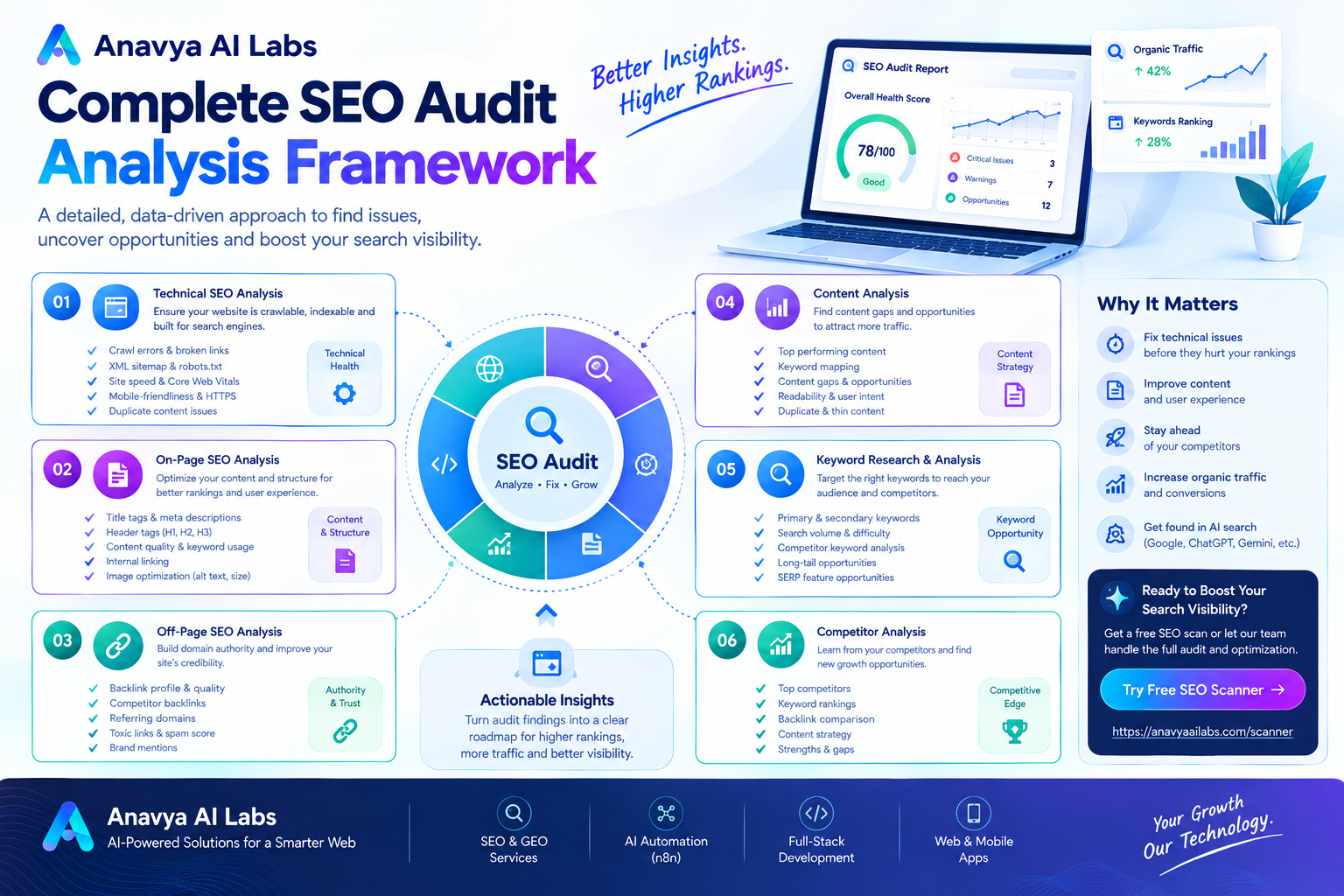
Visual showing all components of a comprehensive SEO audit and how they interconnect
Section 3: Direct Comparison - Scans vs Audits
Feature Comparison Table
| Feature | SEO Scan | SEO Audit |
|---|---|---|
| Turnaround Time | Hours-days | 2-4 weeks |
| Cost | $0-500/month | $2,000-15,000 (one-time) |
| Automation Level | 90-100% automated | 30% automated, 70% expert analysis |
| Depth of Analysis | Surface-level | Deep strategic analysis |
| Technical Issues | ✓ Comprehensive | ✓ Very comprehensive |
| Content Quality | ✗ Limited | ✓ Comprehensive |
| Competitive Analysis | ✗ Basic only | ✓ Detailed |
| Strategic Recommendations | ✗ Generic | ✓ Custom and prioritized |
| Implementation Guidance | ✗ None | ✓ Detailed roadmap |
| One-time or Ongoing | Ongoing (monthly) | One-time or annually |
| Best for Finding Quick Wins | ✓ Yes | ✓ Yes (but also deep work) |
| Best for Strategy | ✗ No | ✓ Yes |
| Actionable Output | Partial | Complete |
| ROI Focused | ✗ No | ✓ Yes |
| Customization | ✗ Standardized | ✓ Highly customized |
Section 4: Real-World Scenarios - Which Do You Need?
Scenario 1: You're Not Ranking for Your Main Keywords
Situation: Your homepage targets "SEO services in Denver" but doesn't appear in top 20 results. You're losing business to competitors.
The Wrong Approach: Run a quick SEO scan
Why it fails: Scan identifies "missing meta description" or "slow page speed," but that's not why you're not ranking. Competitors may have better authority, better content, or better link profiles.
The Right Approach: Full SEO Audit
Why it works: Audit compares your site to top 3 competitors, identifies content gaps, analyzes your link profile, and recommends specific improvements to compete for that keyword.
Expected Investment: $4,000-8,000
Expected ROI: One client from improved ranking = $3,000-10,000+ in revenue
Scenario 2: Your Website Recently Had Performance Issues
Situation: Page speed dropped last month, bounce rate increased 25%, organic traffic declined 15%.
The Wrong Approach: Full SEO Audit
Why it fails: Waste time and money analyzing things that don't matter when your immediate problem is performance.
The Right Approach: Technical SEO Scan + Performance Audit
Why it works: Quick scan identifies the performance bottleneck (images, code bloat, server issues), allows immediate fixes.
Expected Investment: $0-1,000 (in-house fix based on scan results)
Expected ROI: Restore organic traffic within 2 weeks
Scenario 3: You're Launching a New Website Tomorrow
Situation: Redesign is launching tomorrow. Old site has 40,000 indexed pages. You need to make sure nothing breaks SEO-wise.
The Wrong Approach: Wait for a full audit after launch
Why it fails: If something goes wrong during migration, you lose traffic for weeks while you figure it out.
The Right Approach: Pre-Launch Technical Audit
Why it works: Audit reviews redirect strategy, indexation plans, robots.txt configuration, and identifies potential issues before they cost you traffic.
Expected Investment: $2,000-5,000
Expected ROI: Prevent months of lost traffic (worth $10,000-50,000+)
Scenario 4: You Want to Monitor SEO Health Monthly
Situation: Your SEO is performing well, but you want early warning of problems.
The Wrong Approach: Monthly full audits
Why it fails: Overkill and wastes resources. You don't need deep strategic analysis every month when things are working.
The Right Approach: Monthly SEO Scans
Why it works: Automated scans identify technical regressions, broken links, indexation problems, and ranking changes. Only conduct deep audits annually or when issues emerge.
Expected Investment: $50-300/month
Expected ROI: Prevent serious problems before they damage rankings
Scenario 5: You Just Hired an SEO Agency
Situation: You're considering hiring an SEO agency but want to understand the scope and cost.
The Wrong Approach: Comparison scans from different tools
Why it fails: Different tools report different issues, making comparison impossible. You need expert analysis of what matters for YOUR site.
The Right Approach: Comprehensive SEO Audit from the agency
Why it works: Audit becomes the project baseline. Agency shows how they analyze sites, priorities, timeline, and expected outcomes. You can compare proposals apples-to-apples.
Expected Investment: $4,000-12,000
Expected ROI: Informed decision on SEO partnership (saves money vs wrong agency choice)
Image 4: Decision Tree - Scan vs Audit
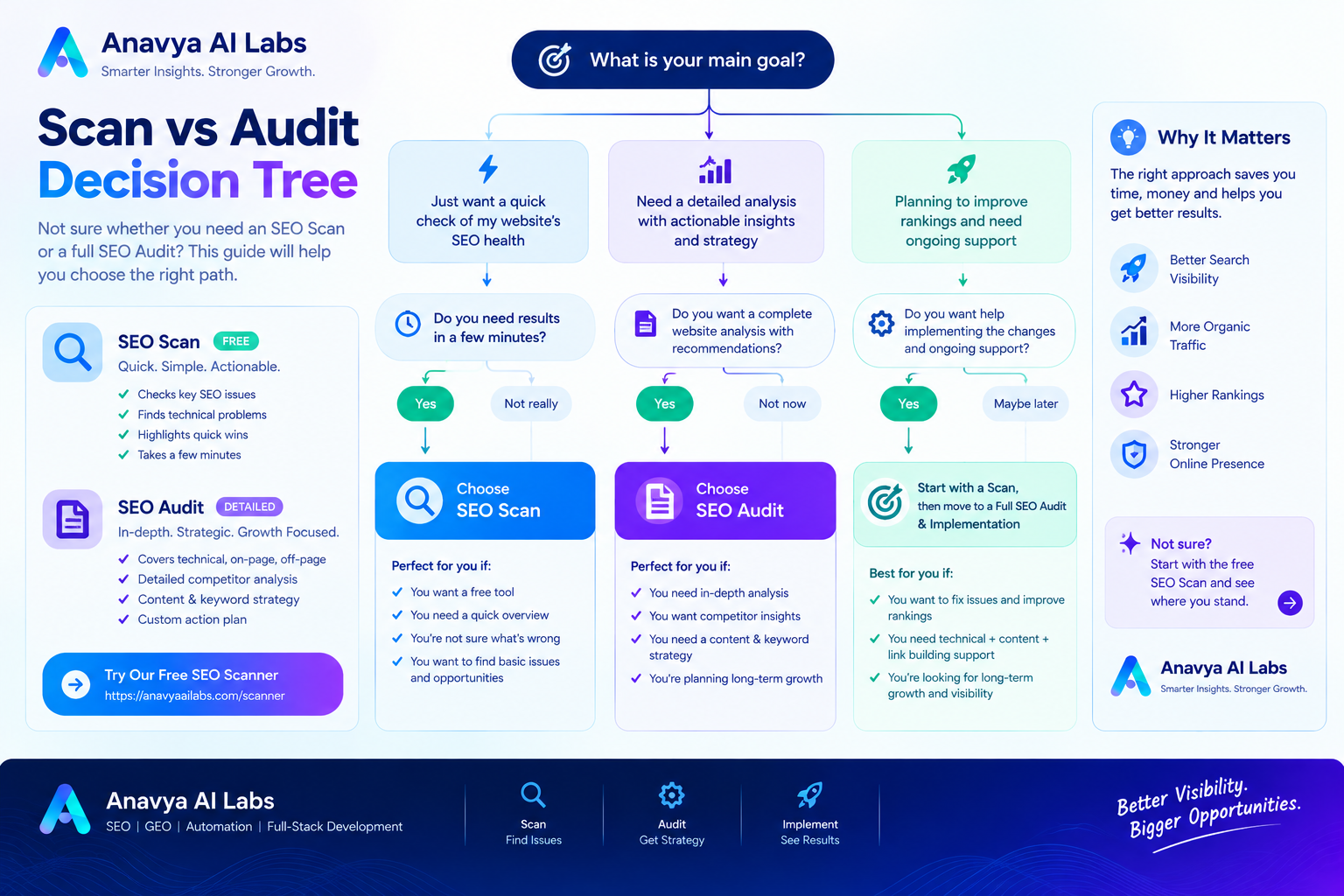
Interactive-style flowchart helping readers determine whether they need a scan or audit based on their situation
Section 5: Best SEO Scan Tools
Technical Scan Tools
Screaming Frog SEO Spider
- Crawls entire site for technical issues
- Free version (up to 500 URLs)
- Paid version: $199/year
- Best for: Technical audits, link analysis
Google PageSpeed Insights
- Free performance analysis
- Core Web Vitals data
- Best for: Quick performance checks
Google Search Console
- Free Google data
- Coverage reports, crawl errors, indexation
- Best for: Monitoring and diagnostics
Semrush Site Audit
- Comprehensive technical scanning
- Competitive data included
- $120/month and up
- Best for: Ongoing monitoring
Ahrefs Site Audit
- Technical + backlink analysis
- Best for: Comprehensive technical scanning
Ranking/Competitive Scan Tools
Google Search Console
- Free ranking data
- Best for: Your own site performance
SEMrush
- Competitive analysis, rankings, keywords
- $120/month and up
- Best for: Competitive insights
Ahrefs
- Rankings, keywords, backlinks
- $99/month and up
- Best for: Competitor analysis
Moz Pro
- Rankings, keywords, local visibility
- $99/month and up
- Best for: Competitive benchmarking
Speed/Performance Scan Tools
GTmetrix
- Detailed performance analysis
- Free and paid versions
- Best for: Page speed optimization
WebPageTest
- Advanced performance testing
- Free
- Best for: Deep performance diagnostics
Section 6: What to Look for in an SEO Audit
Questions to Ask When Hiring for an Audit
1. Scope & Deliverables
- What's included in the audit?
- How many pages are analyzed?
- Will you get a written report?
- Is implementation support included?
2. Experience & Process
- What's their process and timeline?
- Do they analyze competitors?
- Will they review your content strategy?
- Can they reference similar projects?
3. Analysis Depth
- Do they analyze your competitive landscape?
- Will they review your link profile?
- Do they consider user experience?
- Will they align recommendations to business goals?
4. Recommendations
- Are recommendations prioritized?
- Will they create an implementation roadmap?
- Do they explain WHY each recommendation matters?
- Will they distinguish quick wins from long-term work?
5. Support
- Is follow-up support included?
- Can they help with implementation?
- Will they review your progress?
- Are there ongoing services available?
Red Flags in SEO Audit Providers
❌ They promise specific ranking positions
❌ They don't analyze your competitors
❌ They guarantee results
❌ They only provide automated tool output
❌ They don't consider your business goals
❌ They can't provide case studies or references
❌ They won't explain their methodology
❌ They push additional services aggressively
❌ They can't explain why they recommend things
❌ They offer SEO for suspiciously low prices ($500 full audit)
Image 5: SEO Audit Quality Criteria & Red Flags
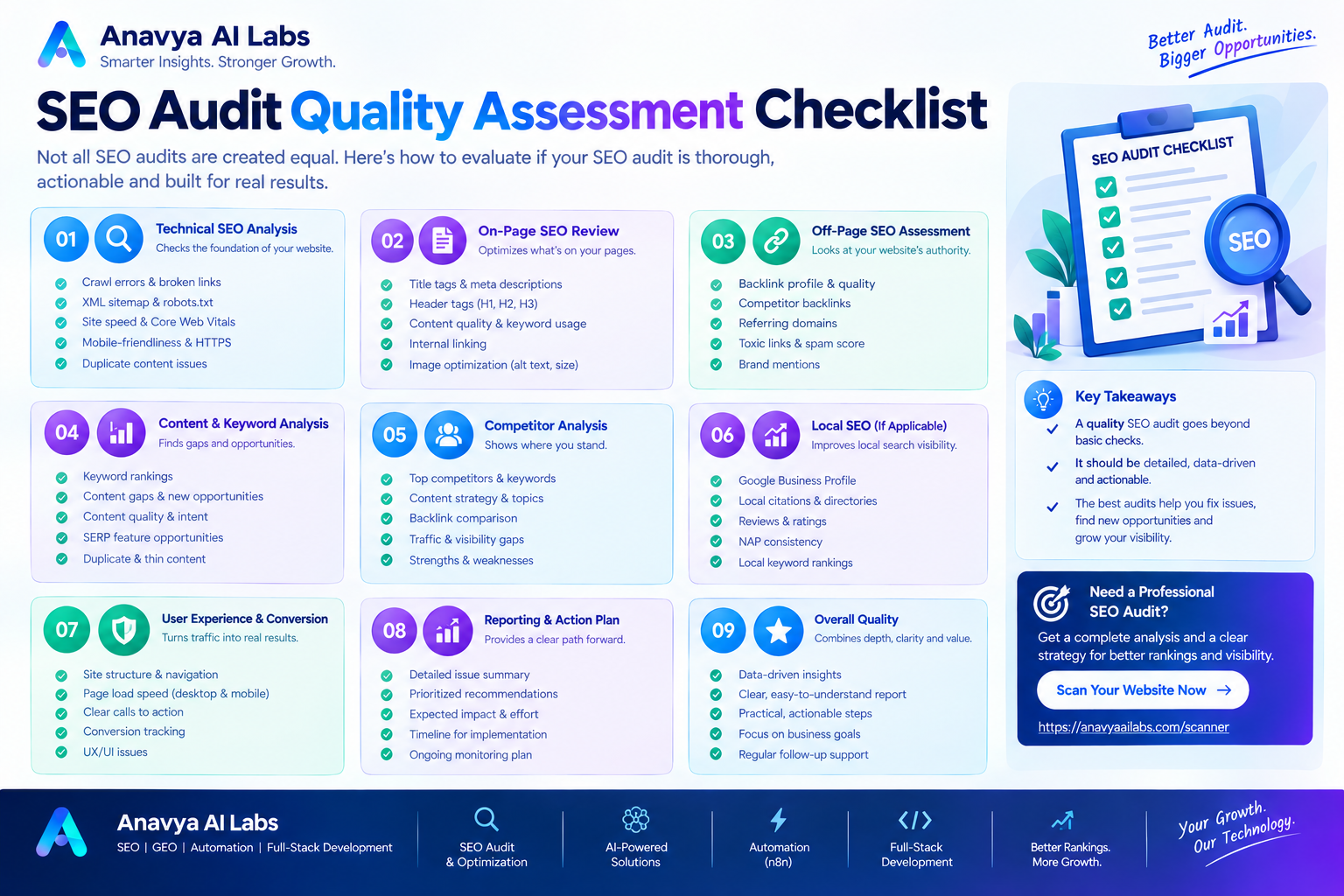
Comprehensive checklist for evaluating SEO audit quality, provider credibility, and recommendations
Section 7: Combined Strategy - Scans + Audits
The Optimal Approach
Most successful SEO programs use both scans and audits strategically:
Phase 1: Baseline Audit (Months 1-4)
- Comprehensive SEO audit at start
- Establishes baseline and priorities
- Creates 6-month roadmap
- Sets success metrics
- Investment: $4,000-10,000
- Output: Detailed action plan
Phase 2: Monthly Scans (Months 2-12+)
- Monthly technical scans identify regressions
- Weekly ranking scans track performance
- Quarterly competitive scans
- Monthly performance monitoring
- Investment: $100-300/month
- Output: Early warning of problems
Phase 3: Implementation Audits (Months 4-12+)
- Mid-project audit to assess progress (Month 6)
- Post-implementation audit of major changes
- Competitive audit to identify new opportunities
- Investment: $2,000-5,000 per audit (quarterly or as-needed)
- Output: Course corrections, strategy updates
Phase 4: Annual Comprehensive Audit (Year 2+)
- Full annual audit to reset strategy
- Competitive landscape reassessment
- New opportunity identification
- Investment: $4,000-10,000 annually
- Output: Updated strategy and priorities
Expected Annual Investment
| Program Size | Annual Scans | Audits | Total Investment |
|---|---|---|---|
| Small Site | $1,200-3,600 | $4,000 (1 annual) | $5,200-7,600 |
| Medium Site | $1,500-3,600 | $6,000 (1 comprehensive + 1 refresh) | $7,500-9,600 |
| Large Site | $2,000-5,000 | $10,000 (1 comprehensive + 2 updates) | $12,000-15,000 |
| Enterprise | $3,000-8,000 | $15,000+ (multiple audits) | $18,000-25,000+ |
Real Case Study - Scan Identified Problem, Audit Created Solution
Company Profile
B2B SaaS Platform - Project management software
Market Position: Struggling to rank for primary keywords
Starting Point: Monthly scanning showed stable but low rankings
The Scan Revealed Issues
Monthly technical scans for 6 months showed:
- No technical problems
- Site performance: Good
- Core Web Vitals: Passing
- Crawlability: Perfect
- Indexation: Complete
Question: Why aren't rankings improving if everything looks fine?
The Audit Revealed Strategy
A comprehensive SEO audit (ordered when rankings continued declining) found:
Technical Status: Scans were correct—no technical issues
Real Problems Identified:
- Content Gap - Competitors targeted 47 keywords that client missed
- Authority Deficit - Competitors had 3x more referring domains
- Topical Weakness - Content wasn't organized by topic cluster
- Competitive Positioning - Messaging didn't differentiate from competitors
- Internal Linking - No strategic internal link structure
The Strategy
Based on audit findings:
- Content Gap Closure - Created 23 new content pieces targeting missed keywords
- Topical Authority - Reorganized site into topic clusters with pillar pages
- Internal Linking - Implemented hub-and-spoke internal linking strategy
- Link Building - Targeted premium backlinks from industry publications
- Content Refresh - Updated top 15 performing pages with depth and authority
Results After 6 Months
Rankings:
- 23 new keywords in top 3
- 15 keywords improved 5+ positions
- Average ranking position: 12.4 → 5.8
Organic Traffic:
- Organic sessions: +185%
- Organic conversions: +240%
- Revenue from organic: +320%
Search Visibility:
- Keyword rankings: 89 → 267 (+200%)
- Visibility score: 1.2 → 4.8 (4x improvement)
Key Insight: Scans identified there were NO technical problems. The audit identified the real problem: strategic content gaps. Scans would never have found this.
Image 6: Case Study - Problem Identification Process
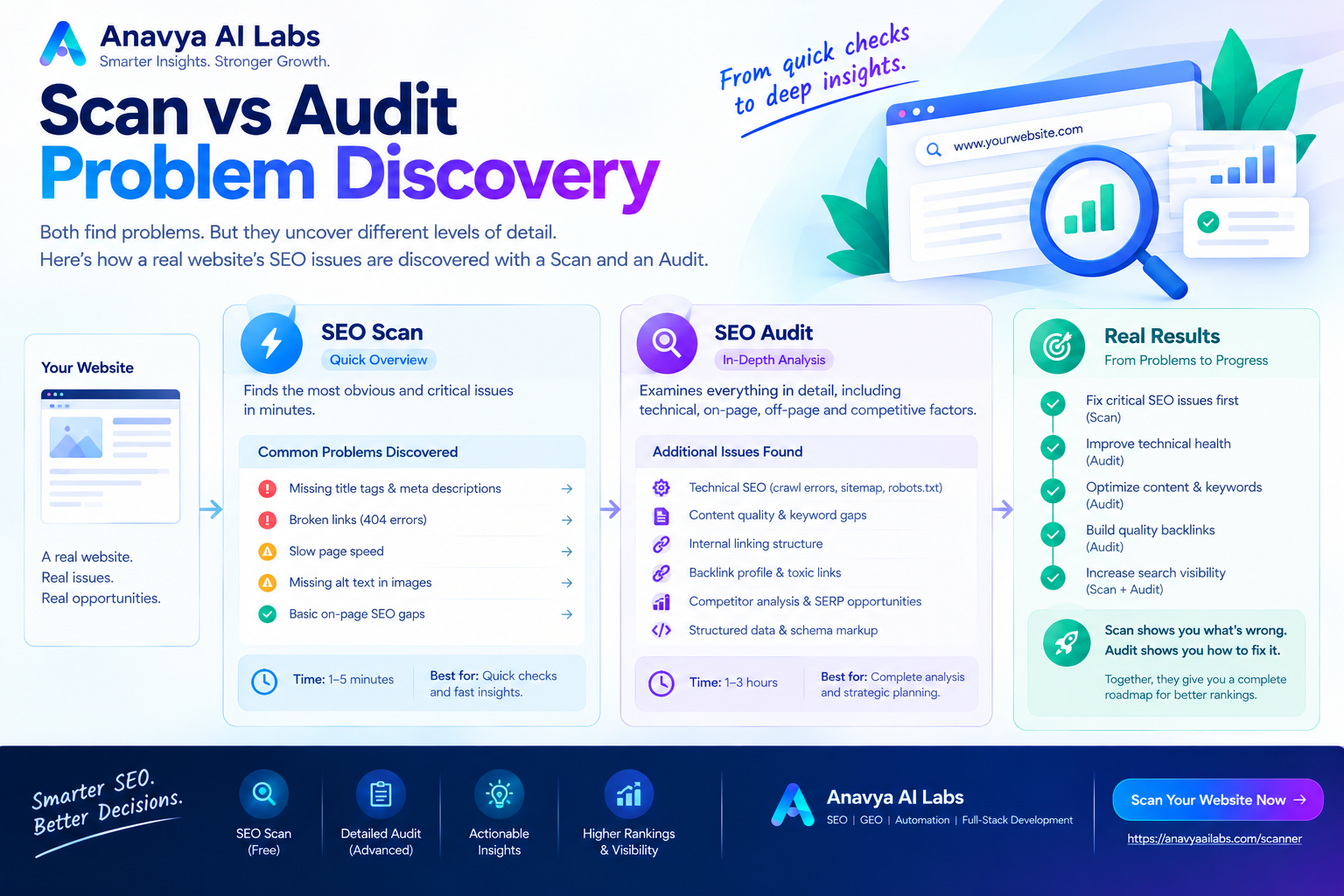
Visual showing how scans identified "no problems" while audit revealed strategic issues
Section 8: SEO Scanning Tools Guide
Technical Scan Tools Comparison
| Tool | Free Tier | Paid | Best For | Crawl Size |
|---|---|---|---|---|
| Screaming Frog | 500 URLs | $199/year | Technical audits | Unlimited |
| Semrush | Limited | $120+/mo | Comprehensive scans | 10K+ pages |
| Ahrefs | No | $99+/mo | Technical + backlinks | Unlimited |
| Google Search Console | Full | N/A | Google data | Your site |
| Google PageSpeed | Full | N/A | Performance | Per page |
| GTmetrix | Full | $0-20/mo | Speed optimization | Per page |
| Moz | Limited | $99+/mo | Rankings + keywords | Unlimited |
Section 9: Framework Considerations - (Reference: React vs Next.js)
When discussing technical SEO scans and audits, the choice of web framework matters significantly. A scan might identify performance issues that are actually framework-related.
For guidance on framework choices from an SEO perspective, reference our comparison: React vs Next.js: Which Is Better for Modern Web Applications?
Key Point: If scans consistently show poor Core Web Vitals, an audit should evaluate whether your framework choice (React with client-side rendering vs Next.js with server-side rendering) is the limiting factor.
Image 7: Implementation Timeline - Scan-Based Monitoring vs Audit-Based Strategy
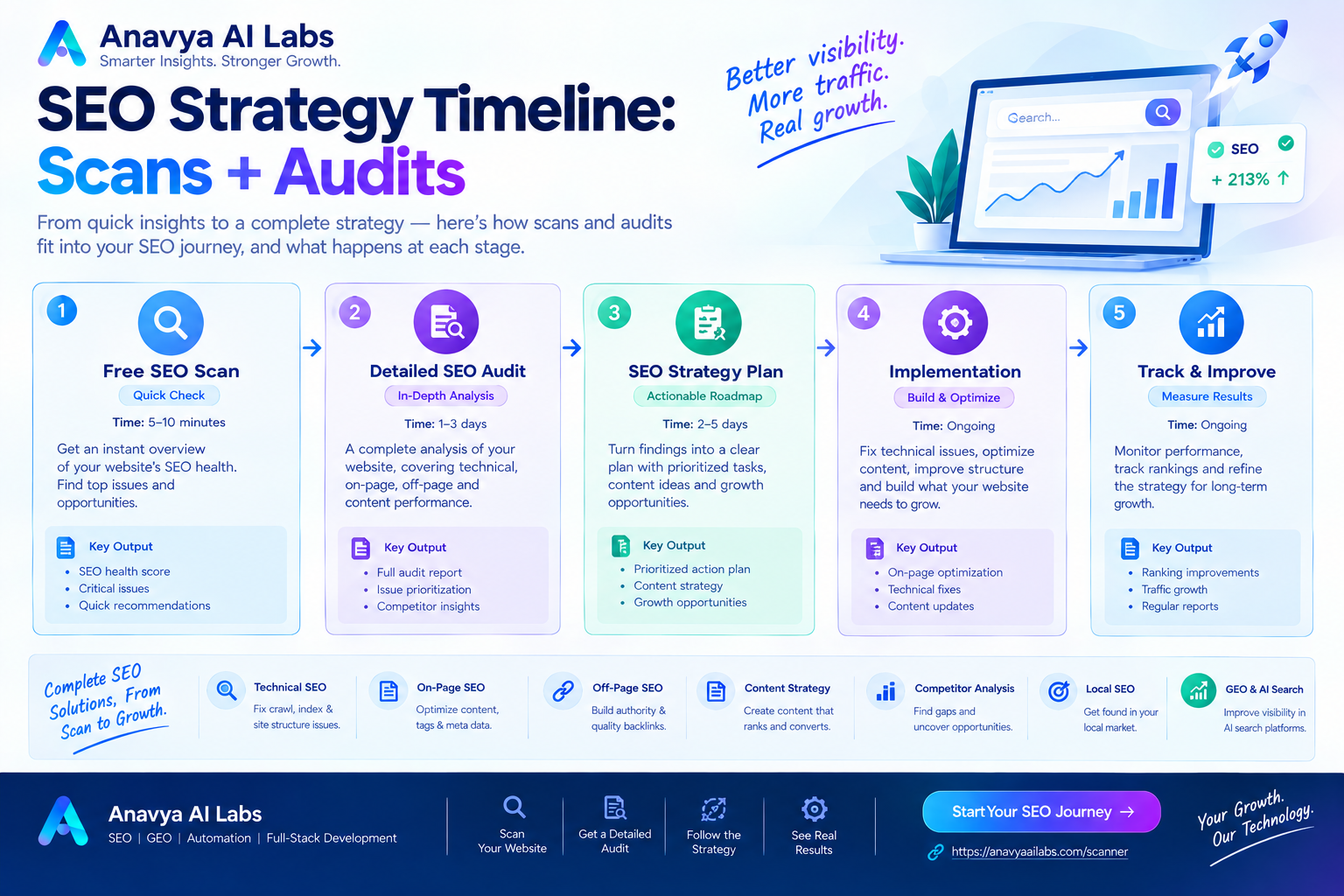
Year-long timeline showing when to use scans for monitoring and audits for strategic updates
FAQ
Q: Can I get a good audit from an automated tool?
A: No. Automated tools provide good scans. Audits require expert analysis, strategic thinking, and business understanding that automation can't provide.
Q: How often should I do a full audit?
A: Typically annually, or when major changes occur (redesign, migration, marketplace shift). For growing companies, every 6 months.
Q: Are free SEO scans worth using?
A: Yes, for monitoring and identifying obvious problems. Google Search Console and PageSpeed Insights are excellent free tools. They just don't replace strategic analysis.
Q: What should I expect to pay for a quality audit?
A: $2,000-15,000 depending on site size and complexity. If someone offers a full audit for $500, it's not a real audit—it's an automated scan being called an audit.
Q: Can I do an audit myself?
A: Partially. You can identify technical issues and perform initial competitive analysis. But objective analysis of your own site is difficult, and you may miss strategic opportunities. Professional audits pay for themselves quickly.
Q: Should I run scans during an audit?
A: Yes. Good audits include automated scanning as one component, combined with expert analysis.
Q: What's the difference between an audit and a consultation?
A: An audit is comprehensive analysis and documentation. A consultation is typically a discussion/advice session. Audits are more thorough; consultations are faster.
Q: Can I audit my own site?
A: You can run scans yourself. A true audit requires objectivity that's hard when evaluating your own work. Professional auditors catch what internal teams miss.
Quick Decision Flowchart
Do you know specifically what SEO issues you have?
→ YES: Use a targeted scan ($0-500)
→ NO: Get an audit ($3,000-10,000)
Is your site performing well in organic search?
→ YES: Use monthly scans + annual audit
→ NO: Get an audit immediately ($3,000-10,000)
Do you need strategic recommendations or just to identify problems?
→ Strategic guidance: Audit ($3,000-10,000)
→ Problem identification: Scan ($0-500)
Is your main goal to prevent future problems?
→ YES: Monthly scans ($100-300/month)
→ NO: One-time audit ($3,000-10,000)
Key Takeaways
✓ Scans are automated, fast, and cheap — Use for ongoing monitoring
✓ Audits are strategic, thorough, and expensive — Use for major decisions
✓ They solve different problems — Don't use one when you need the other
✓ Best strategy uses both — Scans for monitoring, audits for planning
✓ Scans find technical issues — But not strategic problems
✓ Audits explain the why — Why problems matter for your business
✓ ROI on audits is high — Typically 300%+ return within 6 months
✓ Monthly scans are cheap insurance — Prevent bigger problems later
✓ Expert analysis matters — Automated results need human interpretation
✓ Your situation dictates approach — Struggling vs stable = different needs
Action Plan
Immediate (This Week)
- Run one free SEO scan (Google PageSpeed Insights)
- Check Google Search Console for crawl errors
- Determine if you need a scan or audit
- Document your current rankings for 5 key terms
This Month
- Set up monthly monitoring (scans)
- Decide if full audit is needed
- Get quotes from 2-3 audit providers
- Create baseline metrics
This Quarter
- Implement audit recommendations (if conducted)
- Monitor monthly scans for regressions
- Track ranking and traffic changes
- Plan next strategic audit (6-12 months)
Next Steps
- Assess your situation: Are you struggling with rankings, or maintaining good performance?
- Choose your approach: Scan for monitoring, audit for strategy
- Pick the right tool: Free scans for basics, paid scans for comprehensive monitoring
- Start monitoring: Monthly scans catch problems early
- Plan strategic audits: Annually or when major changes occur
For technical implementation guidance on modern web frameworks and their SEO implications, reference: React vs Next.js: Which Is Better for Modern Web Applications?
About the Author
Our SEO strategy and auditing experts work with companies to determine the right SEO approach, conduct deep audits when needed, and establish ongoing monitoring systems. We help organizations understand the difference between quick fixes and strategic improvements.
Ready to understand your SEO needs? Contact our team for a consultation on whether your site needs a scan or a full audit.