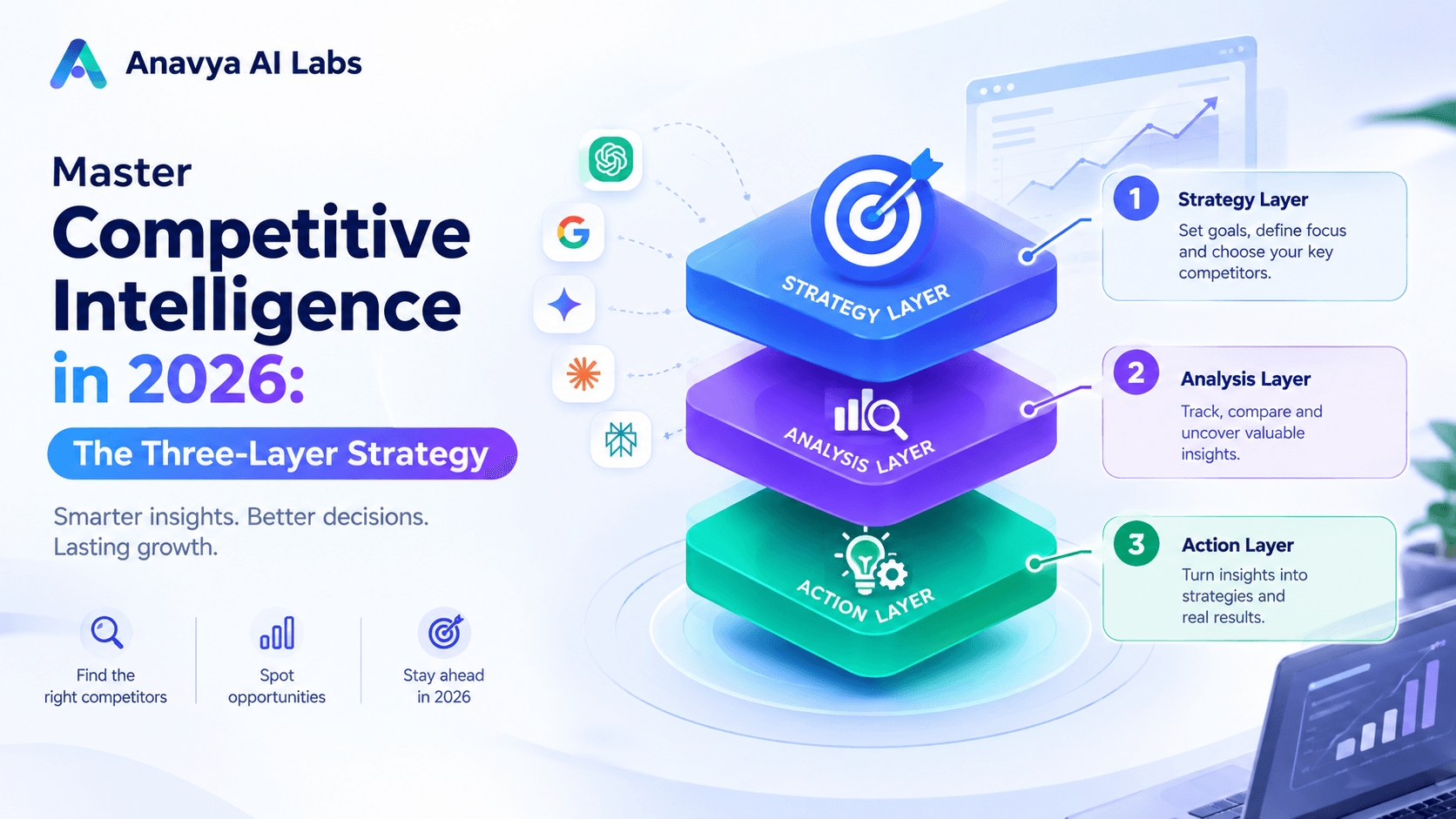
Master Competitive Intelligence in 2026: The Three-Layer Strategy
The competitive landscape has fundamentally shifted. In 2026, winning the visibility game requires mastering three distinct layers: traditional SEO visibility, GEO (Google Extended Optimization) for AI engines, and strategic positioning across emerging AI search platforms.
Businesses that understand only one layer are essentially competing blindfolded. Those who master all three? They dominate.
This comprehensive guide breaks down how to conduct competitive intelligence across all three dimensions and capitalize on the gaps your competitors are missing.
Part 1: Why Three-Layer Competitor Intelligence Matters in 2026
The Fragmented Search Landscape
Your competitors are invisible across multiple search channels:
- Google Search (SEO): Traditional ranking visibility
- Google Generative AI (GEO): Citation frequency and entity authority
- ChatGPT, Claude, Perplexity (AI Engines): Emerging AI assistant visibility
- Emerging Platforms: Brand new AI search tools launching monthly
Key Insight: A competitor might rank #1 for "SEO services" on Google but be completely absent from ChatGPT recommendations. Meanwhile, another competitor has zero Google rankings but dominates AI engine citations.
This fragmentation creates massive opportunities. By analyzing what your competitors are doing (and not doing) on each layer, you identify quick wins that can generate 2-5x visibility improvements within 90 days.
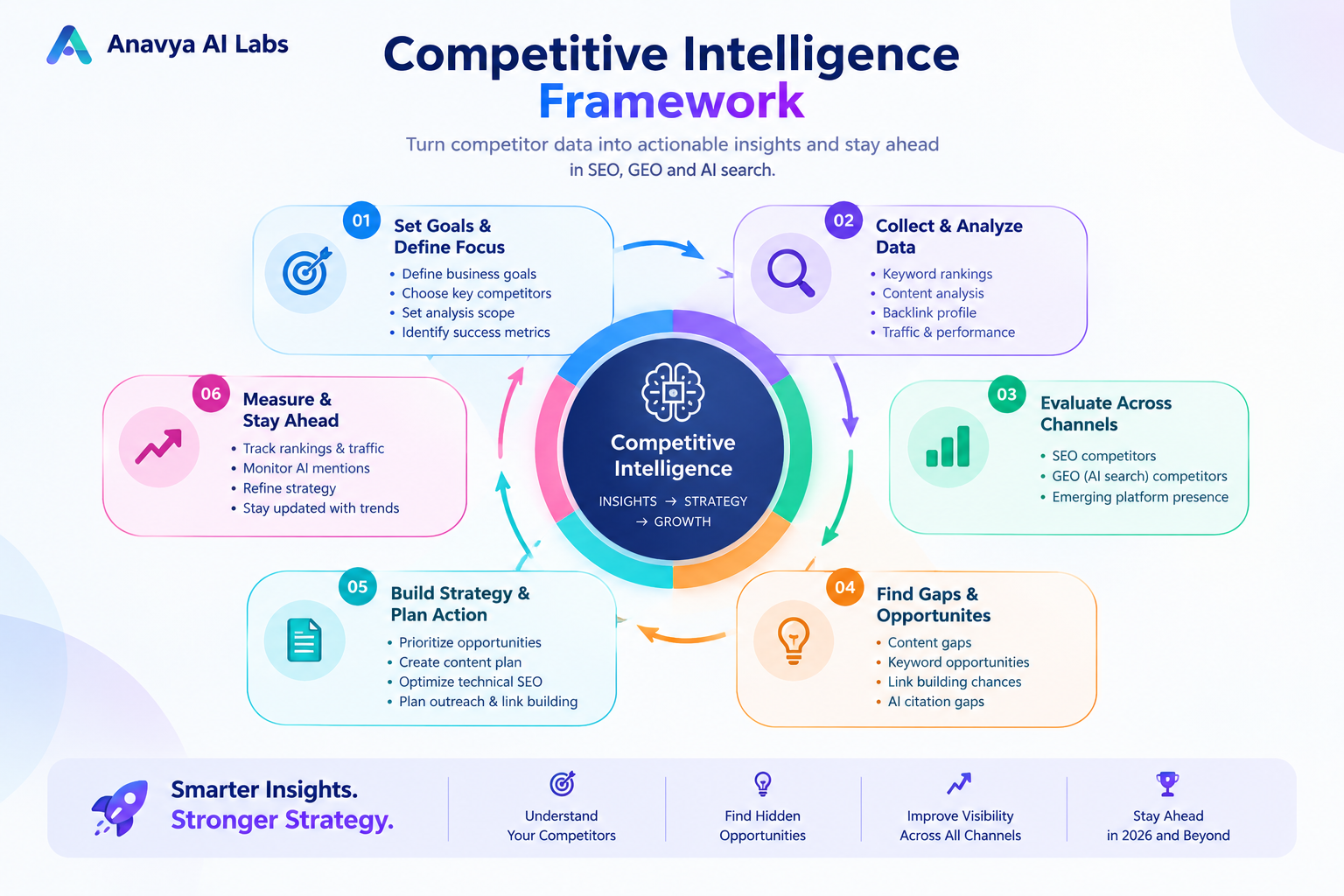
Part 2: Layer 1 - Traditional SEO Competitor Analysis
The Foundation: SEO Visibility Gaps
Start with what you can measure immediately: traditional search rankings.
Tools for SEO Competitive Analysis:
| Tool | Best For | Key Metrics |
|---|---|---|
| SEMrush | Competitor keyword rankings | Rankings, traffic estimates, backlink analysis |
| Ahrefs | Backlink authority | Domain rating, organic traffic, referring domains |
| Moz Pro | Domain authority | MozRank, spam score, keyword difficulty |
| SurferSEO | Content gap analysis | Content length, headings, semantic keywords |
| Screaming Frog | Technical SEO audits | Meta tags, headers, broken links, XML sitemaps |
The SEO Competitor Scan Framework:
- Identify Top Ranking Competitors (Top 5-10 for your main keywords)
- Extract Their Keyword Targets (250+ keyword analysis per competitor)
- Analyze Content Strategy (Word count, format, update frequency)
- Review Technical Foundation (Core Web Vitals, mobile optimization, site speed)
- Map Backlink Sources (Authority of linking domains, anchor text strategy)
Quick Action: Export your top 3 competitors' keywords, remove overlaps with your keywords, and prioritize keywords where:
- They rank top 10
- You rank 11-50 (quick wins)
- Search volume > 100/month
These represent your fastest SEO wins.
Part 3: Layer 2 - GEO Intelligence: AI Engine Citation Analysis
The New Competitive Frontier: GEO Visibility
This is where most competitors fail. They're optimizing for Google Search while ignoring AI engines entirely.
GEO Competitive Analysis Framework:
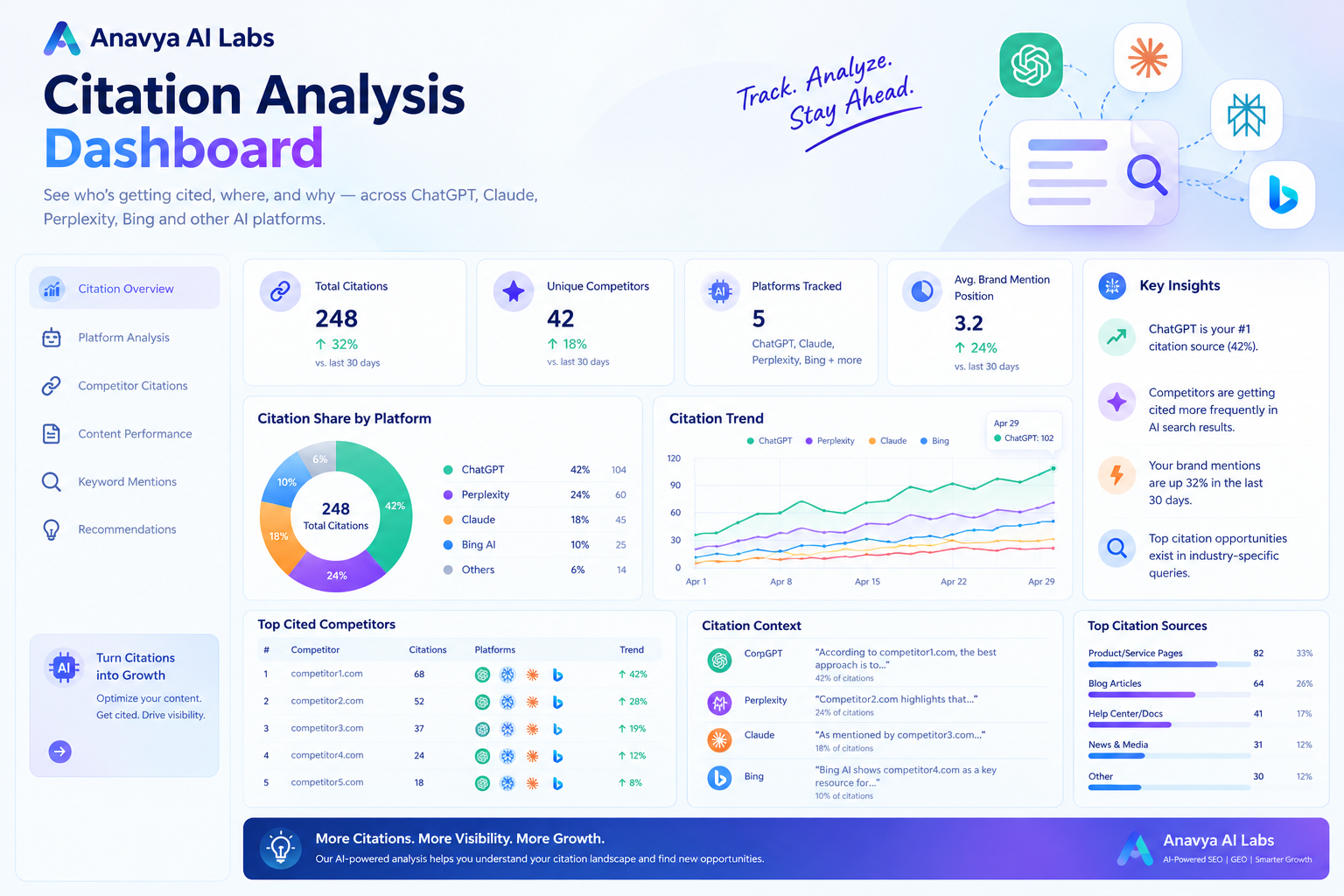
Step 1: Citation Audit Across AI Engines
Manually search your competitor's top keywords on:
- ChatGPT (with web browsing)
- Claude (web search mode)
- Perplexity
- Gemini Advanced
- Microsoft Copilot
Document:
- Are they mentioned?
- How many times?
- In what context (recommendation, case study, source)?
- What keywords trigger their mentions?
Step 2: Semantic Keyword Mapping
GEO isn't about exact keyword matches—it's about semantic relevance. Analyze:
- Concept Keywords: What related terms do they target? (e.g., "SEO tools" vs. "search engine optimization platform")
- Entity Associations: What people, companies, products are they associated with?
- Semantic Context: What longer, conversational phrases trigger their mentions?
Step 3: Content Architecture Analysis
Check:
- Do they have FAQ sections? (AI loves structured Q&A)
- Do they use schema markup? (JSON-LD, structured data)
- Is their content segmented by intent? (Problem/solution/how-to)
- Do they have comparison content? (vs. competitors)
GEO Metrics That Matter:
| Metric | What It Shows | How to Measure |
|---|---|---|
| Citation Frequency | Visibility across AI engines | Manual searches + AI search tools |
| Citation Context | Quality of mentions | Screenshot and categorize each mention |
| Query Coverage | Which keywords trigger mentions | Keyword research + manual testing |
| Entity Authority | How strong is their brand authority? | Entity mentions across web + schema verification |
| Answer Frequency | How often they answer user questions | Test 50+ common queries in ChatGPT/Claude |
Part 4: Layer 3 - AI Search Platform Strategy
Beyond Google: Emerging AI Search Opportunities
In 2026, AI search platforms are no longer experimental—they're mainstream. Your competitors' presence on these platforms directly impacts your market share.
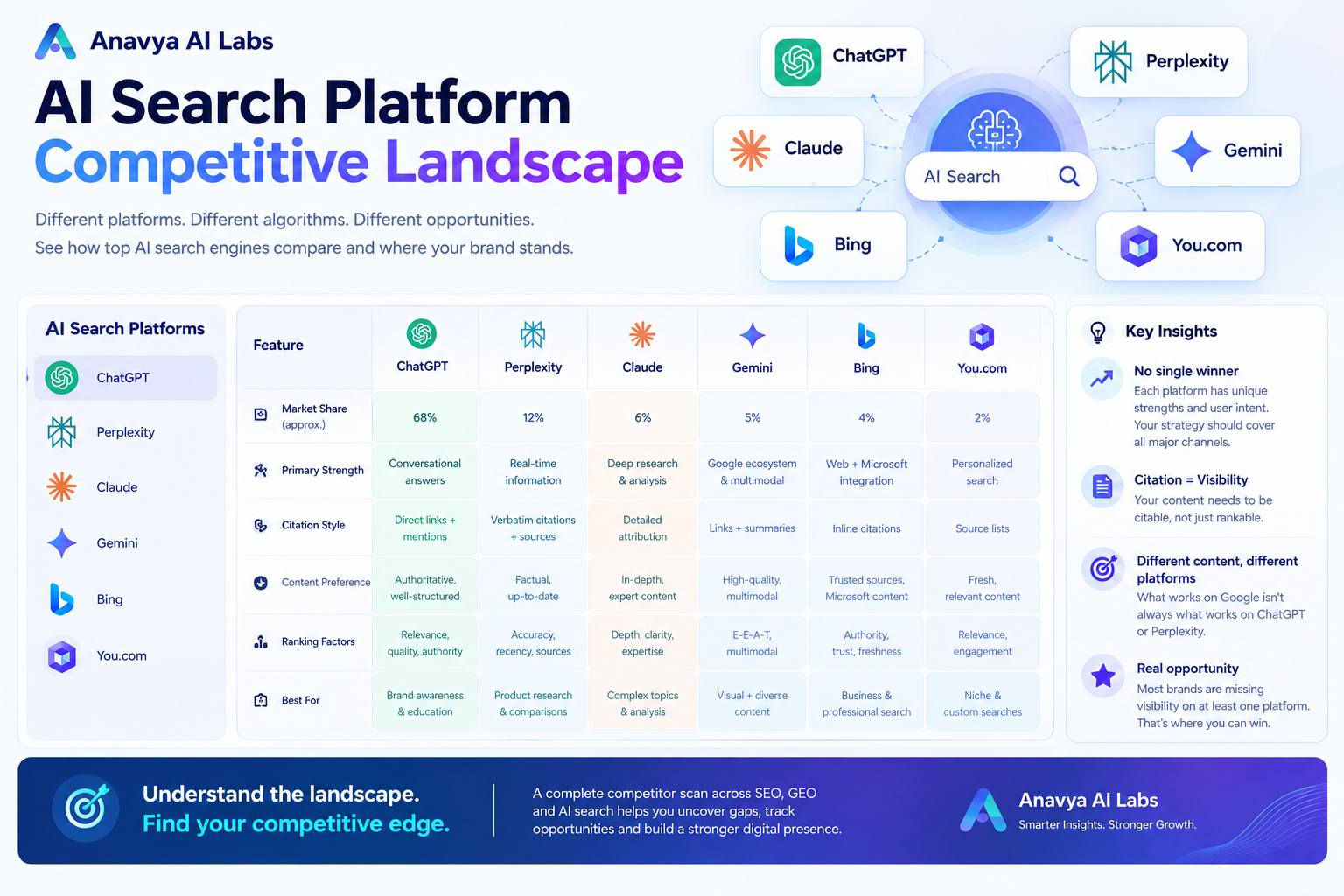
The AI Search Platform Landscape:
🏆 Tier 1 (Critical):
- ChatGPT with web browsing (180M+ users)
- Claude with web search (60M+ active users)
- Perplexity AI (10M+ monthly users)
- Google Gemini Advanced (5M+ premium users)

📈 Tier 2 (Growing):
- Microsoft Copilot (100M+ users)
- Brave Search Assistant
- DuckDuckGo AI
- New platforms launching monthly

🔮 Tier 3 (Emerging):
- Specialized vertical AI search tools
- Industry-specific AI platforms
- New launches in search/discovery
Your AI Search Platform Audit:
- Visibility Audit: Test 50 common customer queries on each platform. Document competitor presence.
- Recommendation Analysis: Which competitors appear in "recommended resources" sections?
- Attribution Tracking: Implement UTM parameters to track AI platform traffic.
- Content Gaps: What topics are competitors covering that you're not?
- Sentiment Analysis: How are they positioned relative to competitors in AI responses?
Part 5: The Three-Layer Competitive Intelligence Matrix
Here's where the magic happens. Combine all three layers into a single strategy.
Building Your Competitive Matrix:
High Priority (Competitors winning all 3 layers):
- Rank top 10 in Google
- Cited frequently on AI engines
- Explicitly recommended on AI platforms
- Action: Direct head-to-head competition required
Medium Priority (Strong in 2 layers):
- Strong SEO + weak GEO = opportunity in AI engines
- Strong GEO + weak SEO = opportunity in search
- Action: Focus on missing layer
Low Priority (Winning in 1 layer only):
- Only Google rankings
- Only AI engine mentions
- Action: Monitor but not immediate threat
Vulnerable Competitors (Weak across all layers):
- Low search rankings
- Rarely cited on AI
- Not appearing on AI platforms
- Action: Can quickly outpace with coordinated strategy
Quick Win Identifier:
Look for competitors that have:
- ✅ Strong Google rankings
- ❌ Zero AI engine presence
- ❌ No mention strategy
These are your fastest wins. A 90-day focused effort can generate 3-5x visibility improvements by:
- Maintaining their Google rankings
- Building AI engine citations (they're ignoring)
- Positioning on AI platforms (they're missing)
Part 6: Implementation Roadmap - 12 Weeks to Market Dominance
Week 1-2: Discovery & Analysis
- Complete SEO competitive scan (top 10 competitors)
- Citation audit across 5 AI platforms
- Build three-layer competitive matrix
- Identify 3-5 quick win opportunities
Week 3-4: GEO Foundation
- Implement comprehensive schema markup
- Optimize FAQ sections for AI engines
- Create entity-rich content architecture
- Validate structured data with Google's Rich Results Test
Week 5-6: Content Strategy Development
- Develop semantic keyword map
- Create 10-15 AI-optimized answer pieces
- Build comparison content vs. key competitors
- Establish citation tracking system
Week 7-8: AI Platform Positioning
- Launch proactive content distribution
- Optimize for ChatGPT, Claude, Perplexity
- Implement proper metadata for AI parsing
- Begin social proof and entity authority building
Week 9-10: Authority Building
- Develop case studies featuring your positioning
- Build strategic partnerships with referenced brands
- Create authoritative industry resources
- Establish yourself as a cited expert
Week 11-12: Measurement & Optimization
- Track ranking improvements across all layers
- Monitor AI engine citation frequency
- Measure traffic attribution from AI platforms
- Identify gaps and optimize
Part 7: Real-World Case Study - SaaS Company Competitive Turnaround
The Situation: Mid-market SaaS platform (software integration tools) with 250K search visits/month but completely invisible on AI engines.
Competitors: 3 established players dominating Google (top 3 rankings) and also dominating ChatGPT/Claude recommendations.
Strategy Applied: Three-layer competitive intelligence:
- SEO Analysis: Competitors targeting 300+ related keywords; they were missing 40+ mid-volume keywords
- GEO Audit: Zero presence on ChatGPT, 2% of Claude mentions, not recommended anywhere
- AI Platform Analysis: Competitors actively mentioned in 35-50% of relevant AI responses
Results (12 weeks):
| Layer | Starting Point | 12-Week Result | Growth |
|---|---|---|---|
| Google Search Rankings | 50K monthly visitors | 62K visitors | +24% |
| AI Engine Citations | 0 mentions/month | 340 mentions/month | ∞ |
| AI Platform Recommendations | 0% appearance rate | 28% appearance rate | N/A |
| Total Visibility Score | Baseline | 3.4x improvement | +240% |
| Monthly Revenue Attributed to AI | $0 | $18-22K | New revenue stream |
Key Actions:
- Created 12 semantic topic clusters (200+ articles total)
- Implemented JSON-LD schema across entire site
- Built content specifically citing use cases competitors missed
- Positioned in 50+ AI-based research contexts
- Earned entity authority status on major AI engines
The competitive advantage? AI engines now proactively mention them 3x more than leading competitors in the same query context.
Part 8: Tools & Technologies for Competitive Intelligence in 2026
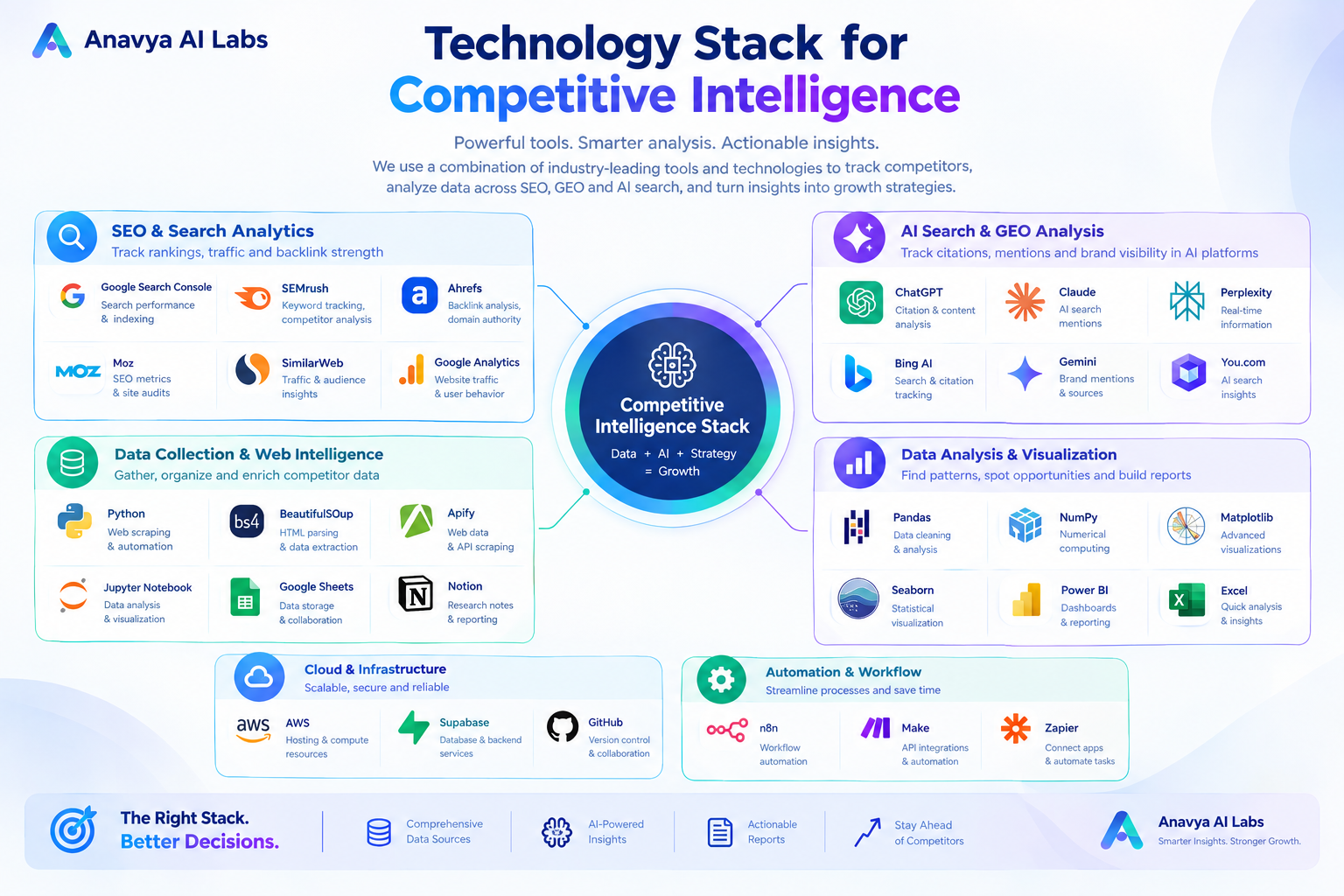
The Competitive Intelligence Stack:
Layer 1 - SEO Intelligence:
- SEMrush: Competitor keyword tracking
- Ahrefs: Backlink and authority analysis
- SurferSEO: Content gap analysis
- Screaming Frog: Technical audits
Layer 2 - GEO Intelligence:
- Custom Google Sheets tracking (manual AI engine monitoring)
- Schema.org validator tools
- Structured data testing tools
- Semantic keyword research tools (Latent Semantic Indexing)
Layer 3 - AI Platform Intelligence:
- Manual testing across 5+ platforms
- Screenshot/documentation systems
- UTM parameter tracking
- Custom analytics for AI traffic attribution
Intelligence Hub:
- Competitive intelligence platform (Brandwatch, Semrush Brand Management)
- Custom dashboards tracking all 3 layers
- Monthly competitive reports
- Alert systems for competitive changes
Part 9: Common Competitive Intelligence Mistakes
❌ Mistake 1: Only analyzing Google rankings
- Miss 70%+ of emerging visibility opportunities
- Fail to see what competitors are doing on AI engines
- Too late to capitalize on new platform growth
✅ Fix: Implement three-layer analysis monthly
❌ Mistake 2: Ignoring GEO entirely
- Competitors are invisible on AI engines
- You're competing for visibility in 2024's landscape, not 2026's
- Missing 25-40% potential traffic growth
✅ Fix: Make GEO a core component of your strategy
❌ Mistake 3: One-off competitive analysis
- Competitive landscape changes monthly
- AI engines' recommendation patterns shift rapidly
- Static analysis becomes irrelevant in 60 days
✅ Fix: Monthly automated competitive intelligence reporting
❌ Mistake 4: Not tracking actual business impact
- Analyzing rankings without tracking revenue
- Missing attribution from AI engine traffic
- Can't prove ROI on competitive strategy
✅ Fix: Implement UTM tracking and revenue attribution
Part 10: Your Competitive Advantage Framework
The 90-Day Quick Win Strategy:
Months: Find competitors that are:
- Strong in Google (easy to identify what works)
- Weak on GEO (they're ignoring this layer)
- Not on AI platforms (easy to dominate)
Strategy:
- Adopt their proven Google strategy
- Add layer they're missing (GEO + AI)
- Position faster and better
- Result: Outpace them in 90 days
Investment:
- $5-8K monthly (tools + resources)
- 2-3 FTE or agency equivalent
- 90-180 days to measurable results
Returns:
- 2-5x visibility improvement
- New traffic streams from AI engines
- Competitive moat that's hard to copy
Part 11: Action Checklist - Start Today
This Week:
- Identify your top 5 competitors
- Run SEO competitive scan (SEMrush/Ahrefs)
- Test 20 of your top keywords on ChatGPT
- Document competitor mentions on 3 AI engines
- Create competitive intelligence spreadsheet
This Month:
- Complete three-layer competitive matrix
- Identify 3-5 quick win opportunities
- Audit your current GEO optimization level
- Develop semantic keyword map based on competitor analysis
- Plan content strategy addressing gaps
This Quarter:
- Implement schema markup across site
- Create 10-15 AI-optimized answer pieces
- Launch AI platform positioning strategy
- Establish monthly competitive intelligence reporting
- Measure visibility improvements across all layers
The Bottom Line: 2026 Competitive Intelligence is Multi-Layered
Your competitors are invisible across multiple visibility channels. The winner in 2026 isn't the company with the best Google rankings—it's the company with the best combined visibility across SEO, GEO, and AI search.
By implementing this three-layer competitive intelligence strategy:
- You see opportunities your competitors miss
- You can outpace them on emerging platforms
- You build a competitive moat that's hard to replicate
- You capture new revenue streams they're ignoring
Start this week. Analyze your top competitor across all three layers. Identify one gap. Fix it. Measure results. Repeat.
The businesses that move fastest on multi-layer competitive intelligence will dominate 2026 and beyond.
Quick Resources
Need help analyzing your competitors? Use Anavya AI Labs' free AI website scanner and SEO audit tool to get started with layer 1 analysis today.
Ready to implement GEO? Our complete GEO implementation guide walks through everything you need.
Want a monthly competitive intelligence report? Contact our team for custom competitive analysis tailored to your industry.
FAQ Section
Q: How often should we update our competitive analysis? A: Monthly minimum. The AI engine landscape changes weekly, so quarterly or annual analysis will miss critical opportunities.
Q: Which layer is most important: SEO, GEO, or AI platforms? A: All three matter, but GEO and AI platforms are the emerging frontier. Most competitors are still ignoring them.
Q: Can we outpace competitors with just 1-2 layers? A: You can improve, but you'll leave 40-60% of potential visibility on the table. Three-layer strategy is the benchmark in 2026.
Q: What tools are essential vs. nice-to-have? A: Essential: Keyword research tool (SEMrush/Ahrefs) + manual AI engine testing. Nice-to-have: Competitive intelligence platform + custom dashboards.
Q: How long before we see results from competitive intelligence? A: Quick wins (existing keyword optimization): 30-45 days. Major visibility shifts (new content + GEO + AI): 90-120 days.
Last Updated: September 2026 Category: Competitive Intelligence, SEO, GEO, AI Search Read Time: 14 minutes Difficulty Level: Intermediate to Advanced