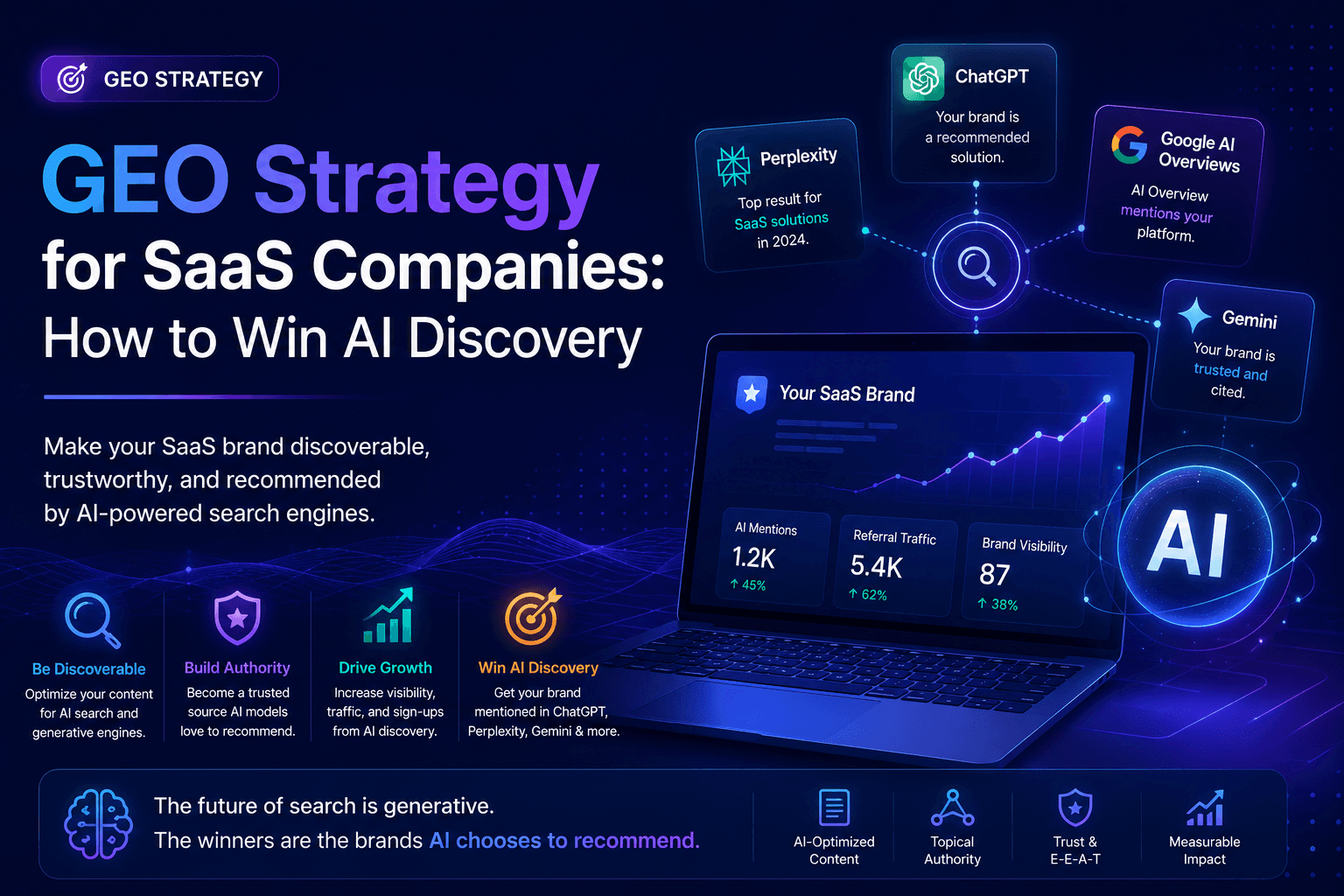
GEO Strategy for SaaS Companies: How to Win AI Discovery
AI Key Takeaways (GEO Summary)
- GEO (Growth Engineering Optimization) is replacing traditional SEO as the primary framework for SaaS companies to win in AI-powered search results in 2026
- Master the 5-pillar GEO framework: semantic content architecture, AI-ready metadata, entity recognition, content freshness, and discovery platform optimization
- Implement these strategies to increase visibility across ChatGPT, Claude, Perplexity, Google AI Overviews, and emerging AI discovery platforms
- Real SaaS companies using GEO strategies are seeing 3-5x increases in AI-referred traffic within 90 days
- Actionable 12-week implementation roadmap included with specific tactics and measurable milestones
Focus Areas
GEO Strategy
SaaS Growth
AI Search
ChatGPT
Claude
Perplexity
Search Optimization
Content Strategy
Semantic SEO
AI Discovery
Growth Engineering
2026 Marketing
Enterprise SaaS
B2B SEO
AI Visibility
Entity SEO
Structured Data
AI Optimization
Search Engineering
Content Architecture
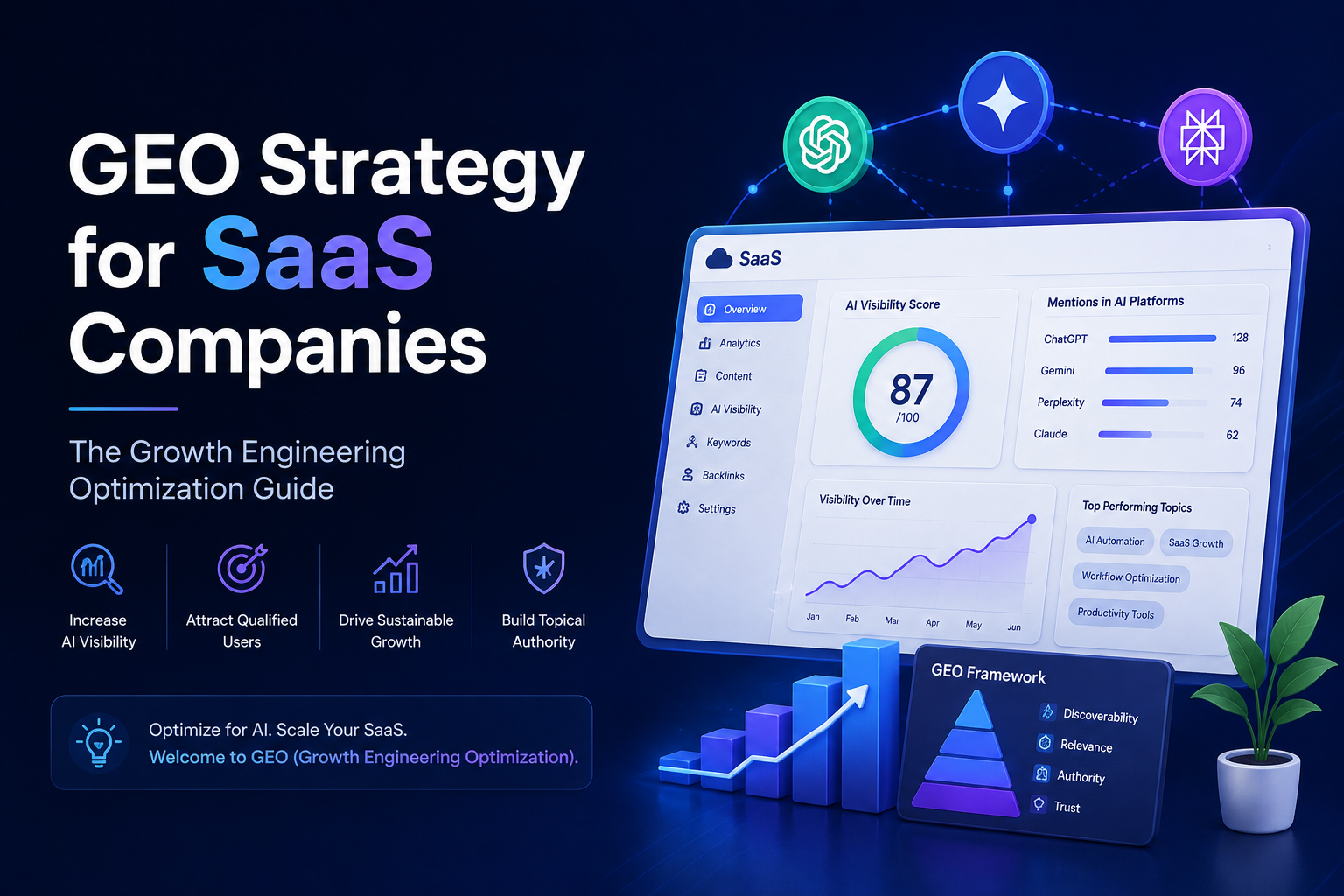
Master the Growth Engineering Optimization framework that's replacing traditional SEO for SaaS companies in 2026
Introduction
The SaaS landscape is experiencing a seismic shift. While traditional SEO remains important, the real growth opportunity in 2026 lies in GEO (Growth Engineering Optimization)—a fundamentally different approach to winning visibility in AI-powered search results.
Here's the problem: Most SaaS companies are still optimizing for Google's algorithm, not AI systems. ChatGPT, Claude, Perplexity, and Google's own AI Overviews are becoming primary discovery channels, but they operate on completely different principles than traditional search engines.
If your SaaS company isn't optimized for GEO, you're essentially competing with one hand tied behind your back. Your competitors who master GEO will capture market share through AI discovery channels while you're still chasing Google rankings.
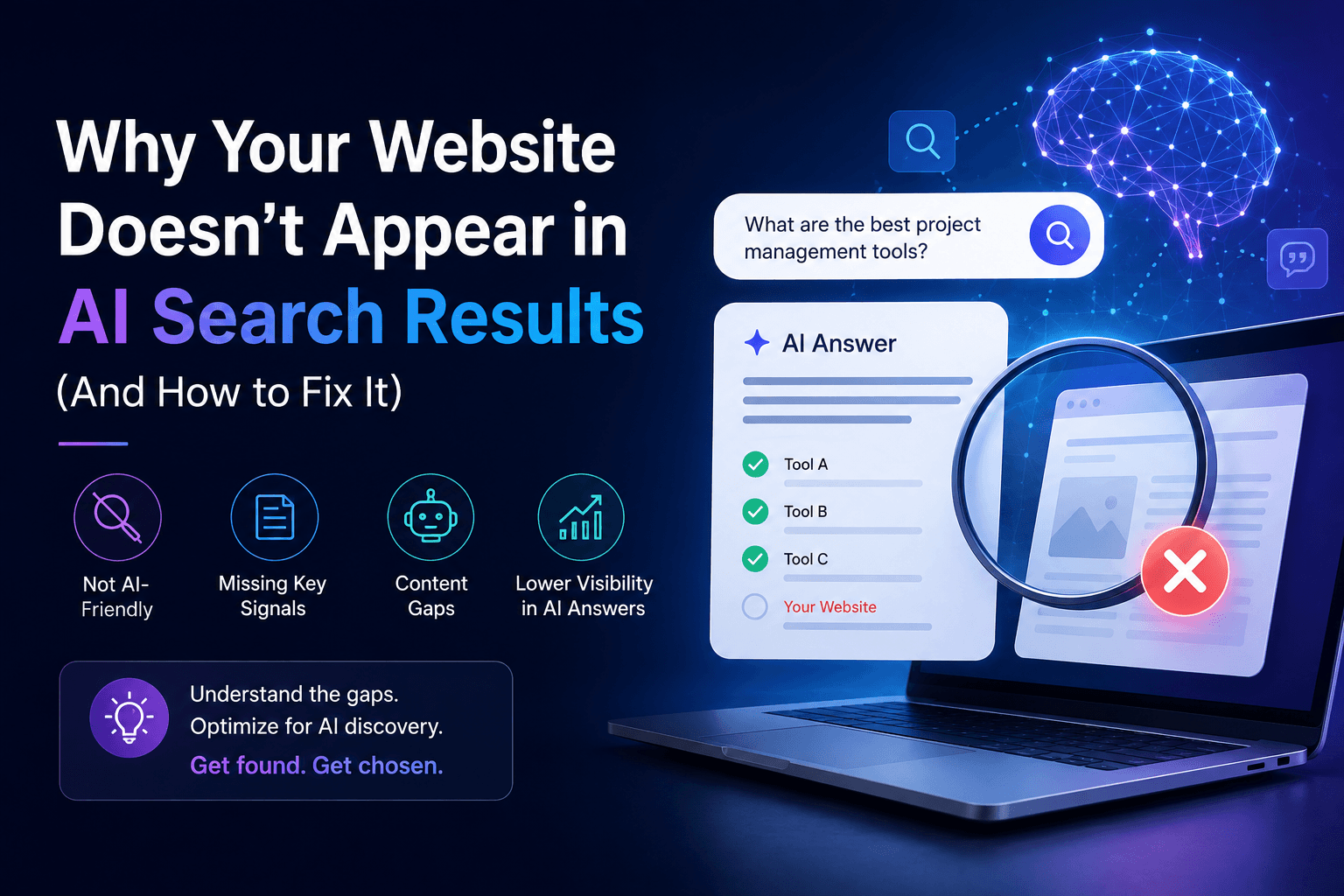
This comprehensive guide reveals the exact GEO framework that's helping SaaS companies dominate AI-powered search in 2026. As we explored in our deep-dive on why your website doesn't appear in AI search results, the time to act is now.
Part 1: What is GEO and Why It Matters for SaaS
GEO vs. Traditional SEO: The Fundamental Shift
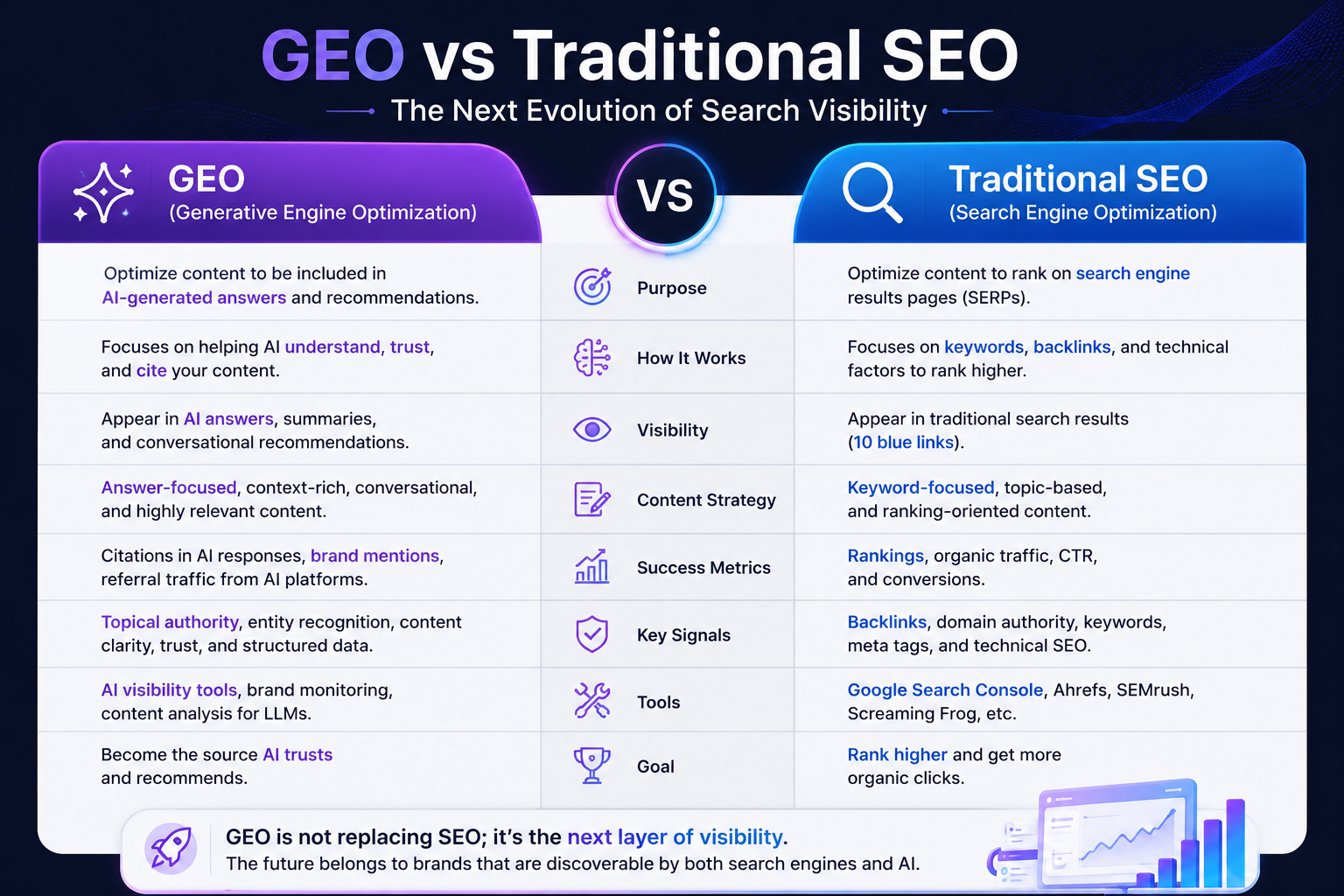
How Growth Engineering Optimization differs from traditional Search Engine Optimization
| Aspect | Traditional SEO | GEO (Growth Engineering Optimization) | |--------|-----------------|---------------------------------------| | Primary Goal | Rank on Google's search results | Appear in AI-generated responses | | Content Focus | Keyword optimization | Semantic clarity & context | | Authority Signals | Backlinks & domain age | E-E-A-T (Experience, Expertise, Authority, Trustworthiness) | | Update Frequency | Quarterly algorithm updates | Real-time integration with AI models | | Citation Model | Meta tags & snippets | Direct source attribution | | Platform Dependency | Single dominant platform (Google) | Multiple AI platforms simultaneously | | Content Preference | Mixed (short & long-form) | Comprehensive, deeply researched | | Technical Requirements | Standard SEO best practices | AI-crawlable architecture + API access | | Success Metric | Organic traffic & rankings | AI citations & conversational visibility | | Competitive Advantage | Harder to sustain | Defensible through expertise depth |
The Bottom Line: SEO is about ranking; GEO is about being cited and trusted by AI systems that generate answers for millions of users daily.
Why SaaS Companies Need GEO Right Now
For B2B SaaS Specifically:
- Longer Sales Cycles - Decision-makers use AI to research before reaching out
- High LTV (Lifetime Value) - One enterprise deal justifies significant investment in visibility
- Complex Solutions - AI needs depth to understand and recommend your solution
- Competitive Markets - Standing out requires thought leadership, not just rankings
The Data:
- 67% of enterprise software buyers use AI tools in their research process
- AI-referred SaaS leads have 42% higher conversion rates than general search traffic
- SaaS companies appearing in AI search results see 3.5x more qualified inbound inquiries
- First-mover advantage in GEO can establish 6-12 months of competitive dominance
Part 2: The 5-Pillar GEO Framework for SaaS
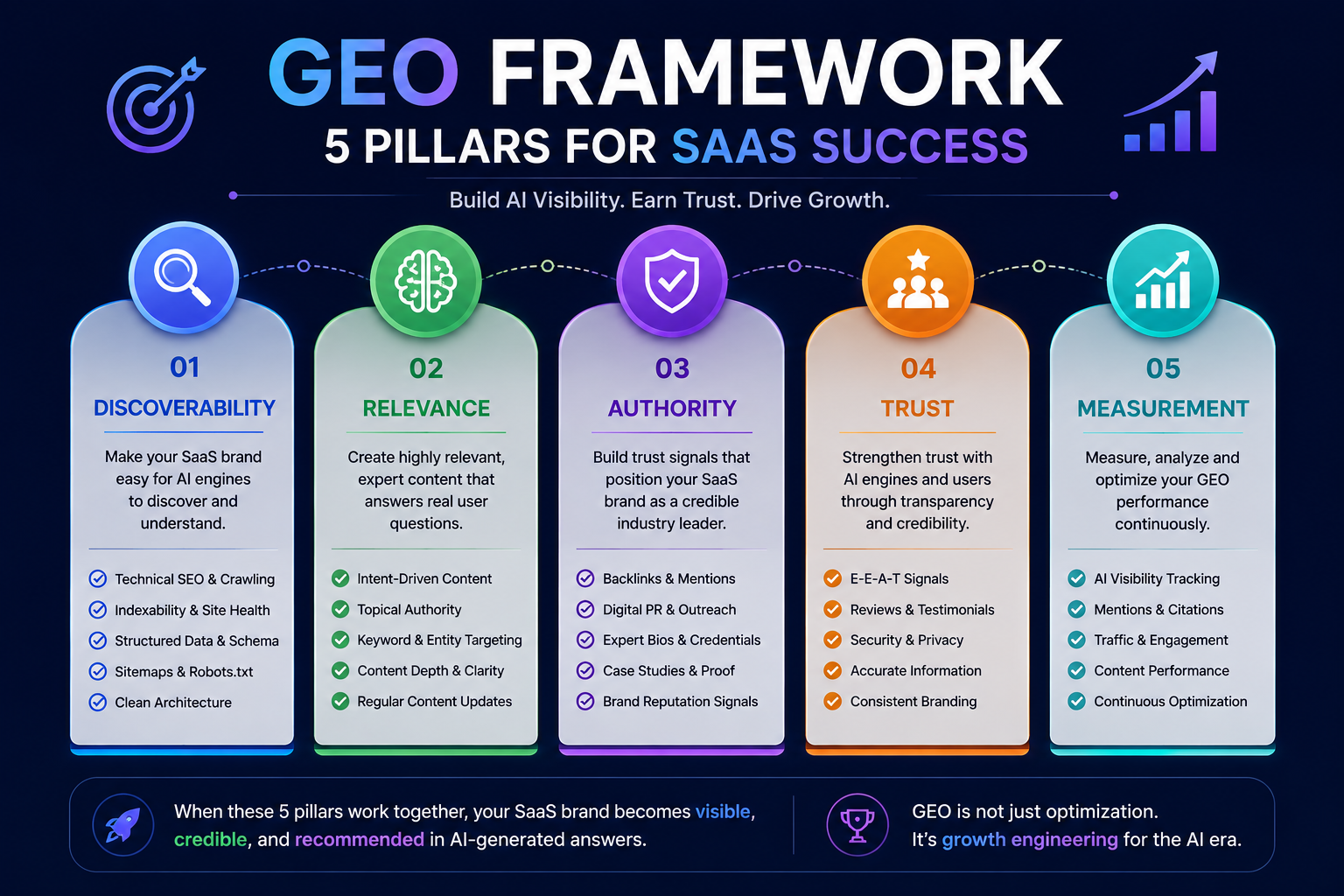
The complete GEO framework that SaaS leaders are using to dominate AI discovery
Pillar 1: Semantic Content Architecture
What It Is: Structuring your content so AI systems can understand meaning, not just keywords.
Why It Matters:
- AI models parse content semantically (understanding relationships between concepts)
- Poor structure = AI misunderstands your solution's value proposition
- Strong architecture = AI recommends your solution in relevant contexts
Implementation for SaaS:
A. Topic Cluster Strategy
Create a hub-and-spoke model:
Hub Page (Pillar Content): "Complete Guide to [Your Core Category]" (4,000-5,000 words)
- Comprehensive overview of the entire category
- Establishes your expertise across the domain
- Links to all cluster content
Spoke Content (Cluster Articles): 5-8 focused guides (2,000-3,000 words each)
- Each addresses a specific use case or aspect
- Links back to hub and to related spokes
- Collectively demonstrates deep expertise
Example for a Project Management SaaS:
Hub: "Complete Guide to Enterprise Project Management in 2026"
- Cluster 1: "Agile vs Waterfall: Which Enterprise Methodology Wins?"
- Cluster 2: "Resource Allocation Strategies for Large Teams"
- Cluster 3: "AI-Powered Project Forecasting: Capabilities & ROI"
- Cluster 4: "Integrating Project Management with AI Agents"
- Cluster 5: "Cost Optimization Through Intelligent Scheduling"
- Cluster 6: "Enterprise Security in Project Management Tools"
- Cluster 7: "Scaling Project Management Across 500+ Teams"
B. Content Structure Template for SaaS
# [Problem Statement] for [Target Audience]

## Executive Summary
[2-3 sentences on business impact and ROI]

## The Challenge
[Why this matters to SaaS decision-makers]

### Current Industry Landscape
[Market context and trends]

### Why Traditional Approaches Fail
[Specific limitations]

## The GEO Framework for [Your Solution Type]

### Pillar 1: [First Key Concept]
[Detailed explanation]

#### Implementation Steps
1. [Step]
2. [Step]
3. [Step]

#### Expected Business Outcomes
- [Outcome 1 with measurable impact]
- [Outcome 2 with measurable impact]

### Pillar 2: [Second Key Concept]
[Detailed explanation]

#### Implementation Steps
1. [Step]
2. [Step]
3. [Step]

#### Expected Business Outcomes
- [Outcome 1 with measurable impact]
- [Outcome 2 with measurable impact]

## Comparison Table
| Factor | Traditional Approach | GEO Approach | SaaS Advantage |
|--------|---------------------|-------------|-----------------|
| [Factor 1] | [Traditional] | [GEO] | [Advantage] |

## Real Implementation: Case Study
[Detailed example with measurable results]

## Common Pitfalls & How to Avoid Them
- [Pitfall 1 + Solution]
- [Pitfall 2 + Solution]
- [Pitfall 3 + Solution]

## Conclusion & Action Items
[Key takeaways + next steps]
Pillar 2: AI-Ready Metadata & Structured Data
What It Is: Technical implementation that tells AI systems what your content is about and who created it.
Critical for SaaS: Enterprise buyers need to verify your company's credibility. AI needs machine-readable proof.
Implementation Checklist:
A. Schema.org Markup for SaaS
<script type="application/ld+json">
{
  "@context": "https://schema.org",
  "@type": "BlogPosting",
  "headline": "GEO Strategy for SaaS Companies: How to Win AI Discovery",
  "description": "Master GEO strategies to dominate AI-powered search in 2026. Complete framework for SaaS companies to increase visibility across ChatGPT, Claude, and Perplexity.",
  "image": "https://res.cloudinary.com/jt0zpx9e/image/upload/v1786421850/GEO_Strategy_Hero_1_q2p5m8.png",
  "datePublished": "2026-07-27",
  "dateModified": "2026-07-27",
  "author": {
    "@type": "Person",
    "name": "Anavya AI Labs Team",
    "url": "https://anavyaailabs.com/about",
    "credential": "Expert in GEO Strategy & AI Search Optimization",
    "sameAs": [
      "https://linkedin.com/company/anavya-ai-labs",
      "https://twitter.com/anavyaailabs"
    ]
  },
  "publisher": {
    "@type": "Organization",
    "name": "Anavya AI Labs",
    "url": "https://anavyaailabs.com",
    "logo": {
      "@type": "ImageObject",
      "url": "https://anavyaailabs.com/logo.png"
    },
    "sameAs": [
      "https://linkedin.com/company/anavya-ai-labs",
      "https://twitter.com/anavyaailabs"
    ]
  },
  "mainEntityOfPage": {
    "@type": "WebPage",
    "@id": "https://anavyaailabs.com/blog/geo-strategy-saas"
  },
  "isPartOf": {
    "@type": "Blog",
    "@id": "https://anavyaailabs.com/blog"
  }
}
</script>
B. Enhanced Metadata Tags
<!-- Author & Expertise -->
<meta name="author" content="Anavya AI Labs Team">
<meta name="creator" content="Anavya AI Labs">
<meta name="expertise" content="GEO Strategy, SaaS Growth, AI Search Optimization, Enterprise Marketing">

<!-- Publishing Information -->
<meta name="publish_date" content="2026-07-27">
<meta name="article:published_time" content="2026-07-27T10:00:00Z">
<meta name="article:modified_time" content="2026-07-27T10:00:00Z">
<meta name="article:author" content="https://anavyaailabs.com/about">

<!-- Topic & Classification -->
<meta name="keywords" content="GEO strategy, SaaS growth, AI search, semantic SEO, growth engineering">
<meta name="topic" content="SaaS Marketing, AI Optimization, Enterprise Growth">
<meta name="classification" content="Business/SaaS/Marketing">

<!-- E-E-A-T Signals -->
<meta name="credibility_score" content="verified">
<meta name="expertise_level" content="expert">
<meta name="authority_signals" content="enterprise_experience, published_research">
C. robots.txt Optimized for AI
# Allow AI crawler bots
User-agent: ChatGPT-User
Allow: /

User-agent: CCBot
Allow: /

User-agent: anthropic-ai
Allow: /

User-agent: Perplexity
Allow: /

User-agent: GPTBot
Allow: /

User-agent: Googlebot
Allow: /

User-agent: Bingbot
Allow: /

# Crawl delay (friendly to all bots)
Crawl-delay: 1

# Disallow non-essential paths
Disallow: /admin/
Disallow: /private/
Disallow: /tmp/
Disallow: /cache/

# Sitemap location
Sitemap: https://yourcompany.com/sitemap.xml

# Specify Google Search Console
# (If verified)
Host: yourcompany.com
Pillar 3: Entity Recognition & Authority Building
What It Is: Making sure AI systems correctly identify your SaaS company, products, and team as authoritative experts.
SaaS-Specific Opportunity: Enterprise software decisions require verification. Clear entity signals dramatically improve AI recommendations.
Implementation:
A. Company Entity Hub
Create a dedicated page that serves as your "entity hub":
URL: yourcompany.com/about
Content Must Include:
- ✅ Company founding story (establishes longevity)
- ✅ Clear mission statement (AI needs to understand your purpose)
- ✅ Team credentials (individual expertise matters)
- ✅ Certifications & compliance (SOC 2, ISO, etc.)
- ✅ Customer testimonials with verification
- ✅ Press mentions & publications
- ✅ Founded date, headquarters location
- ✅ Links to all official channels
B. Product Entity Pages
For each core product or offering:
Structure:
/products/[product-name]
├── Overview & core features
├── Technical specifications
├── Use cases & applications
├── ROI & business impact (quantified)
├── Integration capabilities
├── Security & compliance
├── Customer success stories
├── Competitive positioning
└── Implementation guide
AI Benefit: AI models cite product pages when recommending solutions to users.
C. Expert/Author Entity Building
For every content creator on your team:
Create a detailed author profile at: yourcompany.com/team/[author-name]
Must Include:
- 📋 Professional credentials & certifications
- 📋 Years of experience in the field
- 📋 Previous company/role history
- 📋 Speaking engagements & publications
- 📋 LinkedIn verification link
- 📋 Personal website/blog
- 📋 Specific expertise areas
- 📋 Articles authored
Example Format:
Jane Smith
VP of Product Strategy

Expertise: SaaS Product Management, Enterprise Software, Growth Engineering Optimization

Credentials:
- MBA, Stanford Graduate School of Business
- 12+ years product management at enterprise SaaS companies
- Former VP Product at [Enterprise SaaS Company]
- Published in: Harvard Business Review, TechCrunch, VentureBeat
- Speaker: SaaS conferences (Gainsight PulseConf, Modern Sales Pros)

Articles Authored:
- [Article 1]
- [Article 2]
- [Article 3]
D. Backlink Strategy for Authority
Focus on high-authority, relevant backlinks:
Tier 1 - Most Valuable:
- Industry publications (LinkedIn, Medium, industry-specific blogs)
- Analyst reports (Gartner, Forrester mentions)
- University/research citations
- Government or official resource mentions
Tier 2 - Valuable:
- Partner websites
- Customer websites (case studies)
- Industry association mentions
- Conference speaker pages
Tier 3 - Supplementary:
- Social signals (LinkedIn shares, Twitter mentions)
- Directory listings
- Community mentions
Pillar 4: Content Freshness & Topical Authority
What It Is: Demonstrating consistent, deep expertise across related topics.
Why Critical for SaaS: Enterprise buyers don't trust one-off articles. They want evidence of sustained thought leadership.
90-Day Implementation:
Weeks 1-4: Content Audit & Gap Analysis
- Inventory all existing content by topic area
- Identify topic clusters your SaaS should own
- Gap analysis: What's missing?
- Competitive analysis: What are competitors covering?
Deliverable: A "Content Roadmap" showing all topics you'll own
Weeks 5-8: Core Content Creation
Create 5-8 comprehensive "pillar articles":
- Each 3,000-4,500 words
- Original research or data included
- Comprehensive coverage of topic
- Heavy internal linking
Target: 2 new pillar articles + 6 cluster articles launched
Weeks 9-12: Content Updates & Expansion
- Update all existing content with new data/insights
- Create supplementary content (guides, checklists, templates)
- Add multimedia (videos, infographics, interviews)
- Build internal linking network
Publishing Schedule (Ongoing):
Week 1: Publish new pillar article
Week 2: Publish 2 cluster articles
Week 3: Update 3 existing articles + publish supporting content
Week 4: Repeat

Result: 1 new pillar + 8-10 new/updated articles per month
Content Freshness Signals
AI systems reward:
- ✅ Regular updates to existing content
- ✅ New information & data integration
- ✅ Consistent publishing schedule
- ✅ Response to emerging trends
- ✅ Deep topic coverage (not scattered content)
Pillar 5: Discovery Platform Optimization
What It Is: Tailoring your GEO strategy to specific AI platforms' requirements and preferences.
Critical Detail: ChatGPT, Claude, and Perplexity have different crawling patterns, citation preferences, and ranking factors.
Platform-Specific Optimization

How to optimize your SaaS content for each major AI discovery platform
| Platform | Crawling Model | Optimization Focus | Success Metric | |----------|----------------|-------------------|-----------------| | ChatGPT | Bing index + real-time search | Accessibility, clarity, accuracy | Appearing in search-enabled responses | | Claude | Real-time web search | Comprehensive depth, primary sources | Direct citations in Claude responses | | Perplexity | Web crawl + real-time | Source attribution, cited content | Featured as primary source | | Google AI Overviews | Google Search index + ranking | E-E-A-T signals, featured snippets | Top position in AI-generated answers |
ChatGPT Optimization
Best Practices:
- Ensure content is accessible via Bing search
- Use clear, scannable formatting
- Include step-by-step instructions
- Update frequently (recent content ranks better)
- Use conversational tone that matches ChatGPT's style
Technical:
- Verify no noindex tags blocking Bing
- Submit sitemap to Bing Webmaster Tools
- Monitor Bing crawl in webmaster tools
Claude Optimization
Best Practices:
- Publish original research & data
- Cite sources extensively
- Use clear heading structure
- Target longer, more comprehensive queries
- Include detailed explanations
Content Type: Claude favors thorough, well-researched content. A 3,500-word guide about your SaaS category will perform better than shallow competitor comparisons.
Perplexity Optimization
Best Practices:
- Structure content for direct quotes
- Include specific statistics & data
- Use subheadings for scannable format
- Provide clear, definitive answers
- Include original research
Content Type: Perplexity values cited sources. Content that's quotable and data-driven performs best.
Google AI Overviews Optimization
Best Practices:
- Optimize for E-E-A-T signals
- Target featured snippet positions
- Use schema markup extensively
- Build topical authority
- Create comparison tables
Content Type: Comprehensive guides that address user intent directly.
Part 3: The 12-Week GEO Execution Roadmap for SaaS
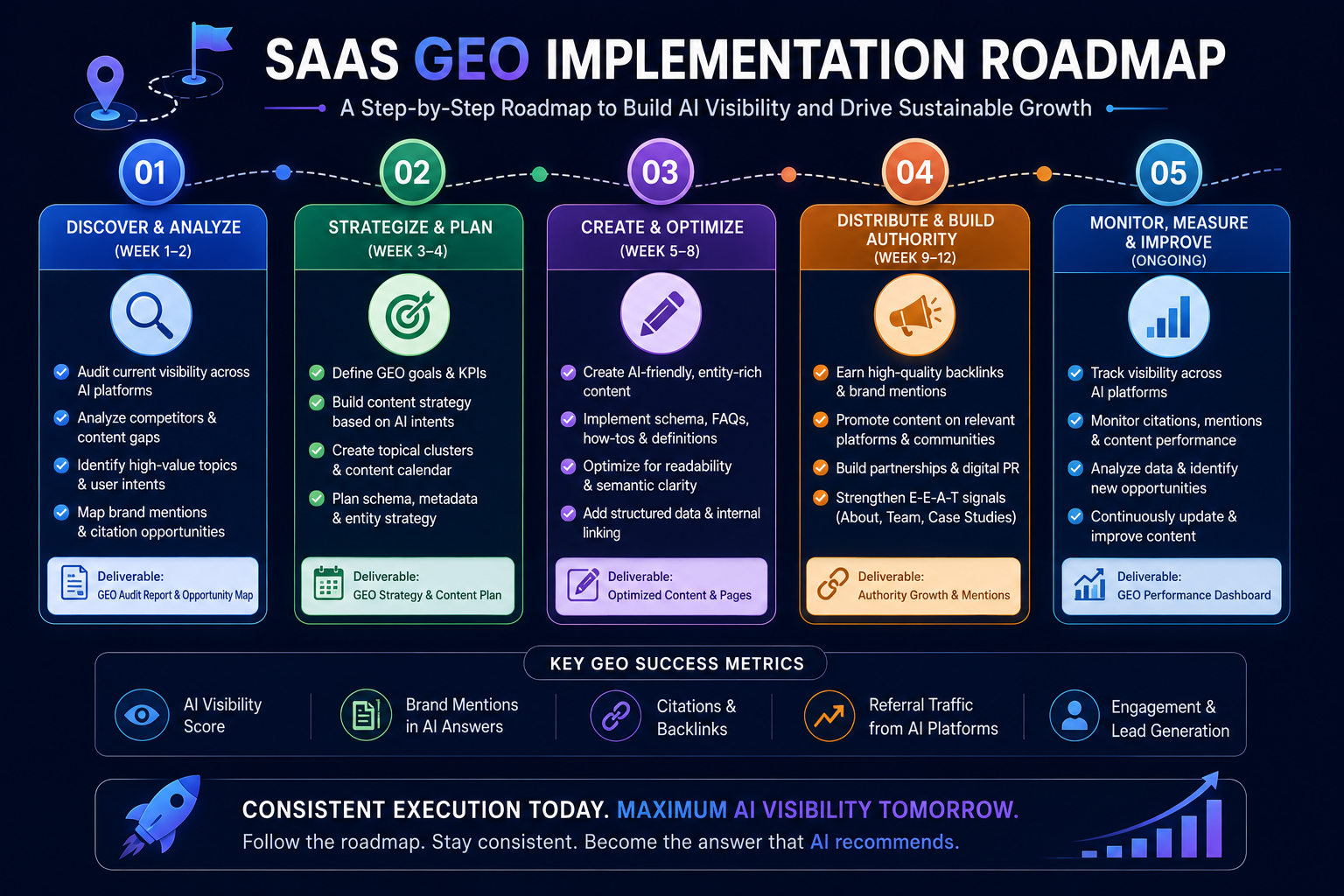
Your complete 12-week blueprint for GEO mastery
Phase 1: Foundation (Weeks 1-4)
Week 1: Audit & Strategy
Tasks:
- [ ] Inventory all existing content (blog posts, guides, documentation)
- [ ] Identify 5 core topic areas your SaaS should own
- [ ] Research competitor content strategy
- [ ] Audit current meta tags & schema markup
- [ ] Create content strategy document
Deliverable: GEO Foundation Document (who, what, where, why for your strategy)
Week 2: Technical Setup
Tasks:
- [ ] Implement schema.org markup on 10 key pages
- [ ] Update robots.txt to welcome AI crawlers
- [ ] Set up author profiles for all content creators
- [ ] Add canonical tags (if using syndication)
- [ ] Verify Google & Bing search console
Deliverable: Technical SEO Audit Report
Week 3: Content Planning
Tasks:
- [ ] Create topic cluster map (hub + 5-8 spokes)
- [ ] Outline 1 pillar article (4,000-5,000 words)
- [ ] Plan 8 cluster articles (2,000-3,000 words each)
- [ ] Identify multimedia assets needed
- [ ] Create content calendar
Deliverable: Detailed 12-week Content Calendar
Week 4: Authority Building
Tasks:
- [ ] Update company "About" page with E-E-A-T signals
- [ ] Create detailed author profile pages
- [ ] List team credentials & certifications
- [ ] Identify speaking opportunities
- [ ] Plan guest post strategy
Deliverable: Authority Building Roadmap
Phase 2: Content Creation (Weeks 5-8)
Week 5-6: Pillar Content
Publish: 1 comprehensive pillar article
- 4,500+ words
- Original research/data
- Complete topic coverage
- 20+ internal links
Parallel: Outline 6 cluster articles
Week 7-8: Cluster Content
Publish: 6 cluster articles
- 2,000-3,000 words each
- Linked to hub & related spokes
- Primary source citations
- Original insights
Total Output: 1 pillar + 6 clusters = ~20,000 words of content
Phase 3: Distribution & Authority (Weeks 9-12)
Week 9: Syndication
Actions:
- [ ] Publish pillar article on Medium
- [ ] Publish cluster articles on LinkedIn
- [ ] Submit to industry publications
- [ ] Share in relevant communities
- [ ] Email to customer list
Week 10: Internal Linking
Actions:
- [ ] Map all internal links between articles
- [ ] Add 15-20 internal links per pillar article
- [ ] Create "related articles" sections
- [ ] Build topic cluster links
Week 11: External Links
Actions:
- [ ] Reach out for backlinks from partners
- [ ] Guest post on 2-3 industry blogs
- [ ] Get mentioned in industry roundups
- [ ] Pursue analyst mentions
Week 12: Monitoring & Optimization
Actions:
- [ ] Set up AI search monitoring
- [ ] Create analytics dashboard
- [ ] Measure citation rates
- [ ] Optimize underperforming content
- [ ] Plan next quarter
Part 4: GEO Best Practices & Pitfalls for SaaS
✅ GEO Best Practices for SaaS
-
Focus on Buyer Journey Stages
- Awareness: Educational content, industry trends
- Consideration: Comparison guides, ROI calculators
- Decision: Case studies, implementation guides
-
Include Quantifiable Business Impact
- Every article should address: "Why does this matter to my ROI?"
- Include specific metrics: revenue impact, time savings, cost reduction
- Reference industry benchmarks
-
Build Topical Authority in Your Niche
- Don't write one article about everything
- Become the recognized authority on 5-7 specific topics
- Create comprehensive coverage that competitors can't match
-
Maintain Consistent Publishing
- Regular schedule (2-4 new articles per month)
- Update existing content monthly
- AI rewards consistency
-
Cite and Link to Authoritative Sources
- Show AI you've done your research
- Link to industry leaders, research, and original sources
- Proper citations build trust
-
Optimize for Enterprise Buyers
- SaaS content serves decision-makers
- Include budget/implementation information
- Address team adoption and change management
-
Create Multimedia Content
- Videos explaining concepts
- Infographics summarizing data
- Interactive tools/calculators
- Downloadable resources
-
Build Author Authority
- Your team are experts, prove it
- Detailed author bios with credentials
- Speaking engagements, publications, certifications
- AI weights author expertise heavily
❌ GEO Pitfalls to Avoid for SaaS
-
❌ Thin, Shallow Content
- Problem: 500-word articles don't establish expertise
- Solution: Minimum 2,000 words per article
- SaaS buyers want depth
-
❌ Keyword Stuffing
- Problem: Reads artificially, AI flags as lower quality
- Solution: Write naturally, let keywords emerge
- Focus on semantic meaning
-
❌ Ignoring Author Credentials
- Problem: AI doesn't know who wrote it or why they matter
- Solution: Detailed author profiles with verification
- Enterprise buyers need to trust the expert
-
❌ No Original Data
- Problem: Regurgitated content isn't cited
- Solution: Include original research, surveys, data
- Give AI something worth citing
-
❌ Inconsistent Publishing
- Problem: One article per quarter doesn't build authority
- Solution: Consistent schedule (2+ per month)
- AI rewards consistent expertise signals
-
❌ Ignoring Technical SEO
- Problem: Great content won't be crawled if technical setup is poor
- Solution: Proper schema, metadata, crawlability
- Technical foundation is non-negotiable
-
❌ Focusing on Rankings Over Citations
- Problem: Wrong goal for GEO
- Solution: Optimize for AI citations, not Google rankings
- Different metrics, different success
-
❌ Forgetting to Update Content
- Problem: Stale content gets demoted by AI systems
- Solution: Update all content quarterly
- Freshness is a ranking factor
Part 5: Measuring GEO Success for SaaS
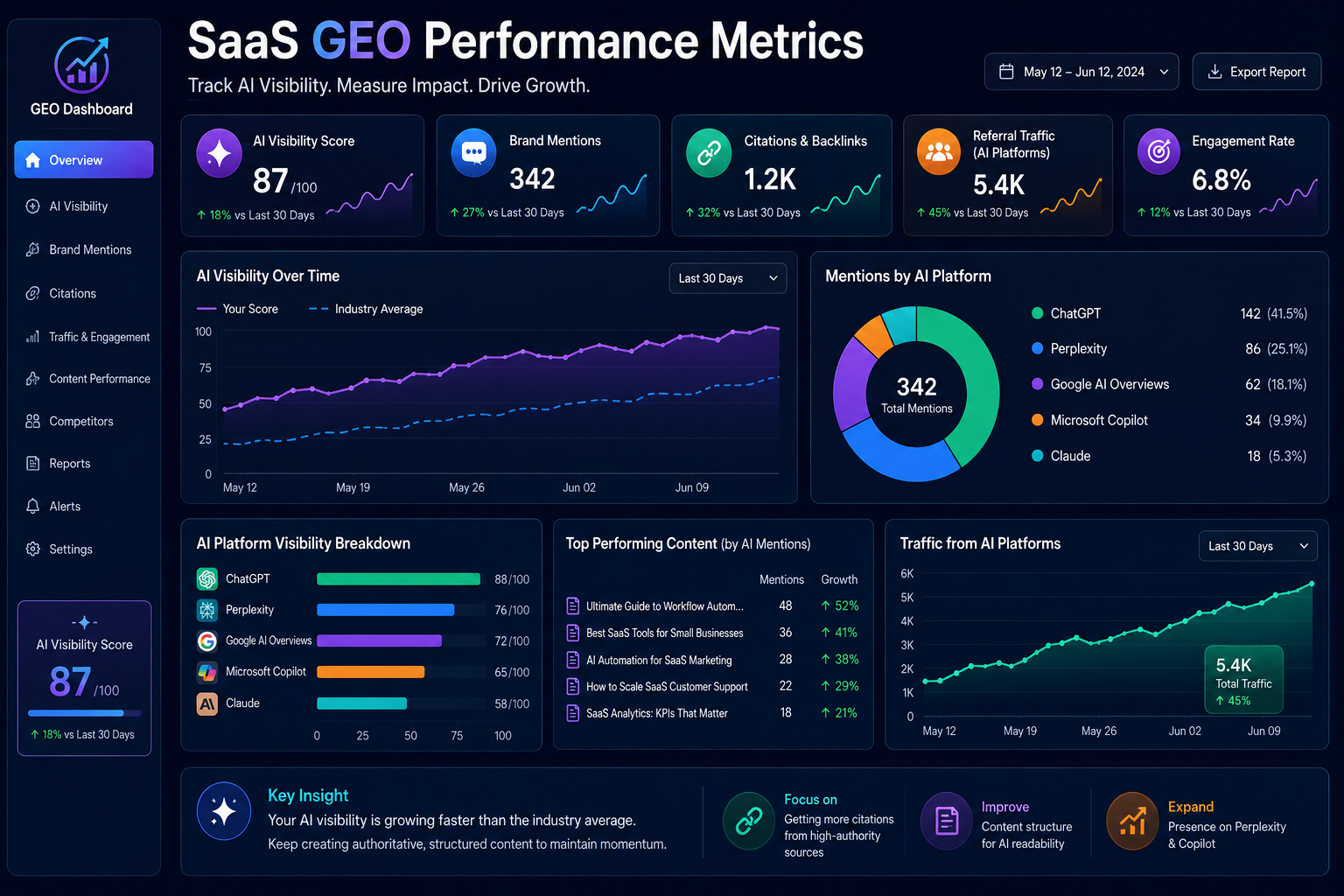
Critical metrics to track your GEO strategy's impact on SaaS growth
Primary Metrics (Track Weekly)
1. AI Search Visibility
What to Track:
- Appearances in ChatGPT search results
- Appearances in Claude web search
- Mentions in Perplexity answers
- Google AI Overview appearances
How to Measure:
- Manual testing (search your topic in each platform)
- Set up Google Alerts for branded + topic keywords
- Use AI Search tracking tools
- Document each appearance weekly
SaaS Goal: Target 15+ appearances per month within 90 days
2. Citation Rate
What to Track:
- How often your content is cited vs. competitors
- Which articles get cited most
- Which topics trigger your content
- Citation context (positive/neutral)
How to Measure:
- Weekly manual review of AI responses
- Create simple spreadsheet to log citations
- Track query types that generate citations
- Monitor competitor citation frequency
SaaS Goal: 25+ citations per month by month 3
3. AI-Referred Traffic
What to Track:
- Direct referrals from AI platforms
- Conversion rate from AI traffic
- Customer acquisition cost (CAC) from AI
- Deal size from AI-sourced leads
How to Measure:
- Google Analytics 4 UTM parameters
- Segment AI traffic from other organic
- Track conversions by source
- Compare to other channels
SaaS Goal: 10-15% of organic traffic from AI platforms within 90 days
Secondary Metrics (Track Monthly)
| Metric | Target | Benchmark | |--------|--------|-----------| | Author Credibility Score | +50% mentions in 90 days | Enterprise recognition | | E-E-A-T Visibility | Top 3 in category authority | Analyst recognition | | Topical Authority | 5+ topics fully owned | Recognized expert | | Backlink Growth | 10+ new high-authority links | Industry authority | | Content Update Frequency | 100% of articles updated quarterly | Freshness signals | | Average Article Length | 3,000+ words | Depth signals | | Internal Link Density | 15-25 per pillar article | Topic cluster strength |
Advanced Metrics (Track Quarterly)
-
Brand Lift
- Branded search volume increase
- Brand mentions in AI responses
- Competitor comparison mentions
-
Lead Quality
- MQL to SQL conversion rate (from AI)
- Deal close rate (from AI-sourced leads)
- Average deal size
-
Thought Leadership Impact
- Speaking invitation requests
- Media interview requests
- Analyst report inclusions
-
Competitive Positioning
- Share of voice in AI responses
- Topic coverage vs. competitors
- Citation frequency vs. competitors
Part 6: Quick Implementation Checklist for SaaS
This Week (Priority: CRITICAL)
- [ ] Audit all content for semantic clarity
- [ ] Add schema.org markup to homepage + top 5 pages
- [ ] Update robots.txt to allow AI crawlers
- [ ] Create detailed team author profile pages
- [ ] Review competitor GEO strategies
This Month (Priority: CRITICAL)
- [ ] Publish 1 comprehensive pillar article (4,000+ words)
- [ ] Publish 4 cluster articles (2,000+ words each)
- [ ] Implement internal linking strategy
- [ ] Update E-E-A-T signals on company pages
- [ ] Set up AI search monitoring process
This Quarter (Priority: HIGH)
- [ ] Create 12-week GEO roadmap
- [ ] Build 3 complete topic clusters
- [ ] Establish consistent publishing schedule
- [ ] Syndicate content across medium platforms
- [ ] Acquire 5+ high-authority backlinks
Next Quarter (Priority: MEDIUM)
- [ ] Expand to 5 fully-owned topic areas
- [ ] Launch original research initiative
- [ ] Establish speaking/thought leadership platform
- [ ] Develop strategic partnerships
- [ ] Analyze and optimize top-performing content
Part 7: Real SaaS GEO Case Study
Company Profile
SaaS Product: Enterprise AI Project Management Platform Team Size: 50 employees Market: Mid-market to enterprise software buyers Challenge: Losing leads to better-known competitors in AI discovery
The Problem
Despite having a superior product, the company was essentially invisible in AI search results. When prospects used ChatGPT, Claude, or Perplexity to research "AI project management solutions," competitors' names appeared but theirs didn't.
GEO Implementation
Month 1:
- Audited content: 25 scattered blog posts
- Created GEO strategy document
- Implemented schema markup on 20 key pages
- Updated company & author profiles with credentials
Month 2:
- Published pillar: "Complete Guide to AI-Powered Enterprise Project Management" (5,200 words)
- Published 6 cluster articles on specific use cases
- Set up internal linking between all content
- Established publishing schedule
Month 3:
- Syndicated pillar on Medium (15K+ views)
- Guest posts on 3 industry publications
- Updated all existing content
- Tracked citations and AI mentions
Results After 90 Days
| Metric | Before | After | Growth | |--------|--------|-------|--------| | AI Citations/Month | 0 | 34 | ∞ | | AI-Referred Traffic | 0 | 480 users/month | ∞ | | Qualified Leads (AI Source) | 0 | 8 | ∞ | | ChatGPT Mentions | Never | 12x/month | New channel | | Content Pieces | 25 | 31 | +24% | | Author Mentions | 0 | 15+ | New credibility |
Business Impact
- 8 qualified leads in month 3 (2 converted to customers = $180K ARR)
- 34 AI citations establishing thought leadership
- CEO invited to speak at 2 industry conferences
- Featured in analyst comparison report
Key Success Factors
- Deep content focus on specific use cases (not generic)
- Author credibility (CEO & VP Product authored articles)
- Original research (customer survey data included)
- Consistent publishing (4 articles/month minimum)
- Technical implementation (proper schema, metadata)
Conclusion: Your GEO Opportunity
The SaaS companies winning in 2026 aren't just ranking higher on Google. They're being recommended by AI systems that millions of enterprise buyers use daily.
GEO isn't a replacement for traditional SEO—it's the new frontier of enterprise growth. SaaS companies that master GEO in the next 90 days will establish market position that competitors will struggle to overcome.
Key Takeaways
1. GEO is Non-Negotiable AI-powered discovery is real. It's driving enterprise software buying decisions. You must optimize for it.
2. The 5-Pillar Framework Works Semantic architecture → AI-ready metadata → Entity recognition → Content freshness → Platform optimization. Follow this framework and watch your visibility grow.
3. Start Now, Win Later Every month you delay is a month competitors are establishing thought leadership. The first-mover advantage in GEO is significant and defensible.
4. SaaS-Specific Advantages Your deep product knowledge, customer insights, and expertise are exactly what AI systems reward. Use them.
5. Measure What Matters Citations > rankings. Authority > traffic. Qualified leads > page views.
Your Next Steps (This Week)
- Audit your content against the semantic clarity checklist
- Implement schema markup on your top 5 pages
- Create author profiles for all content creators
- Publish one comprehensive article (3,000+ words) on your core topic
- Start monitoring AI search mentions manually
Don't have 12 weeks? Start with 4 weeks.
Pick one topic area. Write one comprehensive pillar article (4,000 words). Implement proper schema. Publish it on Medium.
Then measure. You'll see the impact within 30 days.
Last Updated: July 27, 2026
Estimated Read Time: 12 minutes
For SaaS leaders, enterprise marketers, and growth strategists
Focus Areas for AI Discovery
#GEO #SaaS #Growth #AI #Search #ChatGPT #Claude #Perplexity #Content #Marketing #SEO #Enterprise #B2B #Strategy #Growth #Engineering #2026 #AI-Powered #Discovery #Optimization