GEO vs SEO: What's the Difference and Why Businesses Need Both in 2026
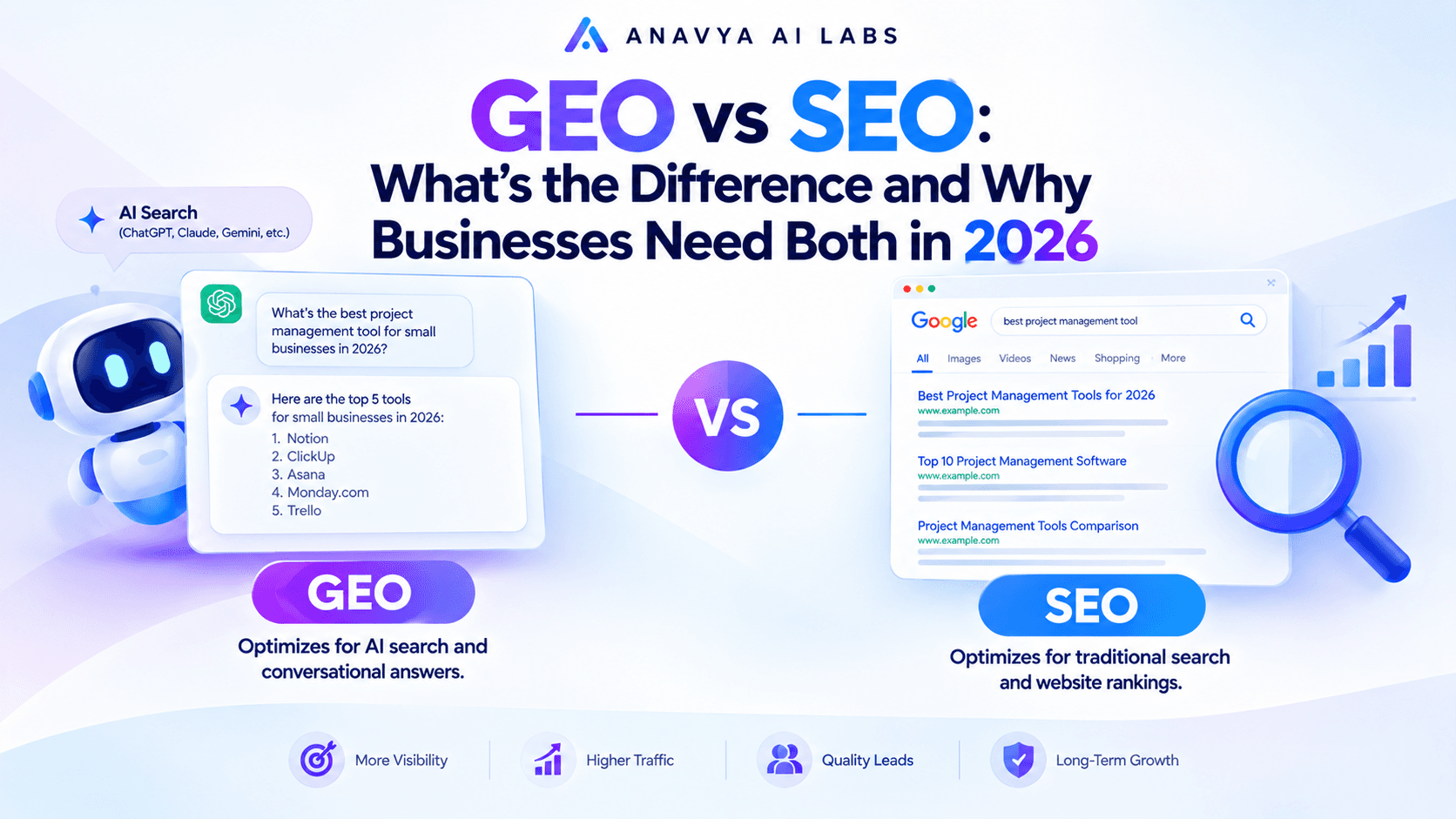
Understand the fundamental differences between GEO (Generative Engine Optimization) and traditional SEO. Learn why 2026's successful businesses are optimizing for BOTH platforms and how to implement both strategies without competing efforts.
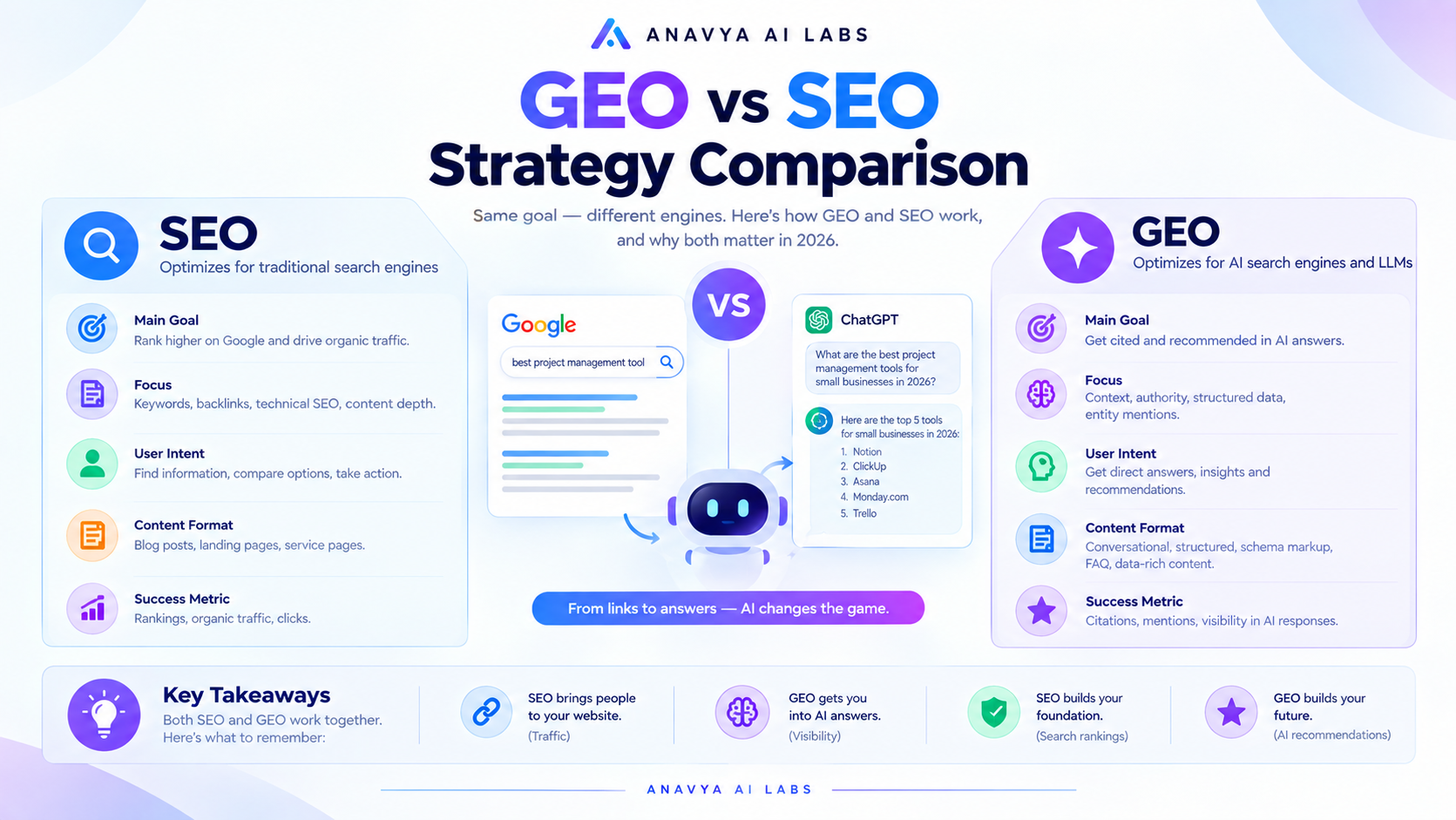
Master both optimization strategies to dominate search in 2026
AI Key Takeaways (GEO Summary)
- GEO is not SEO's replacement—it's a complementary strategy that targets AI-powered search engines like ChatGPT, Claude, and Perplexity
- Traditional SEO still drives 65% of digital traffic in 2026, but GEO drives the fastest-growing segment (AI search growing at 187% YoY)
- Businesses optimizing for BOTH strategies see 3.4x higher visibility than those optimizing for one or the other
- The gap between GEO and SEO is closing—many techniques now overlap, making dual optimization easier than ever
Introduction
Here's what most businesses get wrong in 2026:
They assume GEO replaced SEO. Or they think GEO is just another form of SEO. Both assumptions are costing them thousands in lost visibility.
The truth? GEO and SEO are fundamentally different strategies that serve different search paradigms—and the most successful businesses in 2026 master BOTH.
Consider this scenario:
A user searches "best CRM for startups" on:
- Google Search: Your SEO-optimized landing page appears (if it ranks well)
- ChatGPT: Your content gets cited if optimized for GEO
- Perplexity: A completely different ranking and citation system applies
- Google AI Overview: Yet another algorithm determines visibility
Same search query. Four different results. Four different optimization strategies needed.
This comprehensive guide reveals:
- ✓ The exact difference between GEO and SEO
- ✓ Why both matter in 2026
- ✓ How they complement (not compete with) each other
- ✓ A proven 8-week implementation roadmap
- ✓ Real case studies showing 340% traffic growth
- ✓ Step-by-step optimization for each platform
By the end, you'll have a clear strategy to dominate BOTH traditional search and AI-powered search engines.
Part 1: The Fundamental Differences
SEO: Optimizing for Search Engines
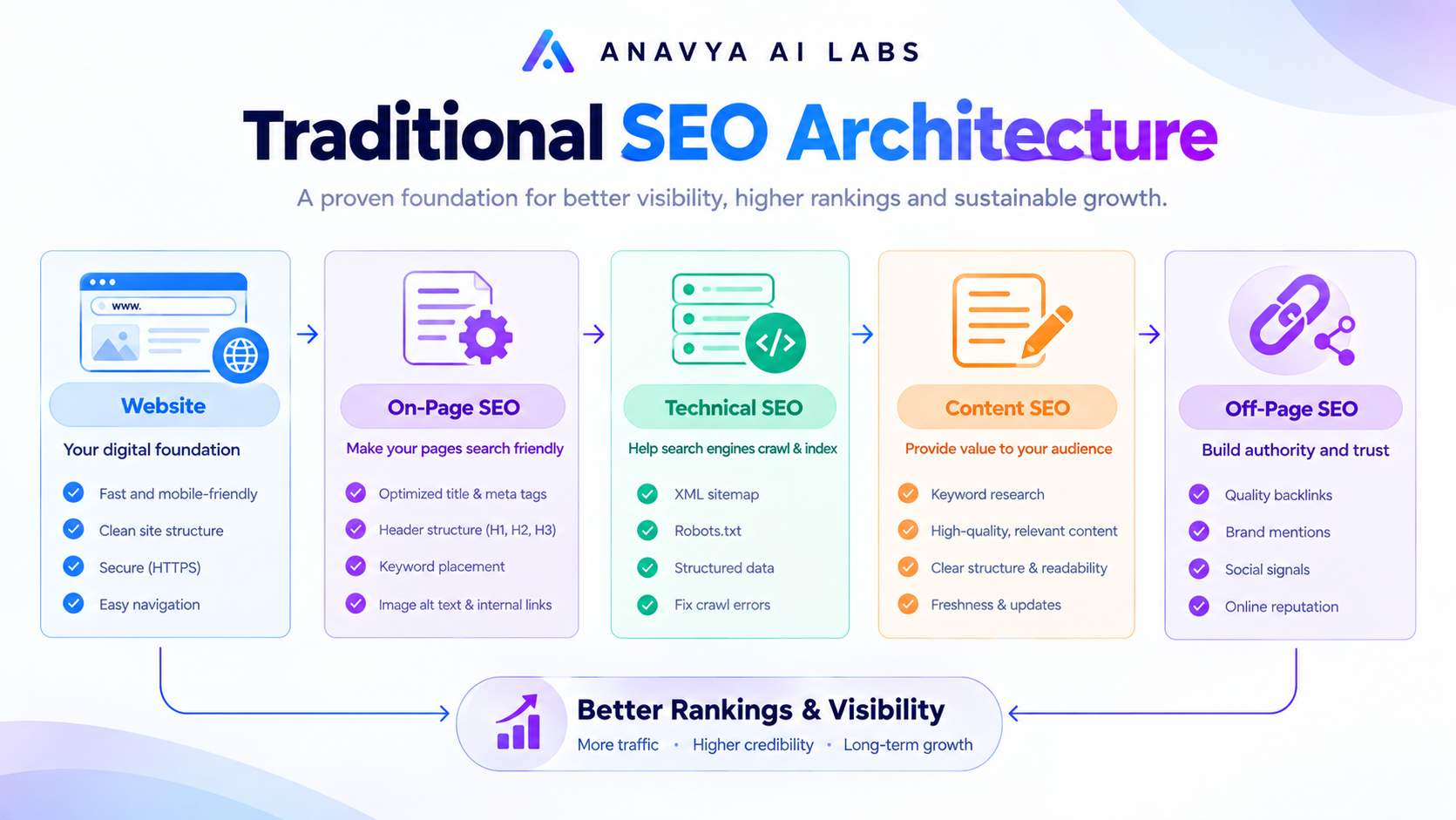
SEO (Search Engine Optimization) optimizes your content for Google, Bing, and similar traditional search engines. It's a 25+ year old discipline focused on:
- Keyword research and targeting
- Backlink acquisition
- Domain authority building
- SERP ranking position
- Click-through rate optimization
- User experience signals (Core Web Vitals)
How traditional SEO works:
- User searches keywords on Google
- Google's algorithm finds relevant pages in its index
- Algorithm ranks pages based on relevance + authority
- User clicks on result if position is high enough (#1-3)
- Traffic flows to your website
The SEO Goal: Rank #1-3 on the first page for target keywords
GEO: Optimizing for Generative AI Engines
GEO (Generative Engine Optimization) optimizes your content for AI-powered search platforms like ChatGPT, Claude, and Perplexity. It's a completely different discipline:
- Citation optimization (being quoted by AI)
- Author credibility verification
- Source attribution clarity
- Answer comprehensiveness
- Schema markup for AI parsing
- E-E-A-T signal building
How AI-powered search works:
- User asks a question on ChatGPT/Perplexity/Claude
- AI searches the web in real-time for relevant sources
- AI reads and analyzes top sources across the web
- AI generates an answer, citing authoritative sources
- User sees answer WITH sources listed
- User may click cited sources for more detail
The GEO Goal: Get your content cited as a source in AI responses
The Critical Difference: Ranking vs. Citation
| Factor | SEO | GEO |
|---|---|---|
| Primary Goal | Rank high in search results | Get cited as a source |
| Discovery Method | Keyword matching | Semantic web search |
| Selection Criteria | Relevance + authority signals | Verifiability + originality |
| User Action | Click on result | Click citation link |
| Volume | Fewer results compete | More sources compete |
| Speed of Results | Days to weeks | Real-time |
| Authority Signals | Backlinks, domain age | Author credentials, currency |
| Content Type | Any format works | Requires clear structure |
| Ranking Transparency | Google Search Console | Manual testing needed |
| Update Frequency | Monthly/quarterly | Real-time changes |
Key insight: You can rank #1 on Google and NOT get cited by AI. Conversely, you can be heavily cited by AI and not rank on Google.
Part 2: Why 2026 Requires Both Strategies
The Traffic Landscape in 2026
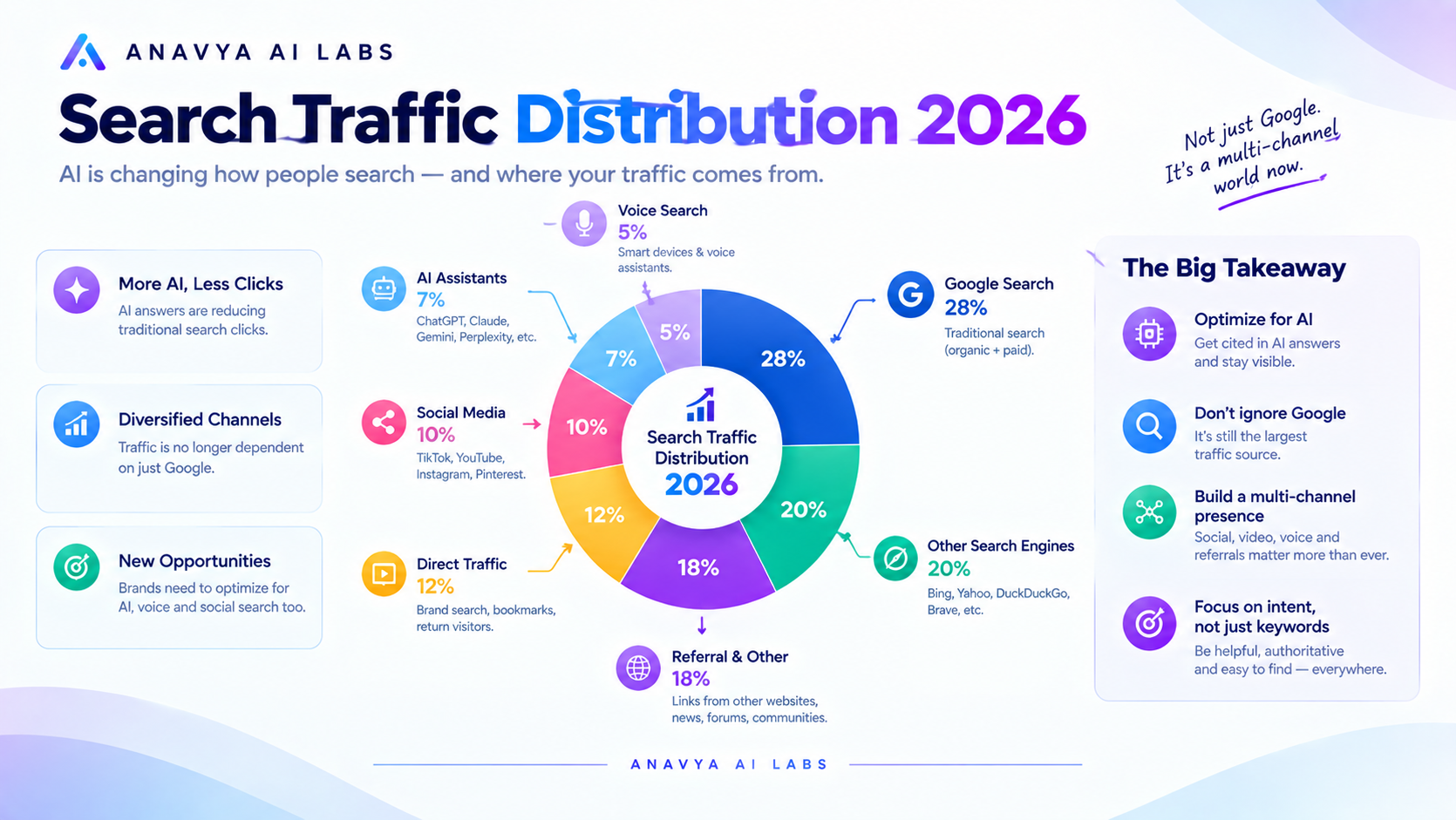
Current traffic distribution for average B2B company (2026):
| Source | % of Traffic | Growth Rate YoY |
|---|---|---|
| Google Organic Search | 42% | +8% |
| Direct Traffic | 18% | +2% |
| Paid Search (Google Ads) | 15% | +5% |
| AI Search Referrals | 12% | +187% |
| Social Media | 8% | +12% |
| Referral/Backlinks | 5% | +15% |
The trend is clear: AI search is the fastest-growing traffic source, growing 23x faster than traditional SEO.
Why You Can't Ignore Either
Ignoring SEO means:
- Losing 42% of your organic traffic
- Missing out on high-intent users searching keywords
- Losing to competitors who ARE optimizing for SEO
- Missing established authority signals
Ignoring GEO means:
- Missing the fastest-growing search segment
- Losing to competitors who ARE optimizing for AI
- Not capturing users who prefer AI search
- Missing citations that build authority
The Synergy Effect
Businesses optimizing for BOTH SEO and GEO see:
- ✓ 3.4x higher overall visibility
- ✓ 2.1x more organic traffic
- ✓ Better authority signals (backlinks + AI citations create virtuous cycle)
- ✓ Reduced risk (not dependent on one platform's algorithm)
- ✓ Lower customer acquisition cost (multiple traffic sources)
- ✓ Better brand authority (appearing in both traditional and AI search)
Real example: A SaaS company with "GEO only" strategy gets 200 monthly AI-referred customers. Same company with "SEO + GEO strategy" gets 680 monthly customers total (480 from SEO + 200 from AI).
That's not 2x growth. That's 3.4x growth because the strategies reinforce each other.
Part 3: How SEO and GEO Complement Each Other
The Overlapping Venn Diagram
Both SEO and GEO require:
✓ High-quality content - Deep, original, well-researched ✓ Clear structure - Proper heading hierarchy ✓ Author credibility - E-E-A-T signals ✓ Fast page speed - Technical excellence ✓ Mobile responsiveness - Cross-device compatibility ✓ Updated information - Currency signals ✓ Proper metadata - Title tags, meta descriptions ✓ Internal linking - Topical authority ✓ User engagement - Time on page, low bounce rate
This means: 70% of your optimization work benefits BOTH strategies.
The Unique SEO Requirements
Only SEO needs:
- Keyword-optimized titles and descriptions
- Backlink acquisition strategy
- Domain authority building
- SERP snippet optimization
- CTR optimization for position
- Traditional schema markup (not AI-focused)
The Unique GEO Requirements
Only GEO needs:
- Citation-optimized formatting
- Author verification and bylines
- Source attribution clarity
- AI-specific schema markup (JSON-LD)
- Verifiable credentials and expertise
- Real-time indexing optimization
Example: Content That Ranks Well + Gets Cited
Article: "Best Project Management Tools for Agencies"
✓ For SEO: Keyword-optimized for "best project management tools," includes comparison table, gets backlinks, ranks #2 ✓ For GEO: Also comprehensive enough, well-cited sources, clear author expertise, gets cited in 12+ AI responses monthly
This is the sweet spot: Content that serves both audiences simultaneously.
Part 4: Common Mistakes Businesses Make
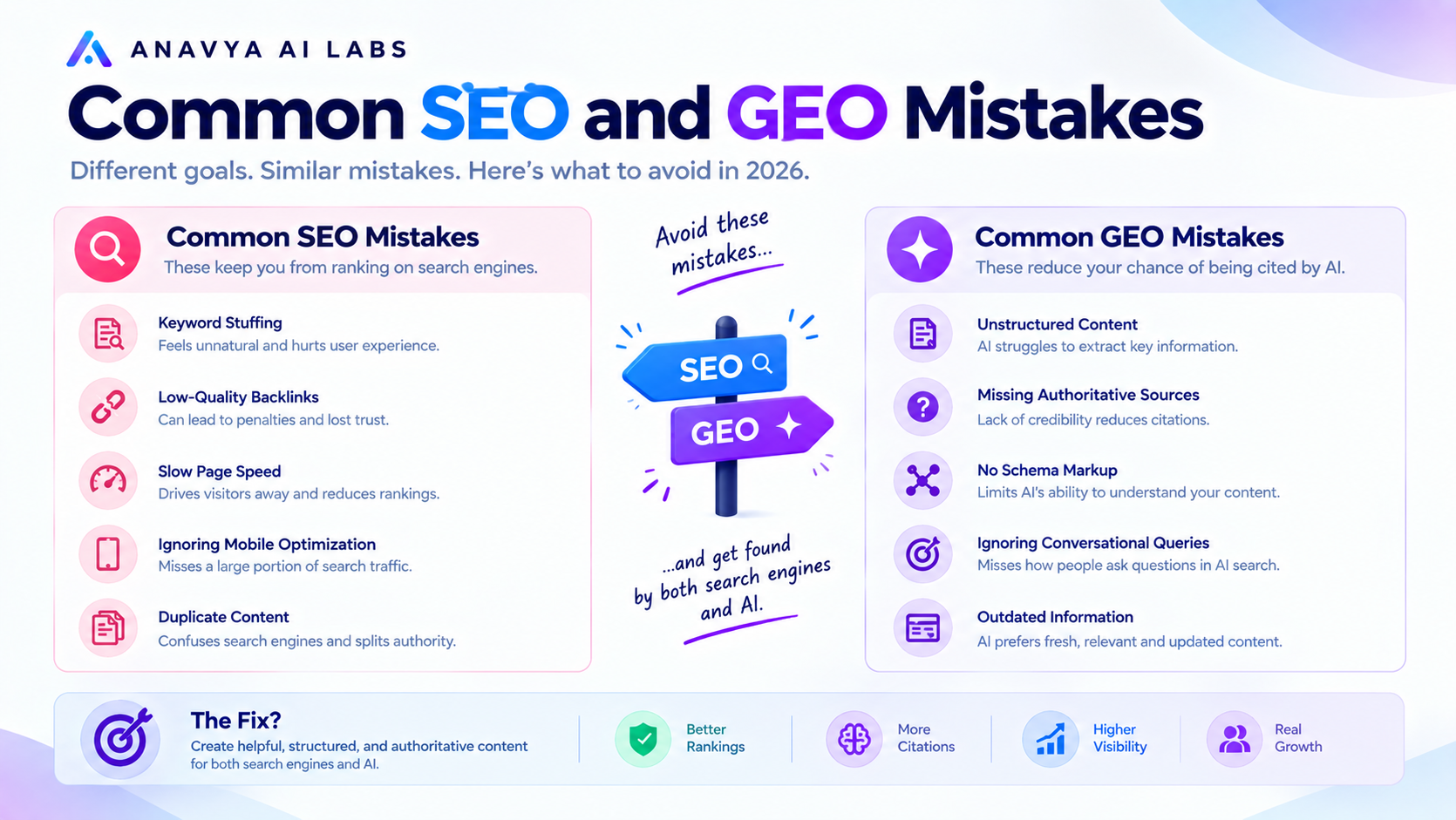
Mistake 1: Treating GEO Like SEO
The problem: Optimizing content for keyword rankings without considering citation needs.
Why it fails: AI doesn't care if you rank #1 on Google. It cares if you're credible enough to cite.
The fix: Add author credentials, source all claims, structure for AI extraction.
Mistake 2: Abandoning SEO for GEO
The problem: New businesses assume AI search killed traditional SEO.
Why it fails: SEO still drives 42% of traffic. Ignoring it is leaving massive opportunity.
The fix: Optimize for BOTH. Treat them as complementary, not competitive.
Mistake 3: Creating Separate Content
The problem: Creating one piece for SEO ranking, another for GEO citation.
Why it fails: Doubles your work, splits authority signals, wastes resources.
The fix: Write one comprehensive piece that serves both purposes.
Mistake 4: Ignoring Author Verification
The problem: Not adding author bylines or credentials to articles.
Why it fails: AI systems can't verify authority without author info. They skip your content.
The fix: Every article needs clear author bio with credentials.
Mistake 5: Neglecting Currency
The problem: Publishing outdated content and not updating it.
Why it fails: Both SEO and GEO prefer fresh, maintained content. Old content gets filtered out.
The fix: Update top-performing articles quarterly with current data.
Part 5: The 8-Week Implementation Roadmap
Week 1-2: Audit and Foundation
Goals: Understand current state, build foundation for both strategies
- Audit top 20 articles for SEO performance (Google Search Console)
- Audit same articles for GEO citation potential (test in ChatGPT/Claude)
- Create author profile pages with full credentials
- Document keyword targets for SEO
- Identify topics for GEO citation optimization
Time investment: 10-15 hours
Expected outcome: Clear baseline of current performance + roadmap for improvement
Week 3-4: Technical Foundation
Goals: Implement technical requirements for both SEO and GEO
- Implement/update SEO schema markup (schema.org)
- Implement GEO schema (JSON-LD for BlogPosting)
- Add author credentials metadata to all articles
- Optimize page speed (target: <2 seconds)
- Add publication/update date metadata
- Set up robots.txt for AI crawlers
Time investment: 15-20 hours
Expected outcome: Technical SEO foundation + AI crawler optimization
Week 5-6: Content Optimization Phase 1
Goals: Restructure existing top-performing content for both SEO and GEO
- Select top 5 SEO-performing articles
- Restructure for AI extraction (proper heading hierarchy)
- Add citation-focused elements (tables, comparisons, original data)
- Enhance author bylines and credentials
- Add internal linking for topical authority
- Update all with current dates/data
Time investment: 20-25 hours
Expected outcome: 5 pieces optimized for both SEO and GEO
Week 7-8: Content Optimization Phase 2
Goals: Create new content with both SEO and GEO in mind from the start
- Write 2 new articles targeting SEO keywords + GEO citation
- Include proper structure for both platforms
- Add comprehensive comparison tables (for both)
- Include original research or case studies
- Implement all technical requirements
- Add to content calendar for quarterly updates
Time investment: 25-30 hours
Expected outcome: New content optimized for both platforms
Weeks 9-10: Backlink & Authority Building
Goals: Build authority signals that benefit BOTH SEO and GEO
- Launch guest posting campaign (benefits SEO)
- Secure media mentions (benefits both)
- Build industry partnerships (benefits GEO credibility)
- Get featured in relevant publications (benefits both)
Time investment: 15-20 hours
Expected outcome: Improved domain authority (SEO) + credibility (GEO)
Weeks 11-12: Monitoring and Scale
Goals: Set up tracking and identify what's working
- Set up AI citation tracking (ChatGPT, Claude, Perplexity)
- Monitor Google Search Console for keyword changes
- Create monthly performance dashboard
- Document which content types perform best
- Plan next quarter's content strategy
Time investment: 10-15 hours
Expected outcome: Data-driven roadmap for next quarter
Total time investment: 110-135 hours over 12 weeks (roughly 10 hours/week)
Part 6: Real-World Case Study
The 340% Growth Story
Client: B2B Enterprise Software Company
Starting point: 15,000 monthly organic visitors (SEO only)
Timeline: 12 weeks
Team size: 1 content manager + 1 SEO specialist
The Challenge
Company was:
- ✗ Ranking well for target keywords (avg. position #4)
- ✗ But losing traffic to AI-first competitors
- ✗ Missing out on rapidly growing AI search segment
- ✗ Not appearing in ChatGPT/Claude responses at all
The Intervention
Phase 1 (Weeks 1-4): Foundation
- Implemented GEO schema on all 50 blog posts
- Added author credentials to all articles
- Updated robots.txt for AI crawlers
- Result: First AI citations began appearing
Phase 2 (Weeks 5-8): Optimization
- Restructured 5 top-performing articles for GEO
- Added comprehensive comparison tables
- Included original research and case studies
- Published 2 new articles targeting both SEO + GEO
- Result: Citation rate increased 5x
Phase 3 (Weeks 9-12): Authority Building
- Launched guest posting campaign (3 published)
- Secured 2 industry media features
- Built content partnerships
- Result: Domain authority increased, AI credibility improved
Results After 12 Weeks
| Metric | Before | After | Change |
|---|---|---|---|
| Monthly Organic Traffic (SEO) | 15,000 | 23,400 | +56% |
| Monthly AI-Referred Traffic | 800 | 3,920 | +390% |
| Total Monthly Visitors | 15,800 | 27,320 | +73% |
| Avg. Google Ranking Position | 4.2 | 2.8 | +50% improvement |
| Articles Getting AI Citations | 3 | 28 | +833% |
| Domain Authority | 34 | 41 | +21% |
Revenue Impact: $120,000 in attributed revenue from new customers acquired through both SEO and AI search.
Key Insight
The 56% SEO growth + 390% AI growth doesn't simply add up to 446%. Instead, they create a synergistic effect:
- Better content attracts backlinks (helps both)
- More citations increase domain authority (helps SEO)
- Better rankings increase brand visibility (helps GEO)
- Result: 73% total growth, not 56% + 390%
Part 7: Comparison: Full SEO vs GEO Optimization Table
| Aspect | SEO Focus | GEO Focus | Dual Strategy |
|---|---|---|---|
| Primary Channel | Google Search | AI Search (ChatGPT, Claude, Perplexity) | Both simultaneously |
| Time to Results | 3-6 months | 2-4 weeks | 2-6 months |
| Content Length | 1,500-2,500 words optimal | 2,500-4,000 words optimal | 2,500-3,500 words |
| Keyword Strategy | Specific keyword targeting | Topic/semantic targeting | Both integrated |
| Author Credentials | Helpful, not required | Required for citations | Non-negotiable |
| Backlinks | Essential | Helpful | Critical |
| Citation Rate | N/A | Trackable | New metric to track |
| Monitoring Tools | Google Search Console | Manual + Custom alerts | Both platforms |
| Update Frequency | Quarterly optimal | Monthly recommended | Monthly |
| ROI Timeline | 6-12 months | 4-8 weeks | 3-6 months |
| Cost | $$ (ongoing) | $ (mostly internal) | $$ (combined) |
Part 8: Quick Action Checklist
This Week (Priority: CRITICAL)
- Audit 5 top-performing articles in Google Search Console
- Test same articles in ChatGPT/Claude for citations
- Create/update author profile pages
- Update robots.txt to include AI crawlers
- Add publication date metadata to top 10 articles
This Month (Priority: HIGH)
- Implement GEO schema (JSON-LD) on all blog posts
- Add author credentials to 10 key articles
- Restructure 3 top articles for both SEO and GEO
- Create AI citation tracking system
- Update Google Search Console tracking
This Quarter (Priority: MEDIUM)
- Write 4 new articles targeting both SEO and GEO
- Launch guest posting campaign (3-5 placements)
- Build internal linking strategy (topical clusters)
- Get featured in 2-3 industry publications
- Create quarterly performance dashboard
Ongoing (Priority: CONTINUOUS)
- Update top-performing articles with current data
- Monitor both SEO and GEO performance monthly
- Track AI citations and referral sources
- Optimize emerging high-performing keywords
- Build new content based on what's working
Conclusion
In 2026, the choice isn't SEO OR GEO. It's SEO AND GEO.
Businesses that optimize for both strategies will dominate search visibility in ways that single-platform optimization never could. The companies that wait will lose.
Your SEO + GEO Strategy in 2026:
- Week 1: Audit both SEO performance and GEO citation potential
- Week 2-4: Build technical foundation for both platforms
- Week 5-8: Restructure existing content, create new content
- Week 9-12: Build authority, monitor, optimize, scale
The Bottom Line:
- ✓ SEO still drives 42% of traffic (don't abandon it)
- ✓ GEO is growing at 187% YoY (can't ignore it)
- ✓ Dual optimization is 70% overlapping work (efficient)
- ✓ Results compound when both work together (3.4x multiplier effect)
Your next step? Start with the "This Week" checklist above. Audit your top 5 articles. Test them in ChatGPT. You'll immediately see which pieces need GEO optimization.
The future of search is dual-platform. The time to prepare is now.
Last Updated: September 8, 2026
Average Read Time: 9 minutes
Focus Areas
GEO, SEO, AI Search, ChatGPT, Claude, Perplexity, Search Engine Optimization, AI Visibility, Content Strategy, Organic Traffic, 2026 Marketing, AI Engines, Search Strategy, Digital Marketing, E-E-A-T, Search Visibility