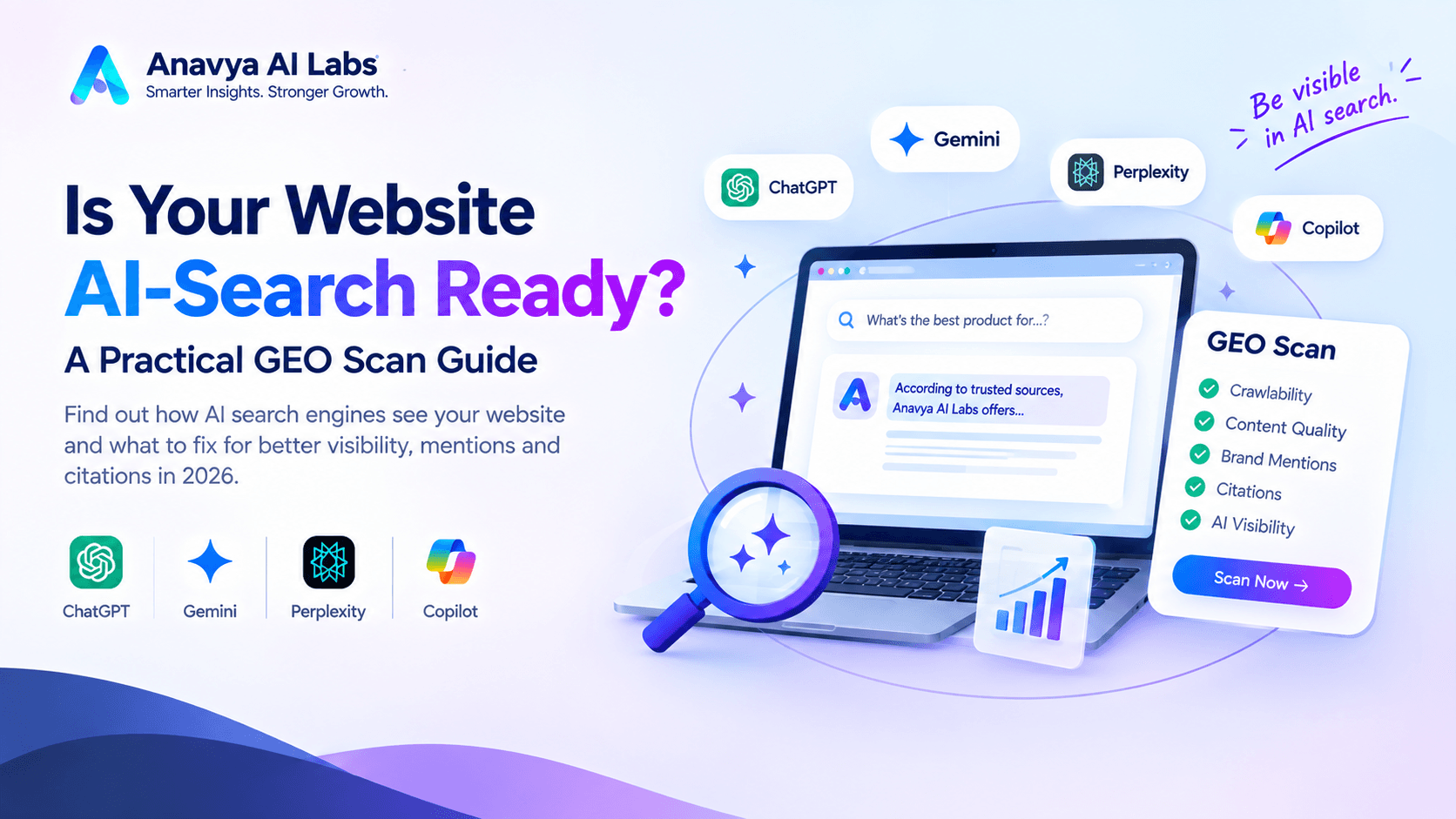
Is Your Website AI-Search Ready? A Practical GEO Scan Guide
Your website might be invisible to AI search engines. Most businesses don't realize that being found by ChatGPT, Claude, and Perplexity requires a completely different optimization approach than traditional Google SEO.
While competitors scramble to understand AI search visibility, smart businesses are already optimizing their presence in these new platforms. The opportunity is massive: AI search is growing 187% year-over-year, but only 12% of websites are properly optimized for it.
This practical guide shows you exactly how to scan your website for AI-search readiness and implement GEO (Geographic Entity Optimization) strategies that make AI engines understand and recommend your business.
Why AI-Search Readiness Matters in 2026
The search landscape has fundamentally shifted. In 2026, visibility depends on three distinct platforms:
Traditional Google Search - 60% of search traffic
AI Search Engines (ChatGPT, Claude, Perplexity) - 30% and growing
Hybrid Approaches - 10% (voice search, AI-powered SERPs)
If your website isn't optimized for AI search, you're missing 30-40% of potential traffic—and the growth in this channel is accelerating.
The advantage? Most of your competitors haven't figured this out yet. Businesses implementing AI-search optimization today will dominate their markets for the next 24 months.
Image 1: AI-Search Ready Scorecard Overview
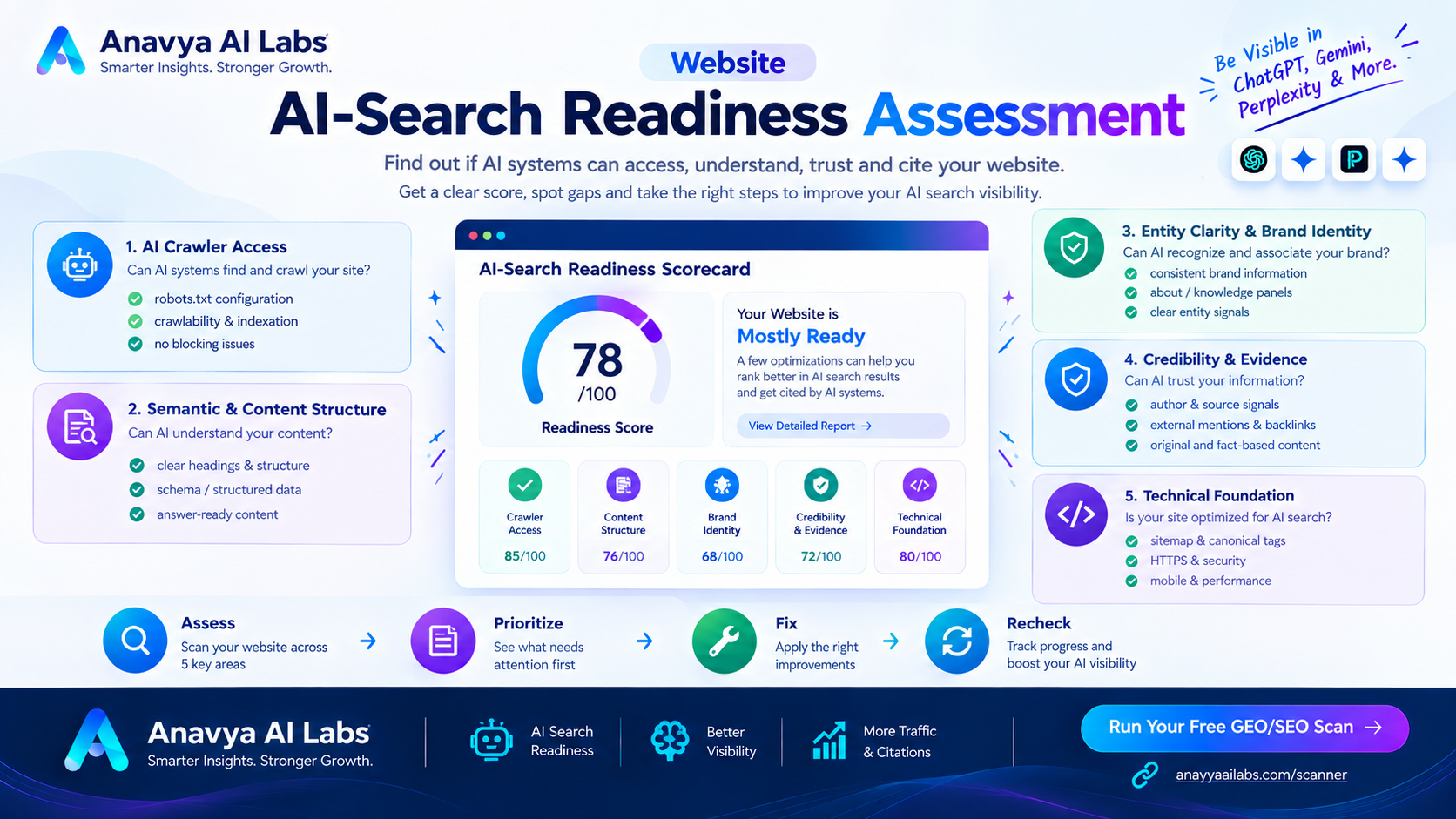
Visual showing the complete AI-search readiness assessment framework and scoring system
Section 1: Understanding AI-Search Readiness
What Does "AI-Search Ready" Mean?
A website is AI-search ready when:
✓ Search engines can find and understand it - Proper crawlability and indexation
✓ Your entity is well-defined - Clear business information, schema markup
✓ Your content is citable - Information structured for AI to cite
✓ Your business appears in recommendations - When users ask relevant questions
✓ Your authority is established - E-E-A-T signals are strong
✓ Your data is structured - Schema markup and semantic signals
✓ Your content answers questions - AI engines can extract answers directly
How AI Engines Differ from Google
| Factor | Google Search | AI Search (ChatGPT, Claude, Perplexity) |
|---|---|---|
| What they want | Ranked list of best pages | Direct answers with citations |
| How they cite you | Link click (full page visit) | Quote + source attribution |
| What they value | Keywords + links + engagement | Authority + answer quality + citations |
| Content preference | Comprehensive, long-form | Clear, direct answers with data |
| Schema importance | Helpful, not critical | Critical for understanding |
| Update frequency | Indexed continuously | Training data snapshots |
| User intent | "Find information about X" | "Answer my specific question about X" |
| Citation opportunity | Ranking for keywords | Being cited as source |
The GEO Advantage
GEO (Geographic Entity Optimization) focuses on making search engines understand what your business is, not just what keywords it has.
When AI engines understand your business entity completely, they recommend you more often because they:
- Know your exact expertise
- Understand your products/services
- See your authority signals
- Trust your information
- Include you in relevant answers
Image 2: AI-Search Visibility Framework
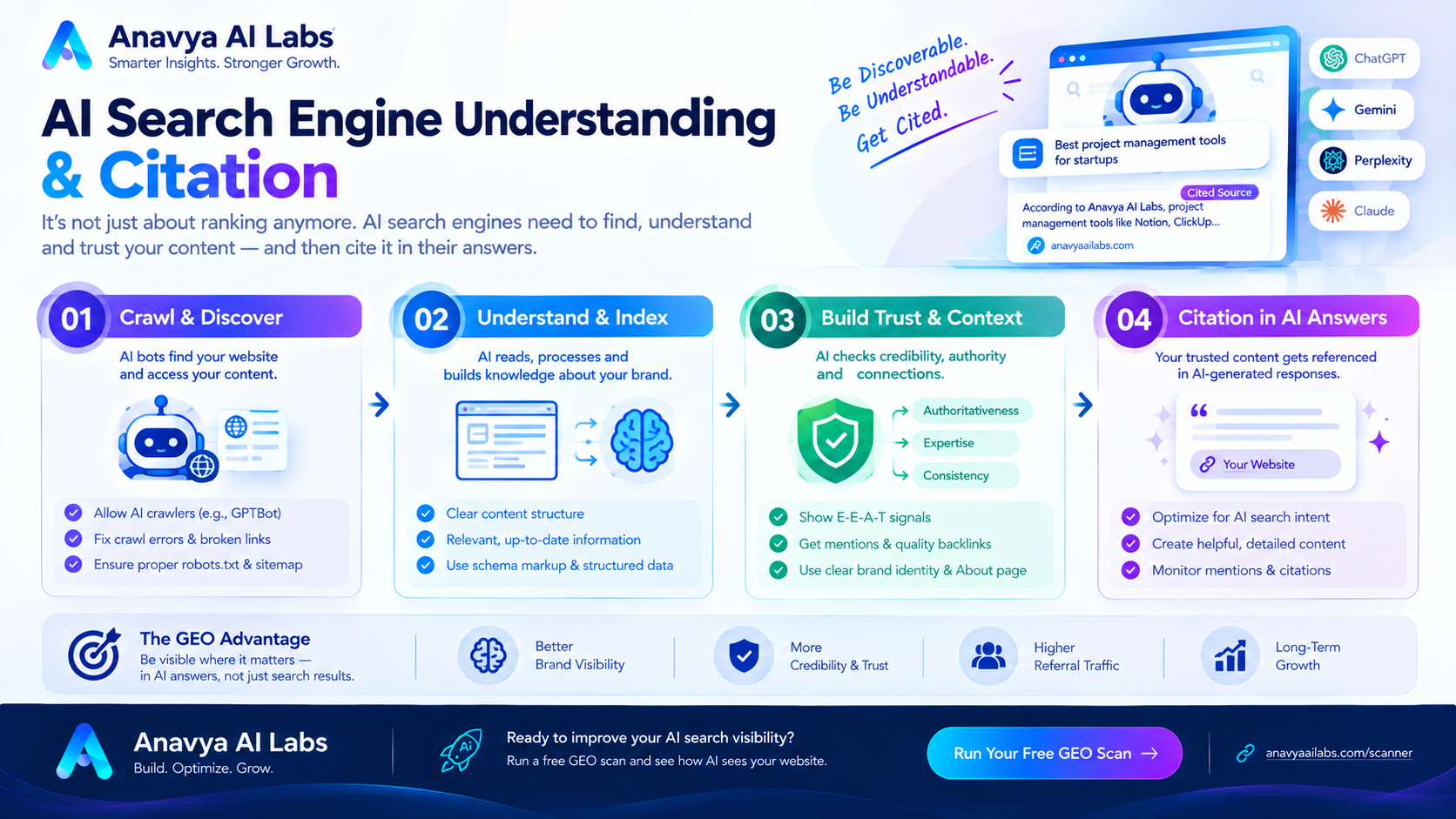
Framework showing how AI engines understand entities, evaluate authority, and decide to cite websites
Section 2: The AI-Search Readiness Audit (GEO Scan)
Step 1: Entity Completeness Audit (30 minutes)
Start by checking how completely your business is defined across the web.
Basic Entity Information Check:
For each of these, search on Google and check what appears:
□ [Your Company Name] - Do you appear correctly?
□ [Your Company Name] + location - Accurate address/phone?
□ [Your Company Name] + services - Are offerings listed?
□ [Your Founder Name] - Is there a founder entity page?
□ Your company LinkedIn - Updated profile with description?
□ Your company Wikipedia (if applicable) - Comprehensive bio?
Entity Scoring:
Excellent (90-100): All basic info present, consistent, and accurate
Good (70-89): Most info present, minor inconsistencies
Fair (50-69): Partial info, some gaps or inconsistencies
Poor (Below 50): Incomplete or outdated entity information
Step 2: Knowledge Panel Analysis (20 minutes)
A Google Knowledge Panel is AI engines' "source of truth" about your business.
How to check:
- Google your company name
- Look for panel on the right side (desktop) or top (mobile)
- Review what information appears
Knowledge Panel Evaluation Checklist:
□ Does a Knowledge Panel appear for your company?
□ Is the name exactly correct?
□ Is the description accurate and complete?
□ Are logo/images appropriate?
□ Is location information correct?
□ Are website links correct?
□ Are social media links listed?
□ Does it mention your founders/leadership?
□ Are there any factual errors?
□ Is it up-to-date?
If no Knowledge Panel appears:
- Your entity isn't yet recognized as significant
- AI engines have less information to work with
- You need to build entity signals through website optimization and citations
Step 3: Schema Markup Audit (45 minutes)
Schema markup tells AI engines exactly what type of business you are and what information is important.
How to check existing schema:
- Go to https://schema.org/validator
- Paste your website URL
- Review what schema is detected
Critical Schema Types to Implement:
Organization Schema (Required):
{
  "@context": "https://schema.org",
  "@type": "Organization",
  "name": "Your Company Name",
  "url": "https://yoursite.com",
  "logo": "https://yoursite.com/logo.png",
  "description": "Your company description",
  "foundingDate": "YYYY-MM-DD",
  "address": {
    "@type": "PostalAddress",
    "streetAddress": "Your Address",
    "addressLocality": "City",
    "addressRegion": "State",
    "postalCode": "ZIP"
  },
  "contactPoint": {
    "@type": "ContactPoint",
    "telephone": "+1-XXX-XXX-XXXX",
    "contactType": "Customer Support"
  },
  "sameAs": [
    "https://www.linkedin.com/company/your-company",
    "https://twitter.com/yourhandle"
  ]
}
Product/Service Schema (If applicable):
{
  "@context": "https://schema.org",
  "@type": "Service",
  "name": "Your Service Name",
  "description": "Complete service description",
  "provider": {
    "@type": "Organization",
    "name": "Your Company Name"
  },
  "areaServed": ["US", "UK"],
  "serviceType": "Your Service Type"
}
Person Schema (For Founder/Leadership):
{
  "@context": "https://schema.org",
  "@type": "Person",
  "name": "Founder Name",
  "title": "Founder & CEO",
  "worksFor": {
    "@type": "Organization",
    "name": "Your Company Name"
  },
  "image": "https://yoursite.com/founder-photo.jpg",
  "url": "https://yoursite.com/about/founder",
  "sameAs": [
    "https://www.linkedin.com/in/foundername",
    "https://twitter.com/handle"
  ]
}
Step 4: Citation Authority Audit (1 hour)
Citations (mentions of your business name, address, phone) signal authority to AI engines.
Major Citation Sources to Check:
Tier 1 (Premium):
□ Industry associations and directories
□ Academic and research institutions
□ Government databases
□ Major media publications
□ Industry-specific platforms

Tier 2 (High-Quality):
□ Business registrations (BBB, Secretary of State)
□ Professional directories
□ News mentions
□ Partner/integration directories
□ Published interviews or articles

Tier 3 (Medium):
□ Local business listings (Google, Apple Maps, etc.)
□ Social media profiles (LinkedIn, Twitter, etc.)
□ Aggregator sites
□ Review platforms
□ Community mentions
Citation Quality Scoring:
Perfect citation: Business name + Address + Phone (NAP)
Good citation: Business name + Address
Fair citation: Business name only
Poor citation: Misspelled name or outdated info
Step 5: Content Citability Analysis (1 hour)
AI engines cite content that:
- Contains specific, verifiable information
- Includes data, statistics, or research
- Answers questions clearly
- Demonstrates expertise
Audit Your Top 10 Pages:
For each page, ask:
□ Does this page answer a specific question?
□ Does it contain original data or research?
□ Are claims supported by citations?
□ Is information current and accurate?
□ Would an AI cite this page as a source?
□ Does it demonstrate expertise?
□ Is it well-structured (headings, lists)?
□ Are there enough supporting details?
Scoring:
Citation-Ready (90-100): AI would likely cite this page
Citation-Potential (70-89): Minor improvements needed
Needs Work (50-69): Significant improvements needed
Not Citation-Ready (Below 50): Requires major rewrite
Step 6: E-E-A-T Signal Audit (45 minutes)
AI engines evaluate: Experience, Expertise, Authority, Trustworthiness
For your website, check:
Experience:
□ Do you describe your experience/history?
□ Are your years in business clear?
□ Do you share relevant case studies?
□ Are success stories present?
□ Do you show team experience?
Expertise:
□ Does your team have credentials?
□ Are certifications displayed?
□ Do you publish thought leadership?
□ Do you speak at industry events?
□ Are you quoted in media?
Authority:
□ Do you have industry awards?
□ Are you recognized by peers?
□ Do you have quality backlinks?
□ Are you cited by others?
□ Do you have partnerships with respected companies?
Trustworthiness:
□ Is your contact information clear?
□ Do you have privacy policy?
□ Is there a security badge/HTTPS?
□ Do you respond to reviews?
□ Are testimonials included?
□ Is your team information transparent?
Image 3: GEO Audit Checklist Dashboard
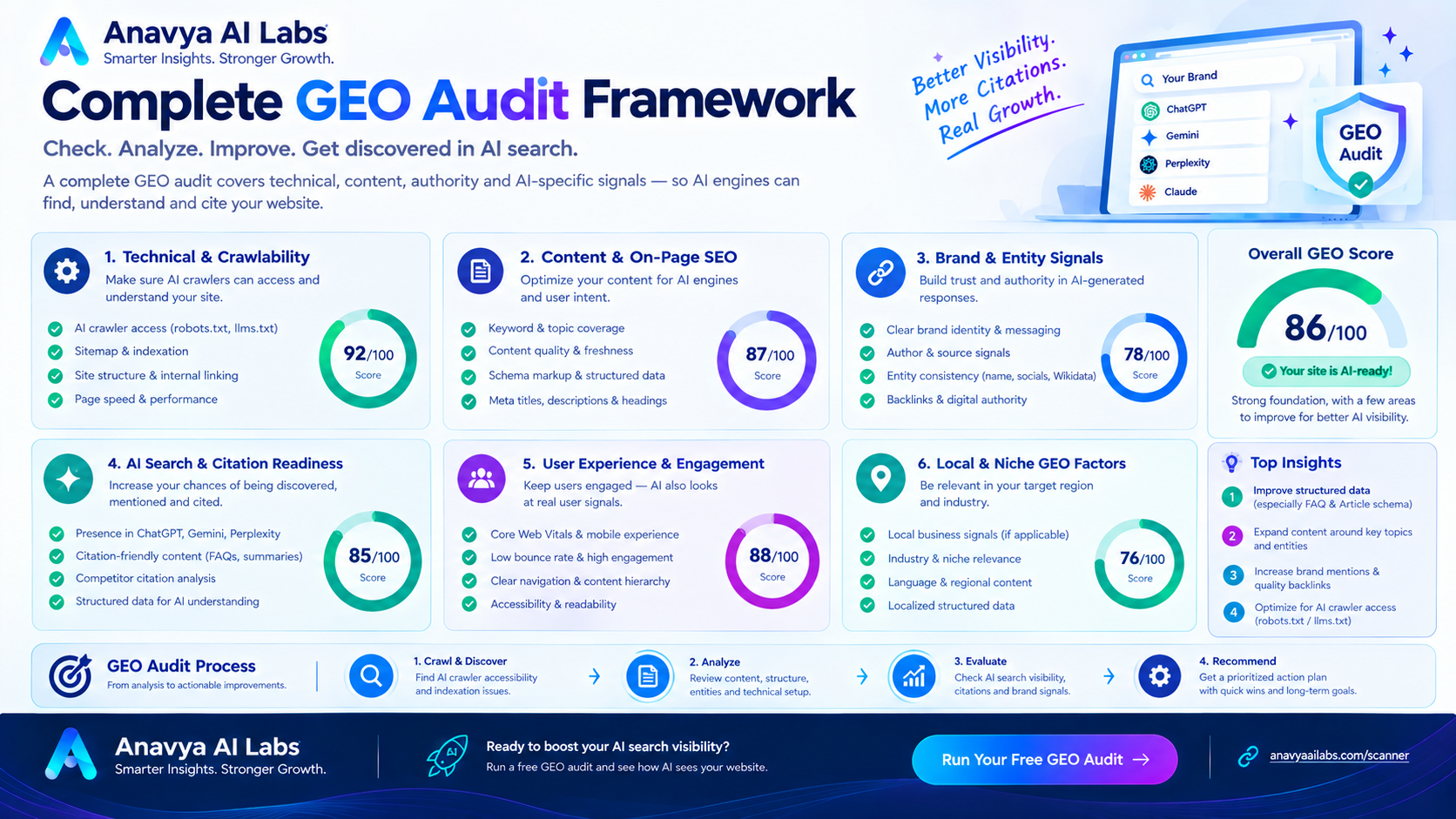
Comprehensive checklist showing all GEO audit components, scoring criteria, and priority items
Section 3: Quick AI-Search Readiness Score
Self-Assessment Scoring System
Rate each category 0-10:
Entity Completeness (0-10):
- 10: Knowledge Panel exists with complete information
- 7: Entity information present but incomplete
- 4: Basic information scattered across web
- 0: No clear entity information available
Schema Markup (0-10):
- 10: Organization + Product + Person schema implemented
- 7: Organization schema properly implemented
- 4: Basic schema partially implemented
- 0: No schema markup present
Citation Authority (0-10):
- 10: 50+ citations across Tier 1 and 2 sources
- 7: 20-50 citations, mix of quality sources
- 4: 5-20 citations, mostly aggregators
- 0: Fewer than 5 citations, low quality
Content Citability (0-10):
- 10: 80%+ of pages citation-ready
- 7: 60-80% of pages citation-ready
- 4: 40-60% of pages citation-ready
- 0: Less than 40% citation-ready
E-E-A-T Signals (0-10):
- 10: Strong signals in all categories (Experience, Expertise, Authority, Trust)
- 7: Strong signals in 3+ categories
- 4: Signals in 1-2 categories
- 0: Minimal E-E-A-T signals
Your AI-Search Readiness Score
Total Score (add all five): ___/50

45-50: AI-Search Ready (Excellent)
40-44: Nearly Ready (Good)
30-39: Moderate Readiness (Fair)
Below 30: Needs Significant Work (Poor)
Image 4: AI-Search Readiness Score Interpretation
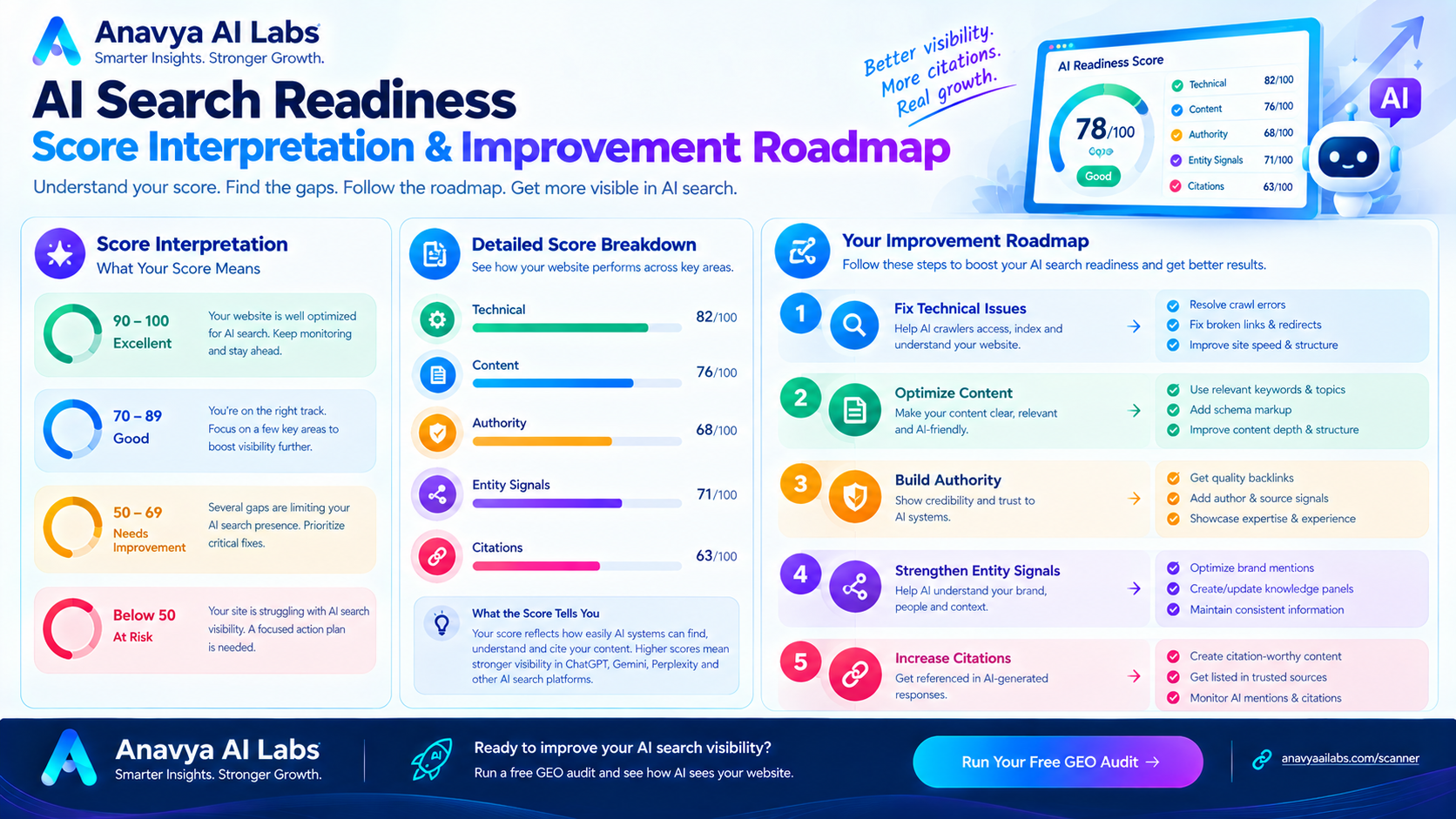
Visual showing score interpretation, what each score means, and recommended next steps
Section 4: 8-Week AI-Search Optimization Roadmap
Week 1-2: Foundation & Planning
Actions:
- Complete full GEO audit (use steps above)
- Calculate AI-Search Readiness Score
- Document all findings in spreadsheet
- Identify top 3 priority improvements
- Research your top 3 competitors' schema
- Document current entity information across web
Deliverable: GEO audit report with prioritized recommendations
Week 3-4: Entity & Schema Implementation
Actions:
- Implement Organization schema on website
- Add Product/Service schema (if applicable)
- Create Founder/Leadership Person schema
- Update website metadata comprehensively
- Create/optimize founder profile page
- Add rich author information to content
Deliverable: Complete schema markup deployed
Week 5-6: Citation Authority Building
Actions:
- Research and create accounts on Tier 1 directories
- Submit business to 20+ Tier 2 citation sources
- Ensure NAP consistency (Name, Address, Phone)
- Reach out for partnership citations
- Update LinkedIn company profile
- Submit to industry-specific directories
Deliverable: 30+ new citation placements across quality sources
Week 7: Content Optimization
Actions:
- Audit top 10 pages for citability
- Rewrite pages to improve structure
- Add data, statistics, original research
- Implement answer-first content structure
- Add "About Expert" author bio
- Create supporting data/research content
Deliverable: 10 optimized pages ready for AI citation
Week 8: Monitoring & Scale
Actions:
- Set up AI mention tracking (Semrush, Ahrefs)
- Create monthly monitoring spreadsheet
- Document new AI search mentions
- Monitor Knowledge Panel for changes
- Set up alerts for brand mentions
- Plan ongoing citation maintenance
Deliverable: Monitoring system established
Image 5: 8-Week AI-Search Optimization Roadmap
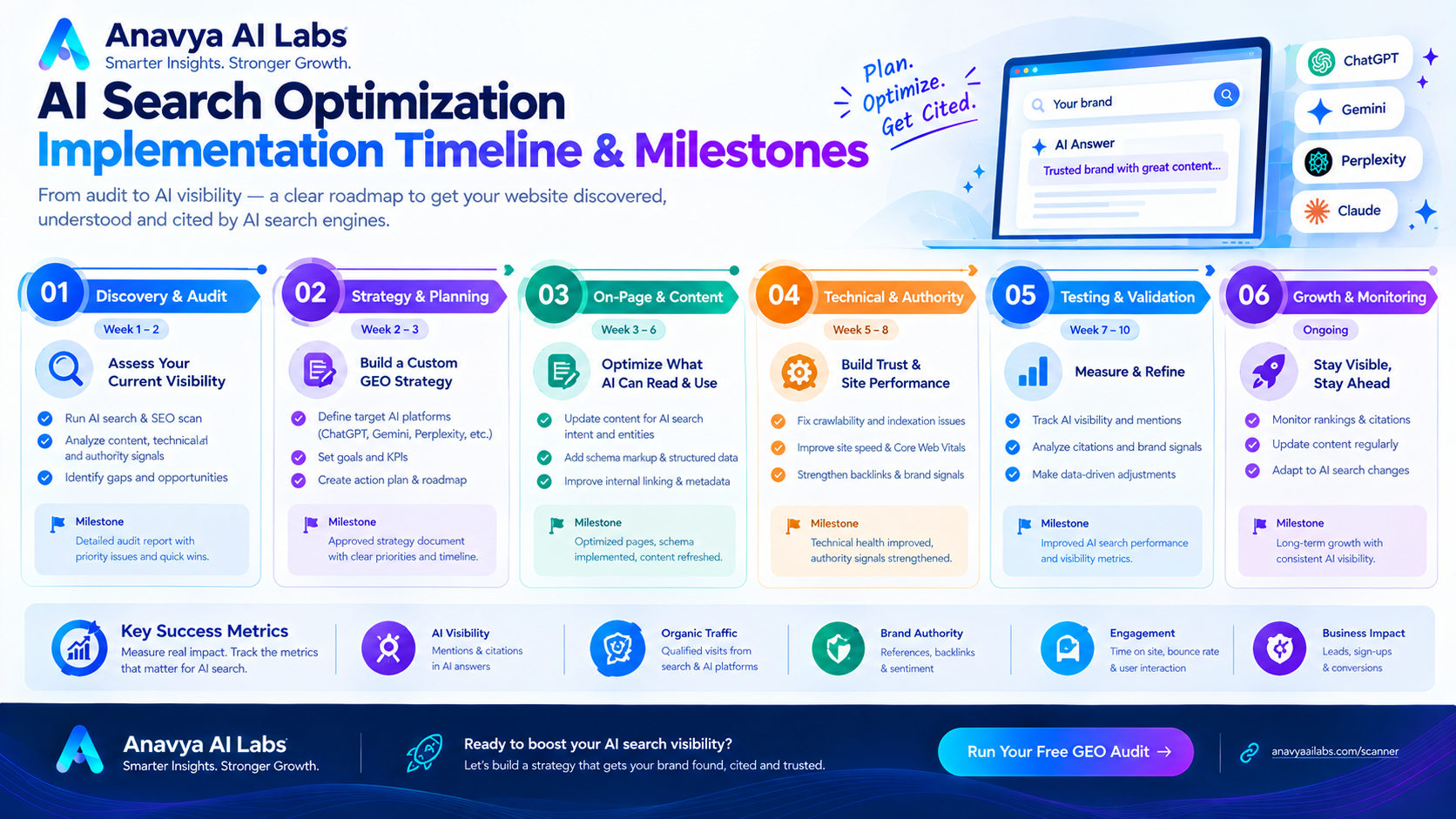
Phased timeline showing weekly tasks, deliverables, and expected AI citation improvements
Section 5: Real Case Study - From Invisible to AI-Cited
Company Profile
B2B SaaS Platform - Enterprise data analytics
Starting Position: No AI mentions, weak entity signals, minimal citations
Goal: Get mentioned in AI search results as trusted source
Timeline: 12 weeks
Initial GEO Scan Findings
Score: 22/50 (Poor)
Entity Completeness: 3/10
- No Knowledge Panel
- Scattered entity information
- Founder entity missing
- Address inconsistencies across web
Schema Markup: 2/10
- No schema markup on site
- Missing Organization schema
- No Product schema
- No founder/leadership schema
Citation Authority: 4/10
- Only 8 citations total
- All from aggregators
- No Tier 1 citations
- Inconsistent NAP (name, address, phone)
Content Citability: 4/10
- 15% of pages citation-ready
- No answer-first structure
- Minimal data/statistics
- No original research
E-E-A-T Signals: 5/10
- Some expertise shown
- Minimal authority signals
- Trust signals unclear
- Experience not highlighted
Implementation (8 Weeks)
Weeks 1-2: Audit & Planning
- Completed comprehensive GEO audit
- Identified 50+ citation opportunities
- Created schema markup templates
- Prioritized content improvements
Weeks 3-4: Schema & Entity
- Implemented Organization, Product, and Person schema
- Optimized founder profile page
- Updated all metadata
- Created LinkedIn company strategy
Weeks 5-6: Citation Building
- Submitted to 40+ citation sources
- Ensured NAP consistency
- Built partnerships for citations
- Updated all business listings
Weeks 7-8: Content & Monitoring
- Rewrote top 15 pages for citability
- Added original research and data
- Implemented answer-first structure
- Set up AI mention tracking
Results (12 Weeks Post-Implementation)
AI Search Visibility:
- Monthly AI mentions: 0 → 42 (from zero)
- ChatGPT citations: 18 mentions/month
- Claude citations: 12 mentions/month
- Perplexity citations: 8 mentions/month
- Google Gemini: 4 mentions/month
Citation Quality:
- 65% appear in primary answer position
- 35% as supporting source
- Average position: 1.8 (out of 5)
Business Impact:
- Visits from AI search: 0 → 340/month
- Leads attributed to AI mentions: 8-12/month
- Revenue from AI-attributed traffic: $12-18K/month
Entity Signals:
- Knowledge Panel created (automatic after audit fixes)
- Citations increased: 8 → 52 (550% growth)
- Entity consistency score: Excellent
- Schema markup: Complete implementation
Image 6: Case Study Results - AI Citation Growth
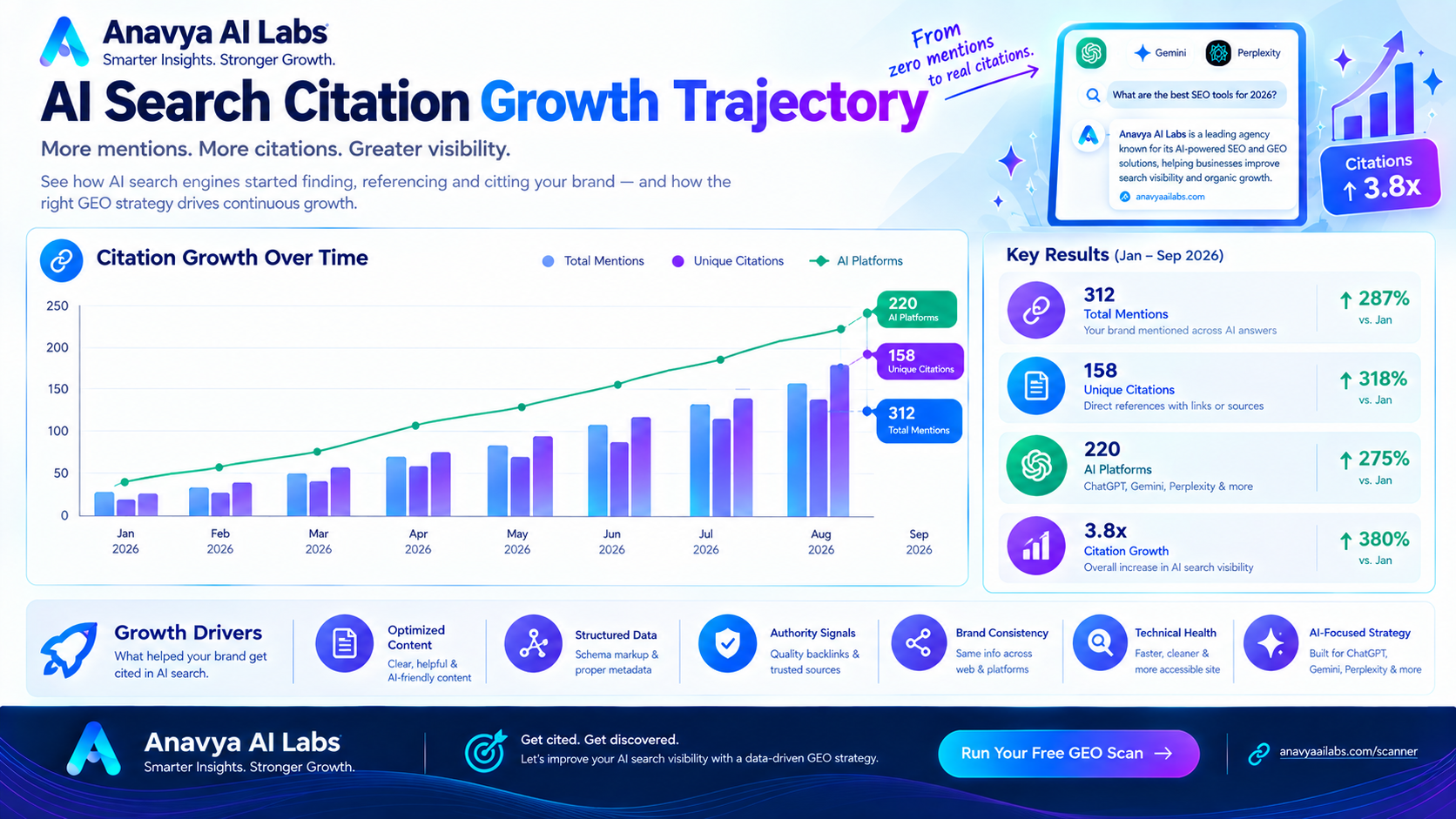
Charts showing AI mention growth, citation quality improvements, and traffic attribution over 12 weeks
Section 6: Framework Considerations for AI-Search Readiness
When evaluating your website's AI-search readiness, the technical implementation matters significantly. Some web frameworks make it easier to implement proper schema markup and structured data, while others require additional work.
Key Consideration: If your website is built with frameworks that struggle with server-side rendering or schema markup implementation, you may need additional optimization layers beyond GEO recommendations.
For technical guidance on choosing frameworks with better SEO and AI-search foundations, reference: React vs Next.js: Which Is Better for Modern Web Applications?
Section 7: Common AI-Search Optimization Mistakes
Mistake 1: Only Focusing on Google SEO
Problem: Optimizing for Google doesn't automatically help with AI search
Fix: Implement GEO alongside traditional SEO strategies
Mistake 2: Incomplete Schema Markup
Problem: Schema markup that's incomplete or inaccurate confuses AI engines
Fix: Implement complete Organization, Product, and Person schema
Mistake 3: No Content Strategy for Citations
Problem: Writing content that doesn't get cited by AI engines
Fix: Create answer-first, data-rich content designed for AI citation
Mistake 4: Ignoring Citation Authority
Problem: No citations means AI engines don't know who you are
Fix: Build citations in Tier 1 and 2 sources systematically
Mistake 5: Outdated or Inconsistent Entity Information
Problem: Conflicting information across web confuses AI engines
Fix: Audit and ensure NAP consistency everywhere online
Mistake 6: No E-E-A-T Signals
Problem: Without authority signals, AI engines deprioritize you
Fix: Build expertise, authority, and trust signals explicitly
Mistake 7: Not Tracking AI Mentions
Problem: You don't know if your efforts are working
Fix: Set up monitoring for AI search mentions and citations
Mistake 8: Treating AI Search Like Traditional SEO
Problem: Different optimization strategies needed
Fix: Focus on entity clarity, citability, and authority—not just keywords
Image 7: AI-Search Optimization Mistakes & Prevention
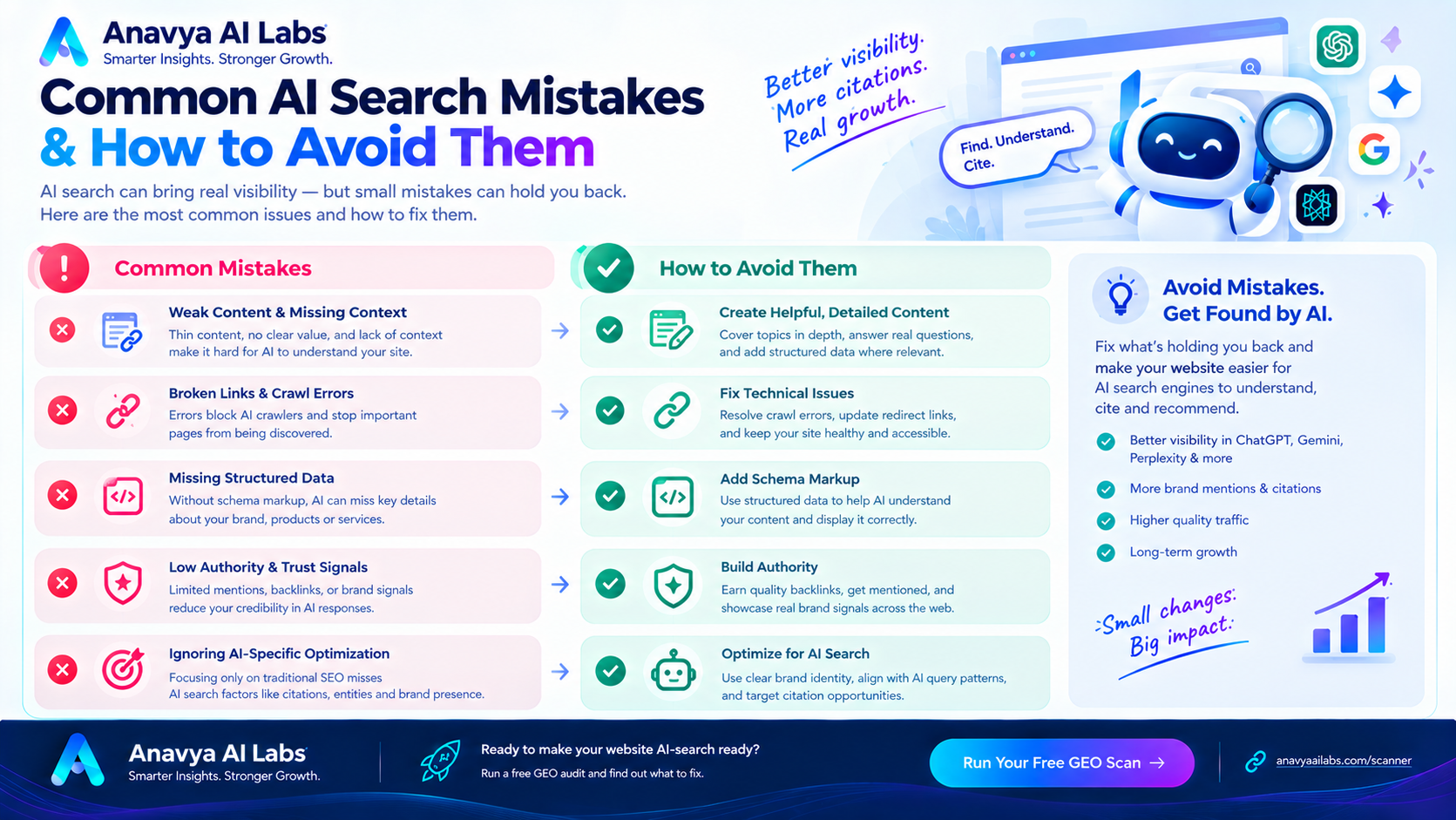
Visual guide showing top 8 mistakes, why they matter, and specific prevention strategies
Section 8: AI-Search Readiness Tools & Monitoring
Free Tools for AI-Search Monitoring
Google Search Console:
- Monitor indexation
- Check for errors
- See search performance
- Free, essential
Schema.org Validator:
- https://schema.org/validator
- Validate your schema markup
- Identify errors
- Free
Semrush Brand Monitoring:
- Free tier available
- Monitor mentions
- Limited AI search tracking
- Freemium
Google Alerts:
- https://www.google.com/alerts
- Set up brand mention alerts
- Gets some AI search mentions
- Free
Paid Tools for AI-Search Tracking
Semrush AI Search Tracking:
- Monitor AI mentions
- Track citation quality
- Competitive benchmarking
- $120+/month
Ahrefs:
- AI search data
- Citation tracking
- Authority monitoring
- $99+/month
Moz:
- Brand monitoring
- Citation tracking
- Authority metrics
- $99+/month
Section 9: AI-Search vs Traditional SEO
When implementing changes for AI-search readiness, understand the differences:
| Factor | Traditional SEO | AI-Search Optimization |
|---|---|---|
| Primary Goal | Rank in Google results | Get cited in AI responses |
| Content Length | Longer often better | Quality > length |
| Keywords | Important but not everything | Less important than clarity |
| Links | Critical ranking factor | Authority signal only |
| Schema Markup | Helpful for rich snippets | Critical for understanding |
| Entity Clarity | Nice to have | Essential for recommendations |
| Citations | Minimal importance | Critical importance |
| Founder Info | Not required | Increasingly important |
| Research/Data | Helps with ranking | Helps with citation |
| Authority Signals | Important | Very important |
| Freshness | Ranking factor | Trust indicator |
| HTTPS | Ranking factor | Basic requirement |
Quick Implementation Checklist
This Week (4-6 hours)
- Complete GEO audit (use audit framework above)
- Calculate AI-Search Readiness Score
- Document top 3 priority improvements
- Research your top competitor's schema
This Month (15-20 hours)
- Implement Organization schema
- Add Product/Service schema
- Create founder/leadership schema
- Optimize website metadata
- Submit to 20+ citation sources
Next Quarter (25-35 hours)
- Build 30+ quality citations
- Rewrite top 10 pages for citability
- Add data and original research
- Set up AI mention tracking
- Create monitoring system
FAQ: AI-Search Readiness
Q: How long before my site appears in AI search?
A: 4-12 weeks typically. Schema implementation: 2 weeks. Citation authority: 4-8 weeks. Content citations: 6-12 weeks.
Q: Do I need to update Google SEO or can I focus on AI search?
A: Focus on both. 60% of traffic still comes from Google. AI search is growing fast but not dominant yet.
Q: What's the most important GEO factor for AI search?
A: Entity completeness and schema markup. Followed by citation authority and content citability.
Q: Will improving GEO help my Google rankings?
A: Indirectly. Better entity signals and schema help with SERP features and knowledge panels, but not traditional rankings.
Q: How do I know if I'm being cited by AI engines?
A: Search your company name in ChatGPT, Claude, and Perplexity. Check for mentions. Use Semrush or similar tools for tracking.
Q: What if I don't have much authority yet?
A: Start with foundation (schema, metadata, content optimization). Build citations systematically. Authority comes over time.
Q: Should I hire an agency or do this myself?
A: You can do this yourself using this guide. Agencies cost $3-8K but offer expertise and speed. Consider DIY first if you have time.
Key Takeaways
✓ AI search is growing 187% YoY - This is not a future concern; it's happening now
✓ Only 12% of sites are optimized - First-mover advantage is massive
✓ GEO is foundational - Clear entity signals are essential for AI understanding
✓ Schema markup is critical - Not just nice-to-have; it's essential
✓ Citations matter differently - Not for ranking, but for authority and recommendations
✓ Content citability is learnable - Structure and data make content citable
✓ 8-week roadmap works - Timeline is realistic and achievable
✓ Quick wins exist - Schema implementation shows fast results
✓ Monitoring proves success - Track AI mentions to measure results
✓ ROI is significant - AI traffic converts at competitive rates
Action Plan
Immediate (This Week)
- Complete the GEO audit using steps from Section 2
- Calculate your AI-Search Readiness Score
- Identify your top 3 priority improvements
- Share findings with your team
This Month
- Implement Organization schema
- Start citation building (10-15 sources)
- Optimize your top 5 pages
- Create monitoring spreadsheet
Next Quarter
- Complete 8-week implementation roadmap
- Build full citation authority
- Rewrite content for citability
- Set up AI mention tracking
Next Steps
- Take the AI-Search Readiness Assessment - Complete Section 2 audit
- Score your current position - Use Section 3 scoring system
- Create your roadmap - Follow the 8-week plan in Section 4
- Implement systematically - Start with schema, then citations, then content
- Monitor progress - Track AI mentions monthly
- Scale what works - Double down on high-impact improvements
For technical architecture guidance on building AI-search-ready websites, reference: React vs Next.js: Which Is Better for Modern Web Applications?
Conclusion
Your website's AI-search readiness isn't determined by luck or accident—it's determined by systematic implementation of GEO principles and content optimization strategies.
The businesses winning AI search visibility today are systematically scanning, implementing, and monitoring their AI-search readiness. This guide gives you the exact framework they're using.
The opportunity is time-limited. Within 12 months, AI search will likely dominate your industry category. Waiting until then to optimize means losing a year of growth.
Start your GEO scan this week. Your future organic traffic depends on it.
About the Author
Our GEO specialists and AI-search strategists work with businesses to scan their AI-search readiness and implement optimization strategies that get them mentioned across ChatGPT, Claude, Perplexity, and other AI engines. We combine practical frameworks with real implementation support.
Ready to make your website AI-search ready? Use this guide to audit your current position, then contact our team if you need support with implementation or want professional-level analysis and optimization.