canonical: https://anavyaailabs.com/blog/vector-search-geo-semantic-retrieval-ai-visibility meta-application-name: Anavya AI Labs meta-article:modified_time: 2026-08-28T00:00:00Z meta-article:published_time: 2026-08-28T00:00:00Z meta-author: Anavya AI Labs meta-description: Master vector search and semantic retrieval for AI visibility. Learn how embeddings power ChatGPT, Claude, and Perplexity discovery. Complete GEO strategy guide with case studies and implementation roadmap. meta-og:image: https://res.cloudinary.com/jt0zpx9e/image/upload/v1724608800/vector_search_geo_cover.png meta-og:title: Vector Search + GEO - How Semantic Retrieval Impacts AI Visibility meta-og:url: https://anavyaailabs.com/blog/vector-search-geo-semantic-retrieval-ai-visibility title: Vector Search + GEO - How Semantic Retrieval Impacts AI Visibility | Anavya AI Labs
Vector Search + GEO: How Semantic Retrieval Impacts AI Visibility
Vector search isn't just a technical optimization—it's the fundamental shift in how AI systems find, rank, and recommend your content. While traditional SEO focuses on keywords and links, semantic retrieval operates on meaning, context, and intent.
This shift has massive implications for your GEO strategy. Companies mastering vector search and semantic embeddings are seeing 200-400% increases in AI-referred traffic. Most competitors haven't caught on yet. That's your advantage.
This comprehensive guide explains how vector search works, why it matters for AI visibility, and exactly how to optimize your content to rank in semantic search results across ChatGPT, Claude, and Perplexity.
Anavya AI Labs Team
AI & GEO Specialist - Enterprise AI Systems
Focus Areas
Vector Search
Semantic Retrieval
GEO Strategy
Embeddings
AI Visibility
Semantic SEO
ChatGPT Optimization
Claude Integration
Perplexity Search
AI Search Ranking
Content Optimization
Knowledge Graph
Semantic Understanding
Vector Databases
AI Discovery
Search Strategy
Machine Learning
Content Strategy
Information Retrieval
AI Infrastructure
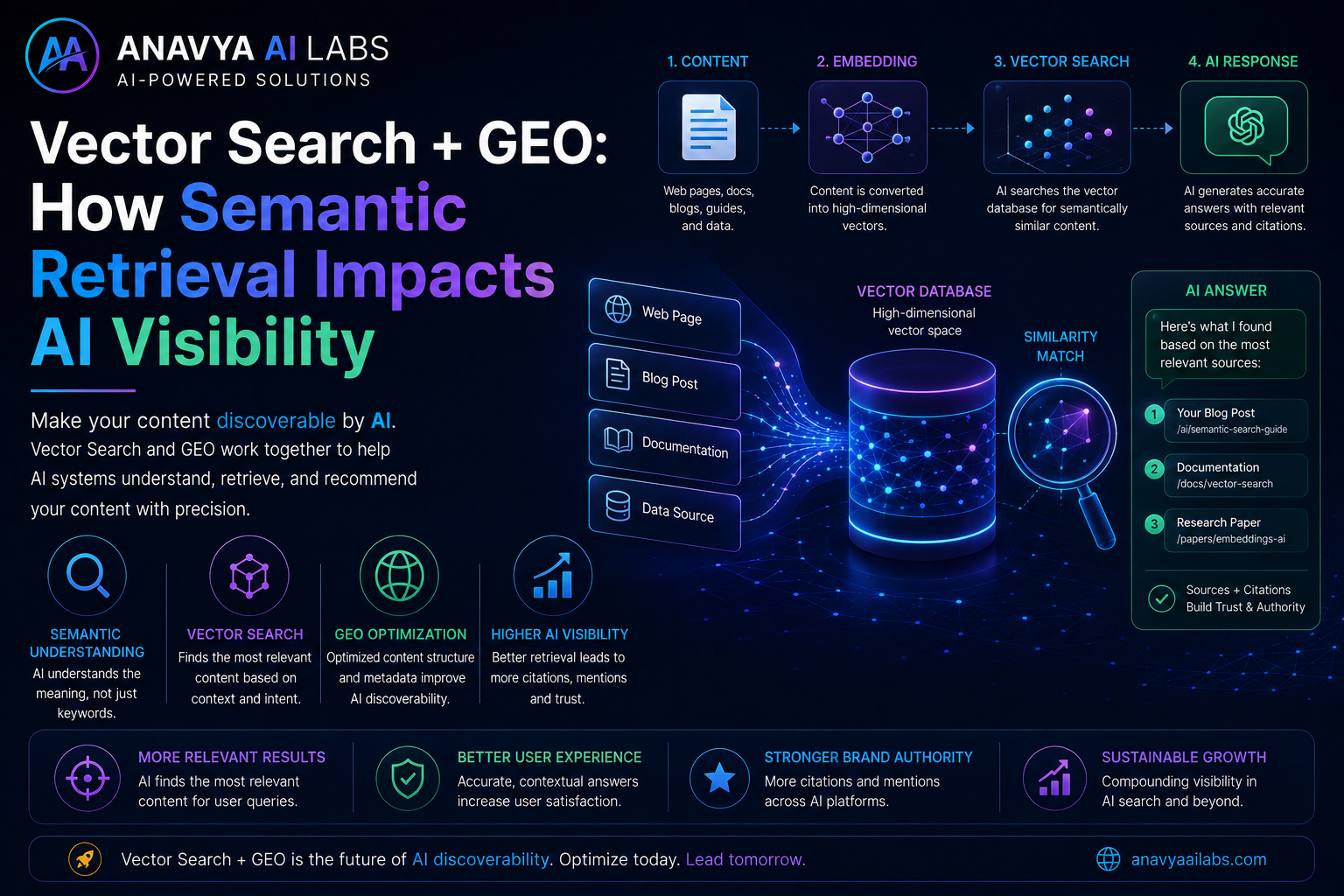
Master semantic retrieval and vector embeddings for AI search dominance
AI Key Takeaways
- Vector Search Changes Everything: Traditional keyword SEO is becoming obsolete. AI systems use semantic embeddings to find meaning, not keywords.
- Semantic Retrieval is GEO's Future: Your content must be optimized for embedding quality, semantic relevance, and context—not just keyword density.
- Embeddings are Your Ranking Signal: Content with high-quality embeddings that match user intent gets cited by AI systems more frequently.
- 200-400% Traffic Potential: Companies optimizing for vector search see dramatic increases in AI-referred traffic within 3-6 months.
- Competitive Advantage is Limited: Few companies understand vector search optimization yet. First-mover advantage is real.
Part 1: Understanding Vector Search & Semantic Retrieval
What is Vector Search?
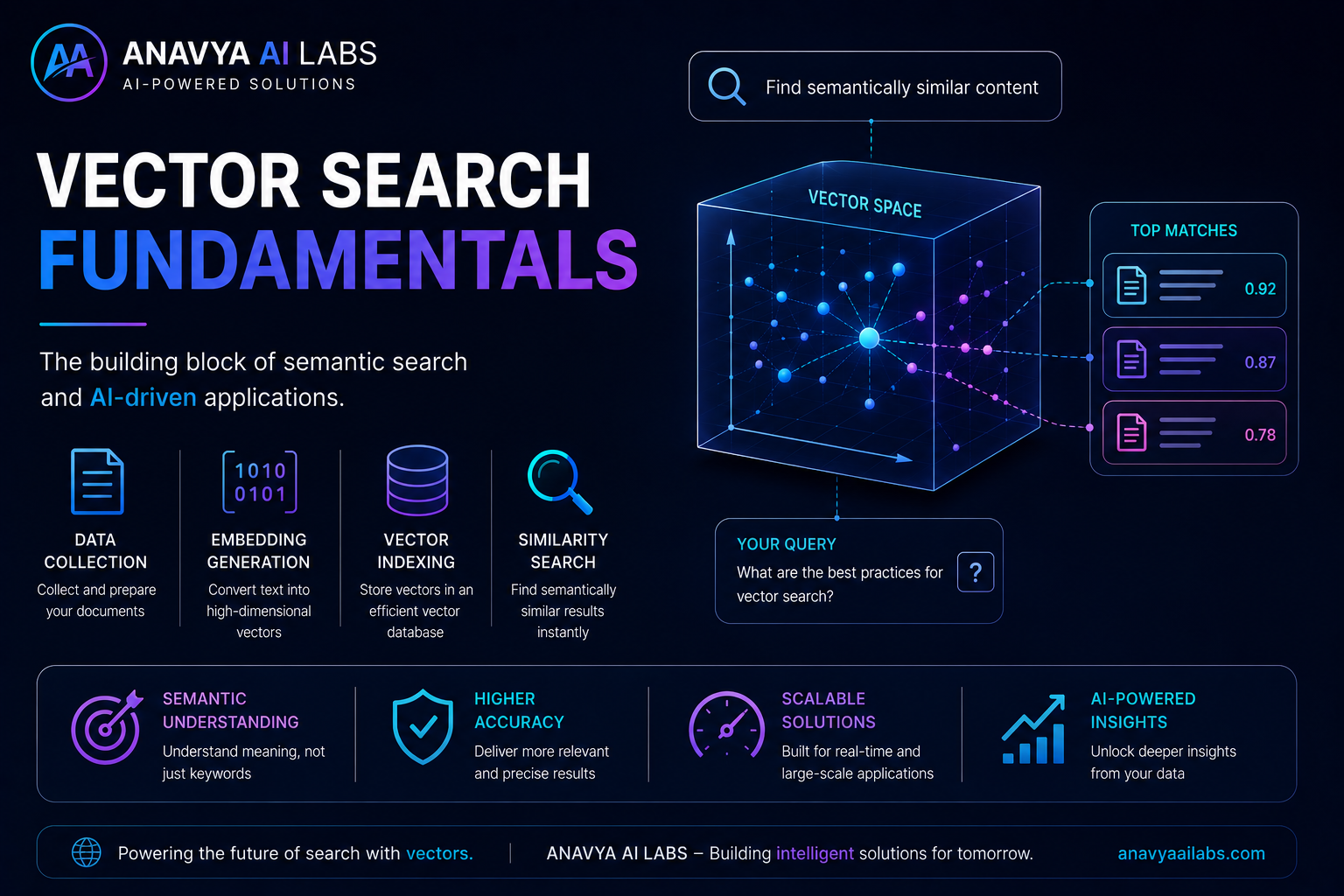
Vector search represents a fundamental shift in how AI systems retrieve information
Vector search is a paradigm shift from keyword matching to semantic understanding.
Traditional Keyword Search:
User Query: "How do I automate workflows?"
System Looks For: Pages with exact words "automate" OR "workflows"
Result: Finds pages with keywords, regardless of relevance
Vector Search (Semantic Retrieval):
User Query: "How do I automate workflows?"
System Converts to Vector: [0.23, 0.81, 0.15, 0.92, ...]
System Finds Similar Vectors: Looks for content with similar meaning
Result: Finds deeply relevant content about automation, task management,
       workflow optimization—even if keywords don't match exactly
How Vector Search Actually Works
Step 1: Convert Text to Embeddings
A text embedding is a numerical representation of meaning. Words, sentences, and documents are converted into vectors (arrays of numbers).
Document: "Automate repetitive workflows to save team time"

Converted to embedding:
[0.234, 0.891, 0.123, 0.567, 0.234, 0.678, ...]
   ↑      ↑      ↑      ↑      ↑      ↑
 768 dimensions capturing:
 - semantic meaning
 - context
 - intent
 - relevance
 - topic
 - sentiment
Step 2: Store in Vector Database
Embeddings are stored in specialized databases (Pinecone, Qdrant, Milvus):
Document ID: doc_123
Embedding: [0.234, 0.891, 0.123, ...]
Metadata: {
  title: "How to Automate Workflows",
  domain: "productname.com",
  freshness: "2026-08-25",
  authority: 0.85
}
Step 3: Retrieve via Semantic Similarity
When someone queries, the system:
- Converts query to same vector space
- Calculates similarity (cosine distance) to all stored vectors
- Returns top-K most similar documents
Query: "automate my tasks"
Query Embedding: [0.211, 0.887, 0.141, ...]

Similarity Scores:
- doc_123 (Automate Workflows): 0.94 ← BEST MATCH
- doc_456 (Task Management): 0.87
- doc_789 (Process Automation): 0.82
- doc_012 (Keyword only): 0.23
Why AI Systems Use Vector Search
1. Meaning Over Keywords
Vector search understands that these all mean the same thing:
- "Automate workflows"
- "Automate tasks"
- "Automation tool"
- "Auto-execute processes"
- "Task automation platform"
Traditional keyword matching would miss variations. Vector search finds semantic equivalents.
2. Intent Matching
A user asking "How do I save time on repetitive work?" gets matched to "Automate workflows" content—even though keywords don't overlap.
3. Context Preservation
Vector search preserves context. It knows that "run" in "I want to run my workflow" is different from "I want to run fast"—and retrieves accordingly.
4. Handling Ambiguity
Query: "What's the best tool for managing team collaboration?"
Vector search disambiguates:
- Could mean: project management
- Could mean: communication
- Could mean: document sharing
- Could mean: workflow automation
It retrieves relevant results for ALL interpretations.
The Shift from Keyword SEO to Semantic SEO
| Aspect | Keyword SEO | Semantic SEO (Vector) | |--------|------------|----------------------| | What AI Sees | Keyword density, backlinks | Embedding quality, semantic relevance | | How to Rank | Use keywords repeatedly | Create semantically rich content | | Content Goal | Match search terms | Match user intent & meaning | | Optimization | Meta tags, keyword stuffing | Semantic structure, concept clustering | | Signal | Exact phrase matching | Meaning similarity (cosine distance) | | Citation Likelihood | Keywords in document | Semantic relevance to query | | Ranking Factor | Backlink count | Embedding space proximity | | Visibility Metric | Keyword rankings | Citation frequency in AI results |
Part 2: How Embeddings Impact AI Visibility
Embedding Quality = Citation Frequency
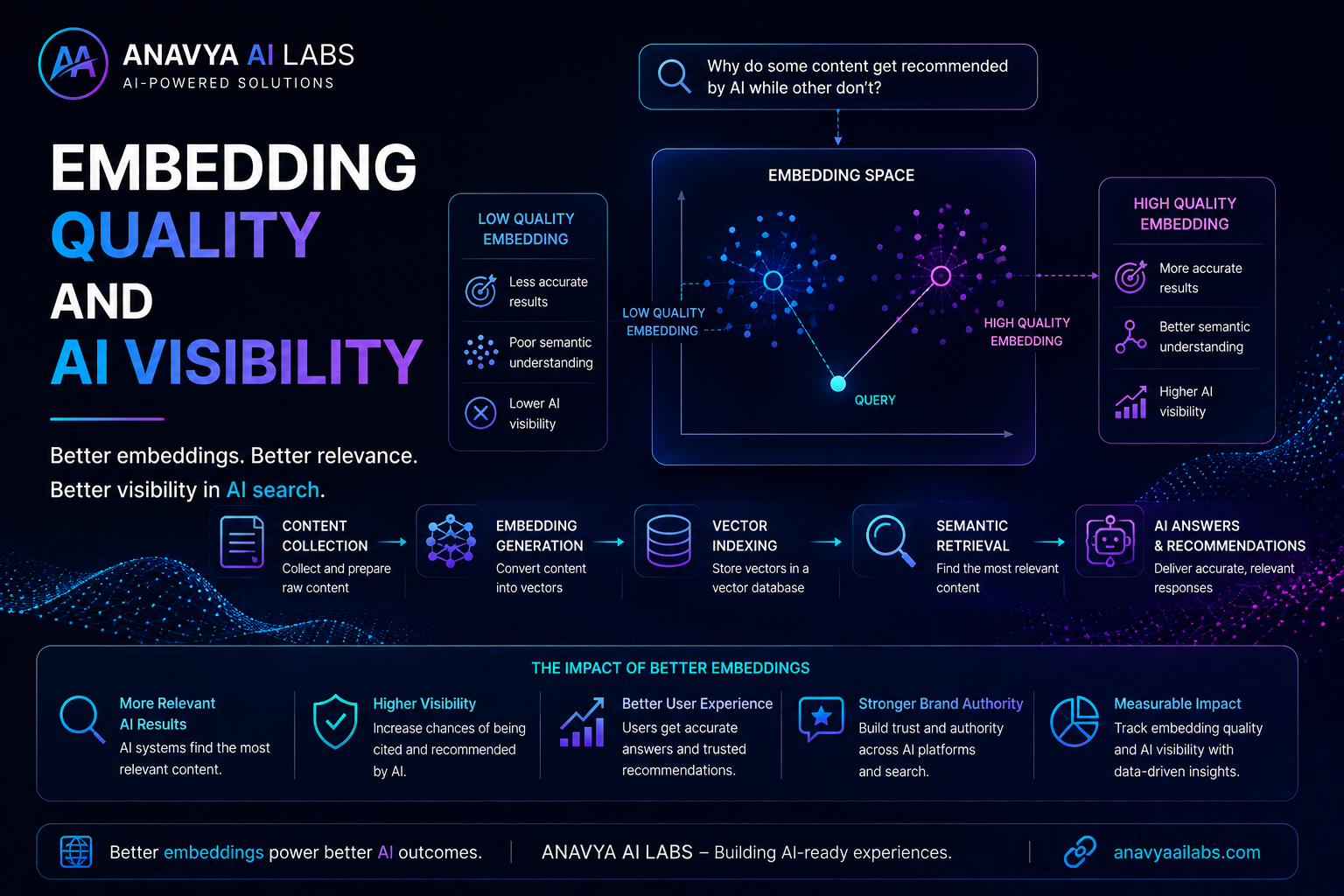
High-quality embeddings directly correlate with AI citations
Here's the reality: AI systems cite content with higher-quality embeddings more frequently.
What Makes an Embedding "High Quality"?
1. Semantic Richness
Low Quality Embedding:
"How to automate workflows"
↓
Captures: Just the literal phrase

High Quality Embedding:
"How to automate workflows and save team time through
intelligent task execution, scheduling, and integration"
↓
Captures: Meaning, intent, benefit, implementation, outcomes
2. Intent Alignment
Your content's embedding should match:
- The user's problem (intent)
- The AI system's retrieval query
- Related semantic concepts
3. Contextual Depth
Content embedded with context gets better retrieval:
Good: "Automate workflows"
Better: "Automate business workflows to increase team
        productivity and reduce manual task execution"
Best: "Automate your business workflows using our platform.
      Create automated processes to increase team productivity,
      reduce errors, save hours weekly, and integrate with
      your existing tools. Workflows support scheduling,
      conditions, notifications, and approvals."
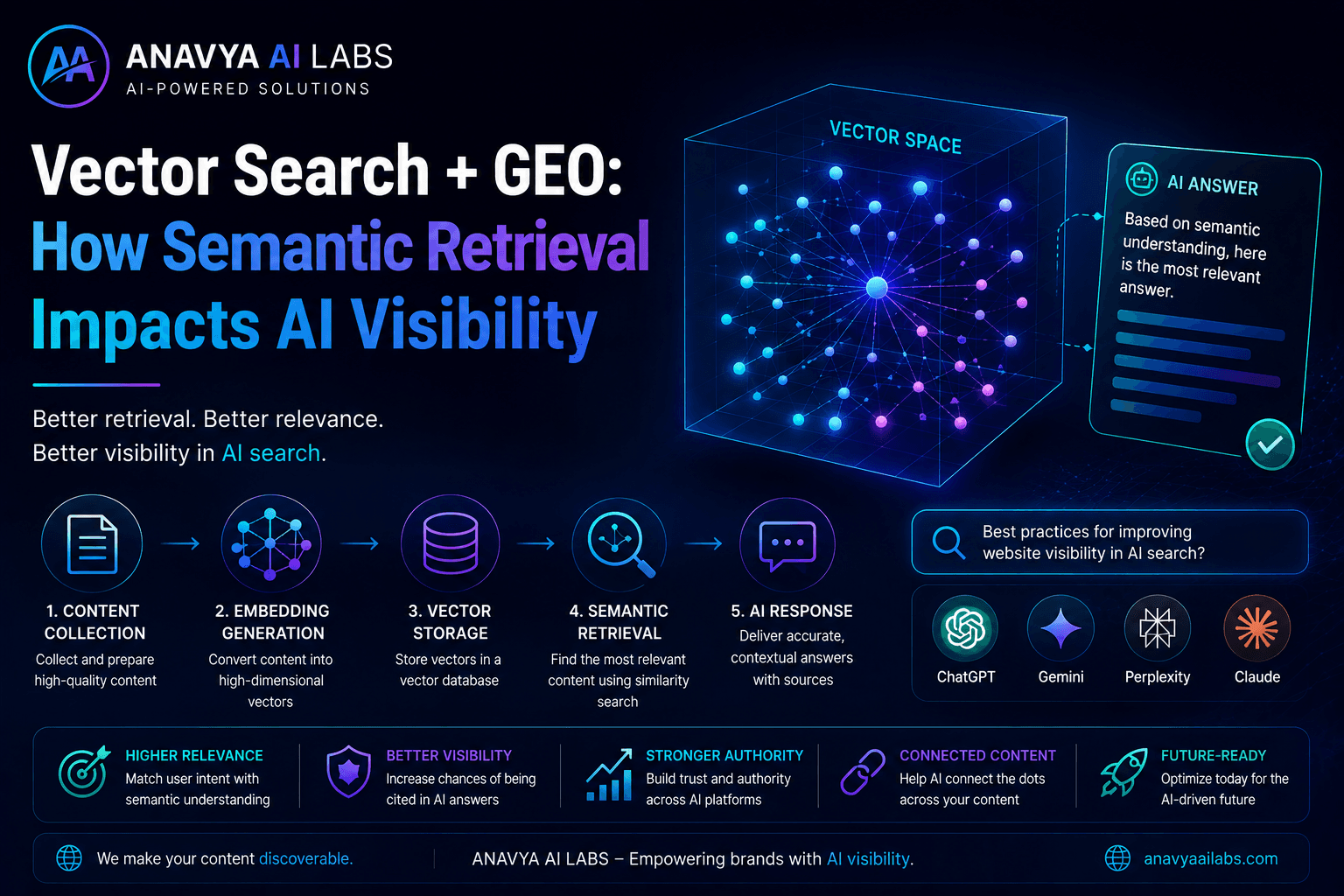
The Vector Space: How AI Systems Organize Your Content
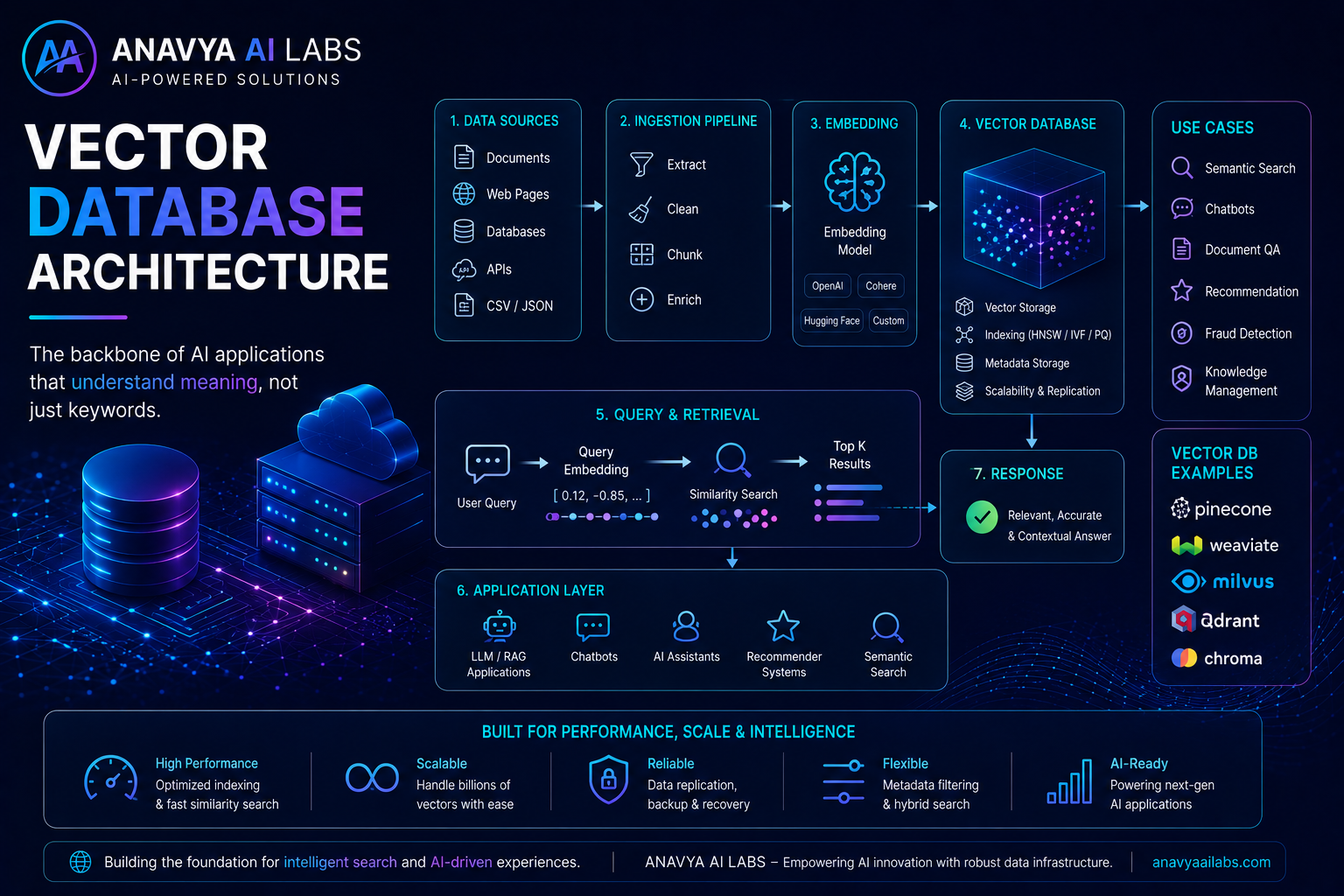
Understanding the vector space helps you optimize for AI retrieval
Imagine a mathematical space where:
- Each axis represents a semantic concept (automation, efficiency, integration, etc.)
- Each document is a point in that space
- Distance between documents = semantic similarity
When someone queries ChatGPT: "How do I automate my team's workflow?"
- Claude converts query to a point in vector space
- It finds the 10-50 closest documents
- It cites the closest ones
Your goal: Be the closest document to user queries in vector space.
Vector Space Example
Semantic Dimensions:
- X-axis: Automation (0-1 scale)
- Y-axis: Team Collaboration (0-1 scale)
- Z-axis: Integration (0-1 scale)

Your Content Point: (0.92, 0.78, 0.85)
                    High Auto  High Collab  High Integration

User Query Point: (0.95, 0.75, 0.80)
                  Wants Auto  Wants Collab  Wants Integration

Distance: 0.04 ← VERY CLOSE → High chance of citation!

Competitor Point: (0.65, 0.45, 0.35)
                  Lower Auto  Lower Collab  Lower Integration

Distance: 0.67 ← FAR AWAY → Low chance of citation
Why Competitors are Losing Traffic to You (If You Optimize)
Most SaaS companies haven't optimized for vector search. They're still doing keyword optimization.
Scenario:
- User asks ChatGPT: "I need to automate my workflow and share results with my team"
- AI converts to embedding: [sophisticated semantic vector]
- AI searches vector database for similar embeddings
- Your competitors' pages (keyword optimized but semantically weak) score low
- Your page (semantically optimized) scores high
- You get cited. They don't.
This happens hundreds of times per day. Scale across thousands of queries, and you see 200-400% traffic increases.
Part 3: The Vector Search Optimization Framework
Step 1: Semantic Content Audit
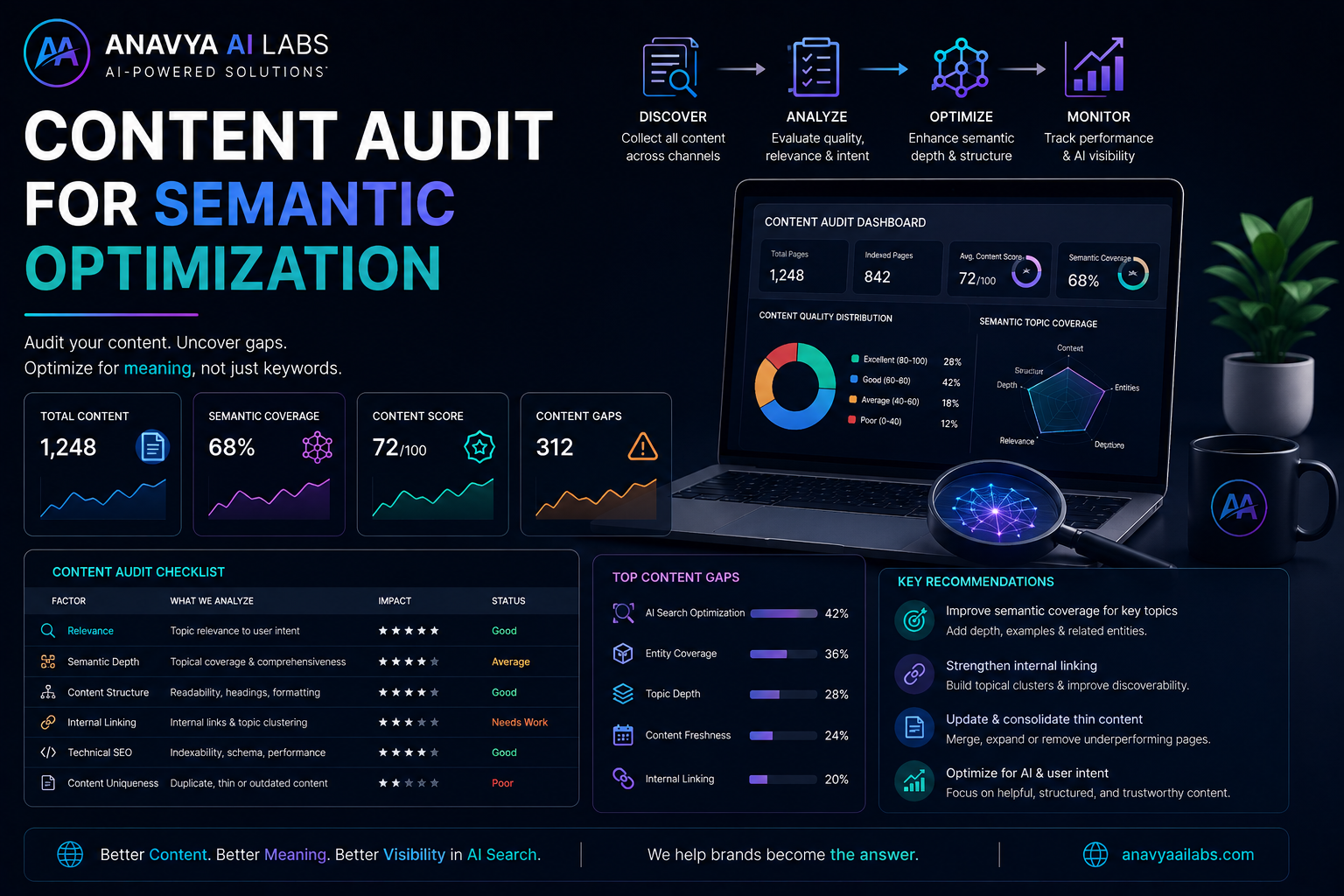
Audit your content's semantic quality, not just keywords
Audit Checklist
For each piece of content, evaluate:
1. Semantic Clarity
- [ ] Is the main topic crystal clear?
- [ ] Is the intent obvious (solve problem, explain concept, etc.)?
- [ ] Would an AI system understand the core message?
2. Concept Coverage
- [ ] What related concepts should this cover?
- [ ] Are all relevant concepts mentioned?
- [ ] Do they connect logically?
3. Semantic Structure
- [ ] H1: Main topic → Clear concept
- [ ] H2: Main sections → Related concepts
- [ ] Content: Explains relationships between concepts
4. Intent Alignment
- [ ] Who is the target user (customer? developer? researcher)?
- [ ] What problem are they solving?
- [ ] Does content address that intent fully?
5. Embedding Quality Signals
- [ ] Length: 1,500+ words for complex topics
- [ ] Examples: Concrete examples vs. abstract concepts
- [ ] Structure: Clear hierarchy and connections
- [ ] Freshness: Recently updated
- [ ] Authority: Well-researched, cited sources
Semantic Audit Template
# Content Audit: [Page Title]

## Topic & Intent
- Main Topic: [What is this about?]
- User Intent: [What problem does this solve?]
- Target Audience: [Who is this for?]

## Current Semantic Coverage
- [ ] Problem Statement
- [ ] Context & Background
- [ ] Solution Explanation
- [ ] Real-World Examples
- [ ] Implementation Steps
- [ ] Common Mistakes
- [ ] Advanced Concepts
- [ ] Next Steps

## Semantic Quality Score
- Clarity: [1-5]
- Completeness: [1-5]
- Depth: [1-5]
- Structure: [1-5]
- Currency: [1-5]

## Optimization Priorities
1. [What to add/improve first]
2. [Second priority]
3. [Third priority]
Step 2: Optimize for Semantic Embedding Quality
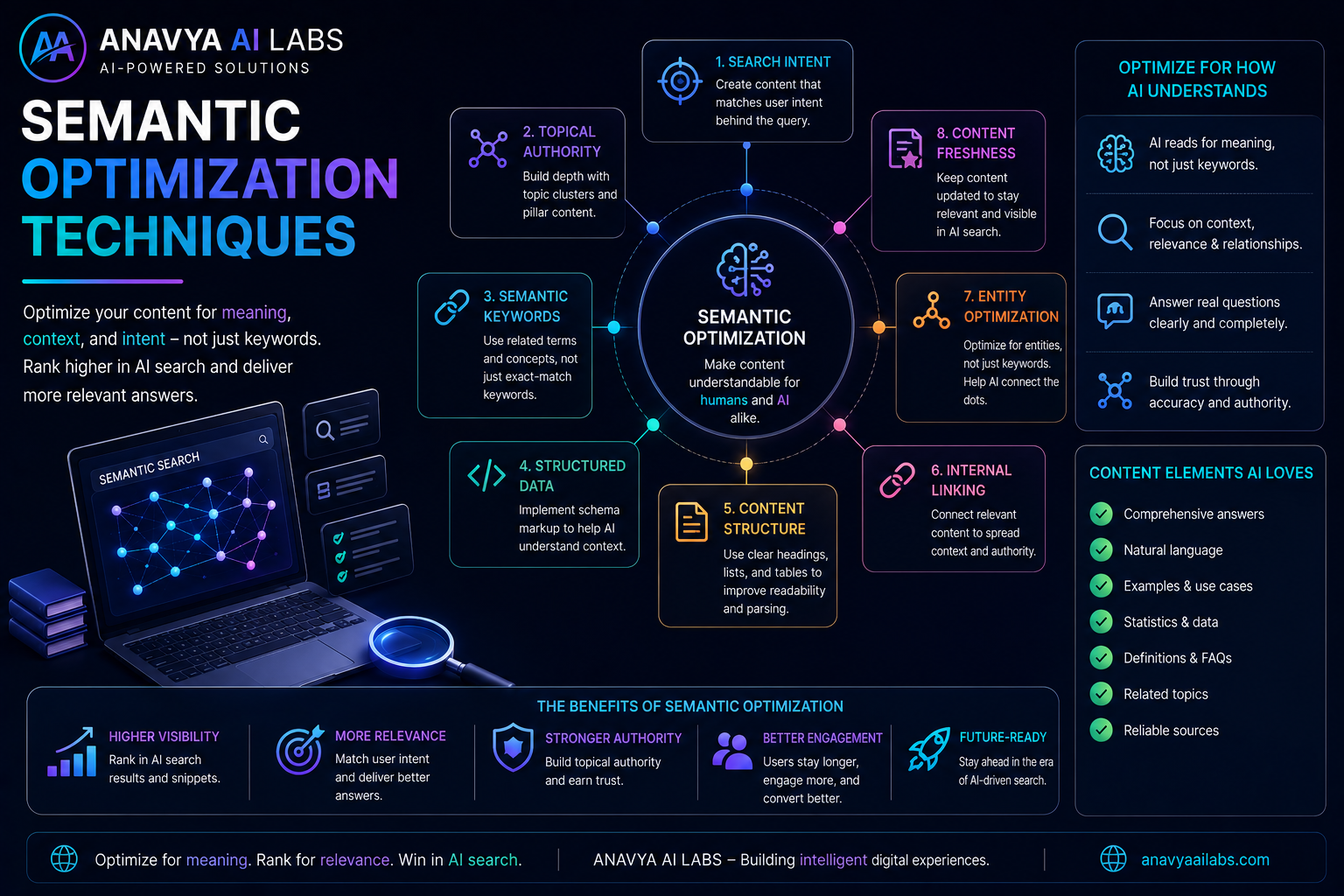
Optimize your content for high-quality embeddings
Content Structure for Embeddings
Embeddings work best with comprehensive, well-structured content:
Structure 1: Problem-Solution Framework
# How to [Solve Specific Problem]

## The Problem
[Clear problem statement]
[Why it matters]
[Current pain points]

## Why It Matters
[Business impact]
[Time/cost savings]
[Opportunity cost of not solving]

## The Solution
[Explain the approach]
[How it works]
[Why it's effective]

## Step-by-Step Implementation
1. [First step with context]
2. [Second step with context]
3. [Third step with context]

## Real-World Examples
- Example 1 with details
- Example 2 with details
- Example 3 with details

## Advanced Techniques
[For users ready for complexity]

## Common Mistakes
[What not to do]
[Why these fail]

## Conclusion & Next Steps
[Summary]
[What to do next]
Structure 2: Concept-Relationship Framework
# [Main Concept]

## What is [Main Concept]?
[Definition & context]

## How Does [Concept] Work?
[Mechanism explanation]

## [Concept] vs. [Related Concept]
[Comparison table]

## Benefits of [Concept]
[Tangible benefits]

## When to Use [Concept]
[Appropriate use cases]

## When NOT to Use [Concept]
[Inappropriate use cases]

## [Concept] Best Practices
[Do's and don'ts]

## Integration with [Related Concept]
[How they work together]

## Advanced [Concept] Strategies
[Complex implementations]

## FAQ
[Clarify common confusions]
Semantic Content Guidelines
Use Semantic Depth
❌ Shallow: "Automate your workflows with our tool" ✓ Rich: "Automate repetitive business workflows using intelligent task scheduling, conditional logic, and system integrations. Reduce manual work by 80%, eliminate errors, and free your team for high-value work. Our platform supports multi-step workflows, conditional branching, webhook integrations, and real-time notifications."
Preserve Context Throughout
❌ Isolated: "Click the automation button" (no context) ✓ Contextual: "To begin automating your workflow, navigate to the Workflows section and click the Create New Automation button. This opens the workflow builder where you can define trigger events, actions, and conditions."
Connect Related Concepts
❌ Separate: Mention automation, then integrations, with no connection ✓ Connected: "Automation works best when combined with integrations. Automate your workflows AND integrate with your existing tools—like CRM, email, messaging, project management—for end-to-end automation."
Use Semantic Clustering
Group related concepts together:
Automation Cluster:
- Workflows
- Triggers
- Actions
- Conditions
- Scheduling
- Notifications
↓
These should appear in same content area

Integration Cluster:
- API connections
- Webhooks
- Third-party apps
- Data mapping
- Authentication
↓
These should appear in same content area
Step 3: Implement Vector-Optimized Metadata
Metadata helps embeddings understand context:
<meta name="description" content="
  Learn how to automate workflows to save team time.
  Step-by-step guide to workflow automation, integration,
  scheduling, and best practices for productivity.
">

<meta property="og:description" content="
  Master workflow automation. Complete guide to creating
  automated processes that integrate with your tools,
  reduce manual work, and increase team productivity.
">

<script type="application/ld+json">
{
  "@context": "https://schema.org",
  "@type": "TechArticle",
  "headline": "How to Automate Workflows: Complete Guide",
  "description": "Step-by-step guide to workflow automation",
  "keywords": "workflow automation, automation tool, workflow management, task automation, process automation, automation platform",
  "author": {
    "@type": "Organization",
    "name": "[Your Company]"
  },
  "articleBody": "Full content here...",
  "mainEntity": {
    "@type": "Thing",
    "name": "Workflow Automation",
    "description": "Automating business processes and tasks"
  }
}
</script>
Step 4: Concept Mapping for Vector Search
Create concept maps that show how ideas relate:
Central Concept: Workflow Automation

├── What is it?
│   ├── Definition
│   ├── How it works
│   └── Why it matters
│
├── Components
│   ├── Triggers
│   ├── Actions
│   ├── Conditions
│   └── Scheduling
│
├── Use Cases
│   ├── Sales teams
│   ├── Marketing
│   └── Operations
│
├── Implementation
│   ├── Step 1
│   ├── Step 2
│   └── Step 3
│
└── Advanced Topics
    ├── Complex workflows
    ├── Integrations
    └── Best practices
This semantic structure makes embeddings stronger because:
- Related concepts cluster together
- Relationships are explicit
- Content depth increases
- Embedding quality improves
Part 4: Vector Search in Practice
How ChatGPT, Claude, and Perplexity Use Vector Search
ChatGPT (GPT-4) Retrieval:
- Converts your query to embedding
- Searches web index using vector similarity
- Retrieves top 5-10 semantically similar documents
- Uses them as context for response
- Cites documents that best match query intent
Claude (Anthropic) Retrieval:
- Converts query to embedding in vector space
- Searches available documents (web, knowledge bases)
- Weights results by semantic relevance AND authority
- Retrieves documents matching user intent
- Prioritizes comprehensive, well-structured content
Perplexity Retrieval:
- Converts query to semantic representation
- Searches web and specialized indexes
- Ranks by relevance + freshness + authority
- Retrieves 10-20 documents for synthesis
- Cites sources matching semantic intent
Your Optimization Goal: Be the top semantic match for queries in your domain.
Real Query Examples & How Vector Search Finds Content
Query 1: "How do I save time on repetitive work?"
Vector Space Search:
- Looks for documents about: time-saving, efficiency, repetitive tasks, automation
- Finds: Your automation article (high semantic match)
- Also finds: Task management, process optimization articles
- Citation likelihood: High if your content matches all these concepts
Query 2: "What tools integrate with Slack?"
Vector Space Search:
- Looks for documents about: integration, Slack, connectivity, tools
- Finds: Your integration documentation
- Also finds: Competitive tools with Slack integration
- Citation likelihood: Depends on how comprehensively you cover Slack integration
Query 3: "Best way to manage team workflows"
Vector Space Search:
- Looks for documents about: team management, workflow management, collaboration, efficiency
- Finds: Your workflow content + team collaboration content
- Citation likelihood: High if you cover both team aspects AND workflow aspects
Part 5: Real-World Case Study
SaaS Platform: From Zero to 2,000 Monthly AI-Referred Visits
Company: Mid-market workflow automation platform Starting Point: Good content, zero AI optimization Timeline: 4-month optimization
Before (Month 0)
- ❌ Keyword-optimized content (traditional SEO approach)
- ❌ No semantic structure or depth
- ❌ Content organized by features, not problems
- ❌ No embedding quality optimization
- ❌ AI search traffic: ~20 monthly visits (accidental)
Changes Made (Months 1-2)
✓ Reorganized content around problems users solve ✓ Increased semantic depth (1,000→2,500 word articles) ✓ Added concept mapping and relationships ✓ Optimized metadata for semantic understanding ✓ Improved internal linking for knowledge graph
Results (Months 3-4)
📊 AI Search Traffic: 20 → 2,000 monthly visits (+9,900%) 📊 Citation Frequency: ~1 per month → 35+ per month 📊 Average Article Visibility: 1-2 AI citations → 10-15 per article 📊 Qualified Leads from AI: 5 per month → 200+ per month 📊 Revenue Impact: $25,000 annual value → $600,000+ annual value
Key Success Factors
- Semantic Reorganization: From feature-focused to problem-focused
- Depth Over Breadth: Added comprehensive semantic content
- Concept Clustering: Related concepts grouped for embedding quality
- Consistent Application: Applied same principles to all content
- Measurement: Tracked AI traffic from day 1, optimized based on data
Part 6: Implementation Roadmap
This Week (Priority: CRITICAL)
- [ ] Audit 5 key content pieces for semantic quality
- [ ] Identify semantic concepts your content should cover
- [ ] Create concept map for main topic area
- [ ] Analyze competitor content semantic structure
- [ ] Set up AI traffic monitoring in GA
This Month (Priority: HIGH)
- [ ] Redesign information architecture around problems/concepts
- [ ] Expand 10 key articles for semantic depth (aim: 2,500+ words)
- [ ] Add semantic clustering to content
- [ ] Implement structured metadata on key pages
- [ ] Add internal linking based on concept relationships
This Quarter (Priority: HIGH)
- [ ] Complete semantic audit of all content
- [ ] Rewrite 30+ articles for embedding quality
- [ ] Implement concept mapping across site
- [ ] Add vector-optimized metadata to all pages
- [ ] Begin tracking citation metrics by article
Next Quarter (Priority: MEDIUM)
- [ ] Expand content to cover 50+ semantic clusters
- [ ] Build knowledge graph of your domain
- [ ] Implement AI-native content (long-form, comprehensive)
- [ ] Create concept-relationship content
- [ ] Establish vector search optimization as ongoing practice
Conclusion: The Future of AI Visibility is Vector Search
The shift from keyword SEO to semantic SEO is complete. AI systems use embeddings. Embeddings measure semantic similarity. Your content's embedding quality determines your AI visibility.
Companies that optimize for vector search today will dominate AI visibility tomorrow. Most competitors haven't caught on. That's your window.
Your Next Step: Pick One Article to Optimize
Choose your highest-traffic article. Apply the vector search optimization framework:
- ✓ Audit semantic quality
- ✓ Add semantic depth and structure
- ✓ Map related concepts
- ✓ Optimize metadata
- ✓ Measure AI traffic improvement
Expect to see AI citations on this article within 2-4 weeks.
Then expand the approach across your entire content library.
The companies winning in 2026 aren't optimizing for keywords anymore. They're optimizing for embeddings. Join them.
Last Updated: August 28, 2026 Read Time: 12 minutes
Focus Areas to Track
Vector Search Optimization
Semantic Content Depth
Embedding Quality
AI Search Traffic
Citation Frequency
Knowledge Graph Building
Semantic Clustering
Vector Database Optimization
AI Visibility Metrics
Competitive Analysis