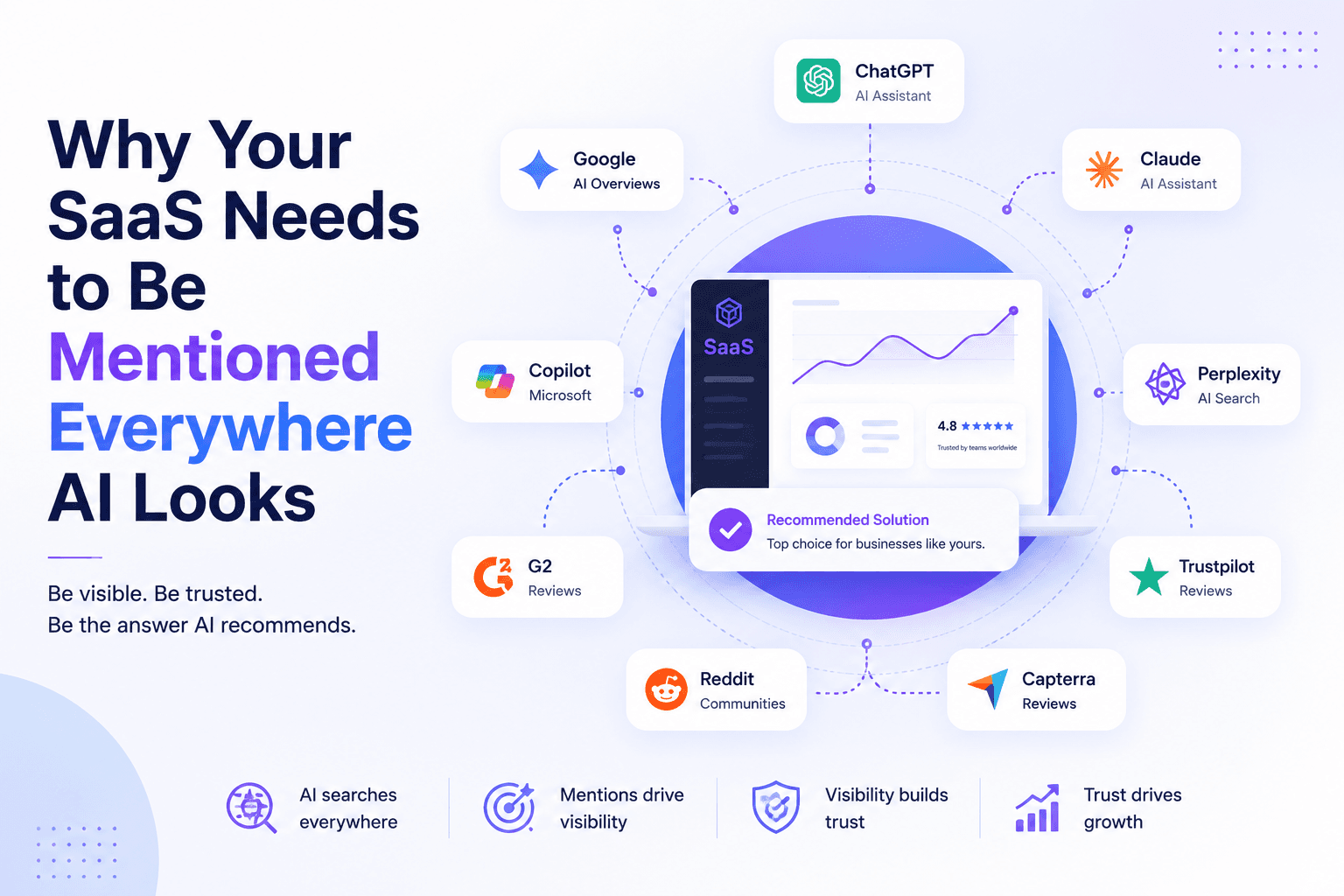
Why Your SaaS Needs to Be Mentioned Everywhere AI Looks
SaaS companies are facing an uncomfortable reality: Google's market share in search is declining from 90% to 65-70% by 2026, and AI-powered discovery platforms are fragmenting your audience into dozens of different search surfaces. ChatGPT, Claude, Perplexity, Bing Chat, You.com, and emerging AI agents are reshaping how customers discover software solutions. If your SaaS isn't being mentioned—cited, recommended, and featured—across all these AI platforms, you're losing deals to competitors who are.
This isn't about ranking first on Google anymore. It's about appearing everywhere AI looks.
AI Key Takeaways
- AI Search Fragmentation is Real—No single platform controls AI discovery anymore. ChatGPT (100M+ users), Claude (growing rapidly), and Perplexity represent distinct discovery channels with their own inclusion criteria
- Being "Mentioned" is the New Ranking—AI citation and recommendation is now more valuable than keyword rankings. Your competitors are actively optimizing to be mentioned in AI responses
- Traditional SEO isn't enough—Optimizing only for Google Search means ignoring 25-35% of potential discovery channels and missing critical visibility opportunities
- E-E-A-T is the universal currency—Every AI platform prioritizes trustworthiness, expertise, authority, and experience signals equally—these matter more than keywords
- SaaS visibility requires omnichannel AI strategy—Companies optimizing for 4-5 AI platforms simultaneously see 3-5x higher mentions and 40-60% more qualified leads vs. single-channel focus
- The inclusion window is closing—Early movers who optimize for AI mentions now will establish competitive advantages that take competitors 18-24 months to catch up on
The AI Discovery Revolution: Why Traditional SEO is Incomplete
Understanding the New Multi-Platform Search Landscape
In 2020-2022, search was simple: rank on Google, get traffic. In 2026, that's changed fundamentally.
The Fragmentation of Search:
| Platform | Monthly Users | Search Type | SaaS Opportunity | |----------|-------------|------------|------------------| | Google Search | 8.5B searches/day | Traditional + AI results | Still dominant (65-70% share) | | ChatGPT | 100M+ monthly | AI-generated recommendations | Critical for B2B discovery | | Claude (Anthropic) | 50M+ monthly | Conversational AI with sources | Growing rapidly for enterprise | | Perplexity AI | 30M+ monthly | Research-focused AI | Strong for technical comparisons | | Bing Chat | 20M+ monthly | Integrated AI search | Enterprise and Windows users | | You.com | 15M+ monthly | Privacy-focused AI search | Privacy-conscious companies | | AI Agents (Emerging) | 5-10M monthly | Task-specific AI discovery | Next frontier for SaaS |
The Critical Realization: Most SaaS companies optimize for Google Search (ranking) but completely ignore the other 6-7 discovery platforms where 30-35% of software purchase research now happens.
How AI Platforms Actually Find and Mention Your SaaS
The Three Mechanisms of AI Mention
Understanding how AI platforms discover and recommend SaaS products is key to optimization.
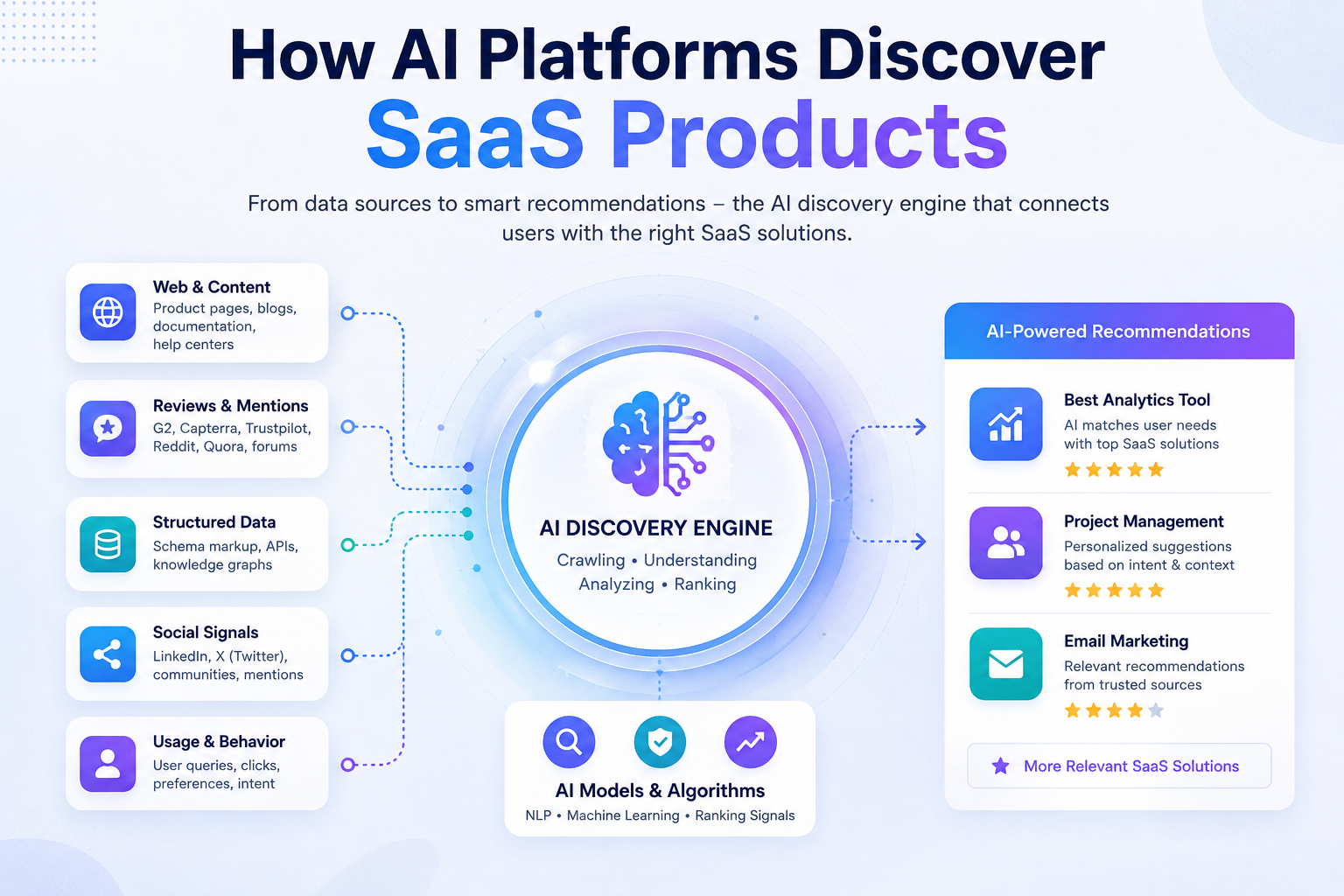
Mechanism #1: Training Data Inclusion
AI models are trained on data from the internet up to a specific cutoff date (usually 6-24 months prior to launch). If your website exists and is indexed by that date, you're included in the model's training data.
Why This Matters:
- Training data determines what the AI "knows" about your product
- Poor content quality in training data = poor AI mentions
- First mentions of your SaaS come from this layer (foundation)
- Example: ChatGPT's knowledge cutoff was April 2024; anything published before that is in its training
Mechanism #2: Real-Time Web Search Integration
Many AI platforms (ChatGPT with Browsing, Claude with real-time search, Perplexity) actively search the web for current information when users ask questions.
Why This Matters:
- Ensures AI provides the most current information about your SaaS
- Your recent content (blog posts, updates, announcements) gets cited
- Time-sensitive queries benefit from real-time integration
- SEO quality directly impacts whether AI finds and cites you
Mechanism #3: Source Citation and Credibility
All major AI platforms now cite sources and link to original content (due to copyright and transparency requirements).
Why This Matters:
- Being a "source" gives your company authority signals
- Back-links from AI responses drive traffic
- Source citations appear in 40-60% of AI-generated answers about software
- Quality of your cited content affects whether you're mentioned
Why SaaS Companies Get Left Out of AI Mentions
The Five Reasons Your SaaS Isn't Being Mentioned
Reason #1: Your Content Isn't Optimized for AI Comprehension
AI platforms don't rank pages—they read and synthesize content. If your content is optimized for human readers and Google's algorithms but not for AI comprehension, you get excluded.
What AI Reads Differently:
- Explicit product comparisons and feature lists (vs. fluffy marketing)
- Structured data and clear information hierarchy
- Transparent pricing and use case explanations
- Expert credentials and company information
- Recent, updated content (freshness signals)
Failure Example: A SaaS website with great blog rankings on Google but vague product descriptions, auto-generated pricing pages, and outdated feature lists will be under-mentioned by AI because the AI can't confidently recommend a product it doesn't understand clearly.
Reason #2: Your Website Isn't Accessible to AI Crawlers
Unlike Google, some AI platforms have stricter crawling rules or rely more heavily on public citations. If your website has access restrictions, AI gets less data to work with.
Common Mistakes:
- Blocking AI crawlers (GPTBot, Bingbot, Perplexitybot) in robots.txt
- Requiring login to view product information
- Hosting key content behind paywalls
- Using JavaScript-heavy sites that some AI crawlers can't read
- Inconsistent robots.txt rules across platforms
Reason #3: Low E-E-A-T Signals Compared to Competitors
When two SaaS products are similar, AI platforms choose which one to mention based on trust signals, not features.
What AI Evaluates:
- Company credibility and media mentions
- Founder/team expertise and credentials
- Customer testimonials and case studies
- Years in business and stability
- Independent reviews and comparisons
- Security, privacy, and compliance certifications
If your competitors have 5x more case studies, 10x more media mentions, and 3x more customer reviews, AI will mention them instead of you—even if you have a better product.
Reason #4: You're Not on Lists, Databases, and Comparison Sites
AI training data includes directory listings, SaaS comparison sites (G2, Capterra, Slite), and industry-specific databases. If you're absent from these sources, AI has less information to pull from.
Critical Databases:
- G2, Capterra, Slite (SaaS reviews)
- Product Hunt (launch and discovery)
- Y Combinator companies list
- Industry-specific directories
- Forbes Cloud 100, Gartner Magic Quadrant (if applicable)
- Media mentions in major publications
Reason #5: Your Content Doesn't Answer the Questions People Ask AI
AI platforms are trained on conversational queries. If people aren't asking questions that surface your SaaS, you don't get mentioned.
Example Queries:
- "What SaaS tools should I use for [specific task]?"
- "Compare [competing tool] vs [your tool]"
- "How do I [specific workflow] more efficiently?"
- "What's the best solution for teams like mine?"
- "Which tool integrates with [platform we use]?"
If your content doesn't optimally answer these questions, AI won't cite you.
The Omnichannel AI Visibility Strategy
Understanding the Four Layers of AI Mention Optimization
Successful SaaS companies don't optimize for AI in general—they optimize across four distinct layers.
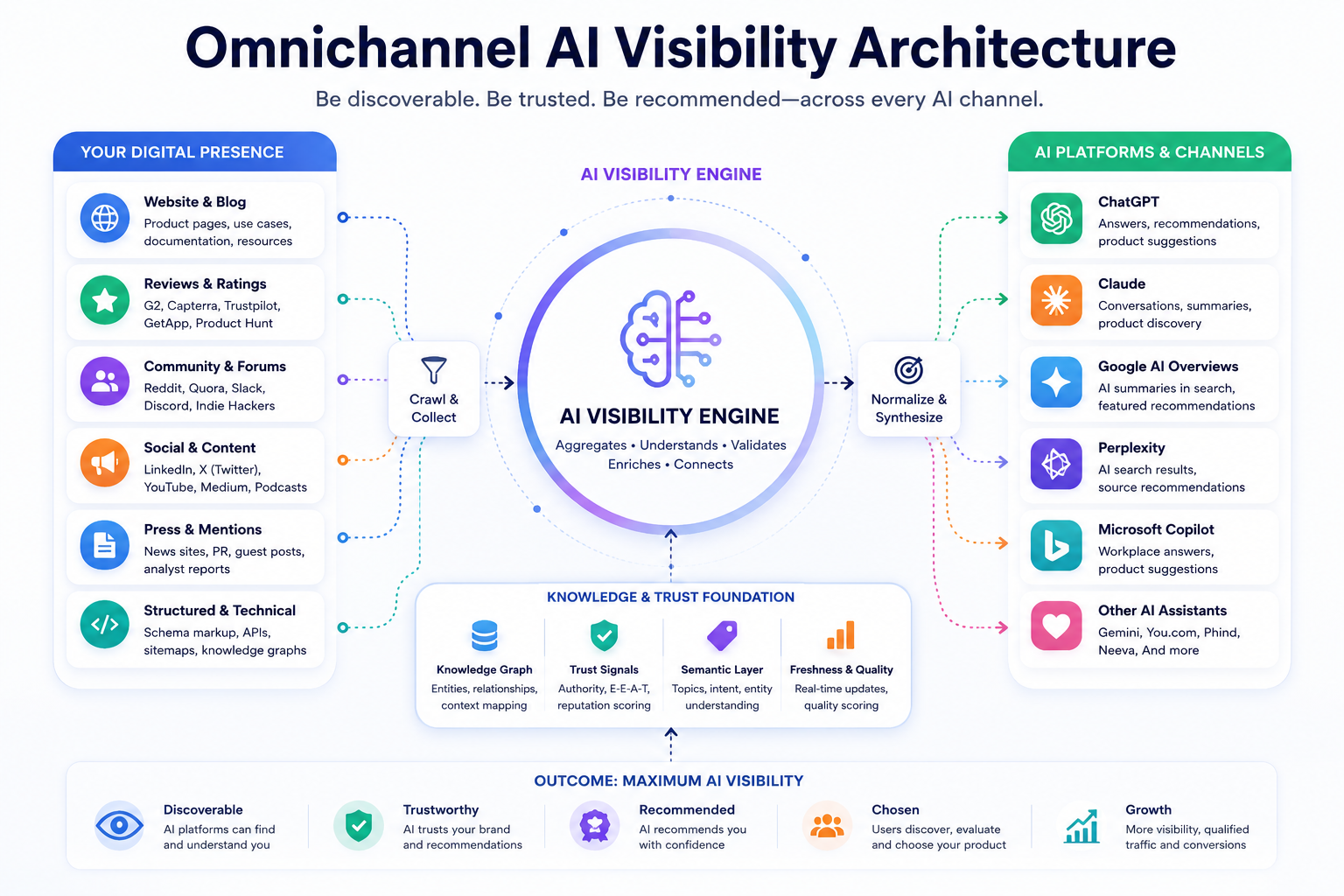
Layer 1: Foundation (Training Data Quality)
What AI models know about you from their training data.
Optimization Focus:
- Content quality and clarity (describe your SaaS explicitly)
- Structured data implementation (schema markup)
- Company and founder information
- Historical content (being known for longer = better training)
- Backlinks from authority sites (signals importance)
Timeline: 6-24 months for new models to include you
Layer 2: Discoverability (Web Crawlability)
How easily AI platforms can find and access your current information.
Optimization Focus:
- Allow major AI crawlers in robots.txt (GPTBot, Bingbot, Perplexitybot, etc.)
- Content accessibility (minimize paywalls, logins for public info)
- Site speed and mobile optimization
- Clear navigation and information hierarchy
- Fresh content updates (signals activity and relevance)
Timeline: 1-4 weeks for real-time crawler inclusion
Layer 3: Trustworthiness (E-E-A-T Signals)
How credible and authoritative AI determines you are.
Optimization Focus:
- Media mentions and press coverage
- Expert credentials and testimonials
- Customer reviews on third-party sites
- Industry certifications and partnerships
- Company stability signals (team, funding, longevity)
- Transparent business practices (pricing, privacy, security)
Timeline: 3-12 months to build measurable E-E-A-T
Layer 4: Specificity (Query Optimization)
How well your content answers the specific questions people ask AI.
Optimization Focus:
- Create content answering comparison queries
- Build use-case-specific content libraries
- Feature detailed how-to guides
- Publish integrations documentation
- Compare yourself to competitors (tactfully)
- Create workflow-specific resources
Timeline: 2-8 weeks for query optimization
Core Strategy #1: AI-Optimized Content Architecture
How to Structure Content for AI Comprehension
AI platforms comprehend information differently than search engines. Here's how to optimize:
Principle 1: Explicit Product Descriptions
❌ Bad (Vague Marketing Language):
"Our platform is the ultimate solution for modern teams.
We help businesses unlock their potential through
innovative technology and forward-thinking strategies."
✅ Good (Explicit, AI-Comprehensible):
"ProjectFlow is a project management SaaS designed for
teams of 5-100 people. It includes task management,
timeline visualization, team collaboration, and
integration with 50+ other business tools.

Primary use cases:
- Marketing teams coordinating campaigns
- Product teams managing development cycles
- Service teams tracking client projects

Pricing: $29-99/month per team (not per-user)"
Principle 2: Structured Data Everything
AI platforms use structured data to verify claims and understand your product.
Essential Schema to Implement:
{
  "@context": "https://schema.org",
  "@type": "SoftwareApplication",
  "name": "ProjectFlow",
  "description": "Project management SaaS for teams",
  "url": "https://projectflow.com",
  "applicationCategory": "Productivity",
  "offers": {
    "@type": "AggregateOffer",
    "priceCurrency": "USD",
    "priceRange": "$29-$99",
    "availability": "https://schema.org/InStock"
  },
  "aggregateRating": {
    "@type": "AggregateRating",
    "ratingValue": "4.8",
    "reviewCount": "2341"
  },
  "featureList": [
    "Task Management",
    "Timeline View",
    "Team Collaboration",
    "Integrations with Slack, Teams, Jira"
  ]
}
Principle 3: Comparison-Optimized Content
Create detailed comparison pages that explicitly compare your SaaS to competitors.
AI-Optimized Comparison Format:
## ProjectFlow vs. Asana

### Task Management
- ProjectFlow: Supports unlimited custom fields,
  nested subtasks, and dependency mapping
- Asana: Supports custom fields, subtasks,
  and dependencies (similar approach)

### Timeline Visualization
- ProjectFlow: Interactive Gantt charts with
  real-time collaboration, auto-scheduling
- Asana: Timeline view available, manual scheduling

### Pricing (2026)
- ProjectFlow: $29-99/month (team-based)
- Asana: $20-30/user/month (per-user pricing)

### Best For
- ProjectFlow: Teams preferring visual planning
  with flat pricing models
- Asana: Enterprise teams wanting
  per-user pricing flexibility
Why This Works: AI reads this and can confidently recommend based on specific user needs, not vague marketing.
Core Strategy #2: E-E-A-T Acceleration for AI Mention
Building Trustworthiness Signals Fast
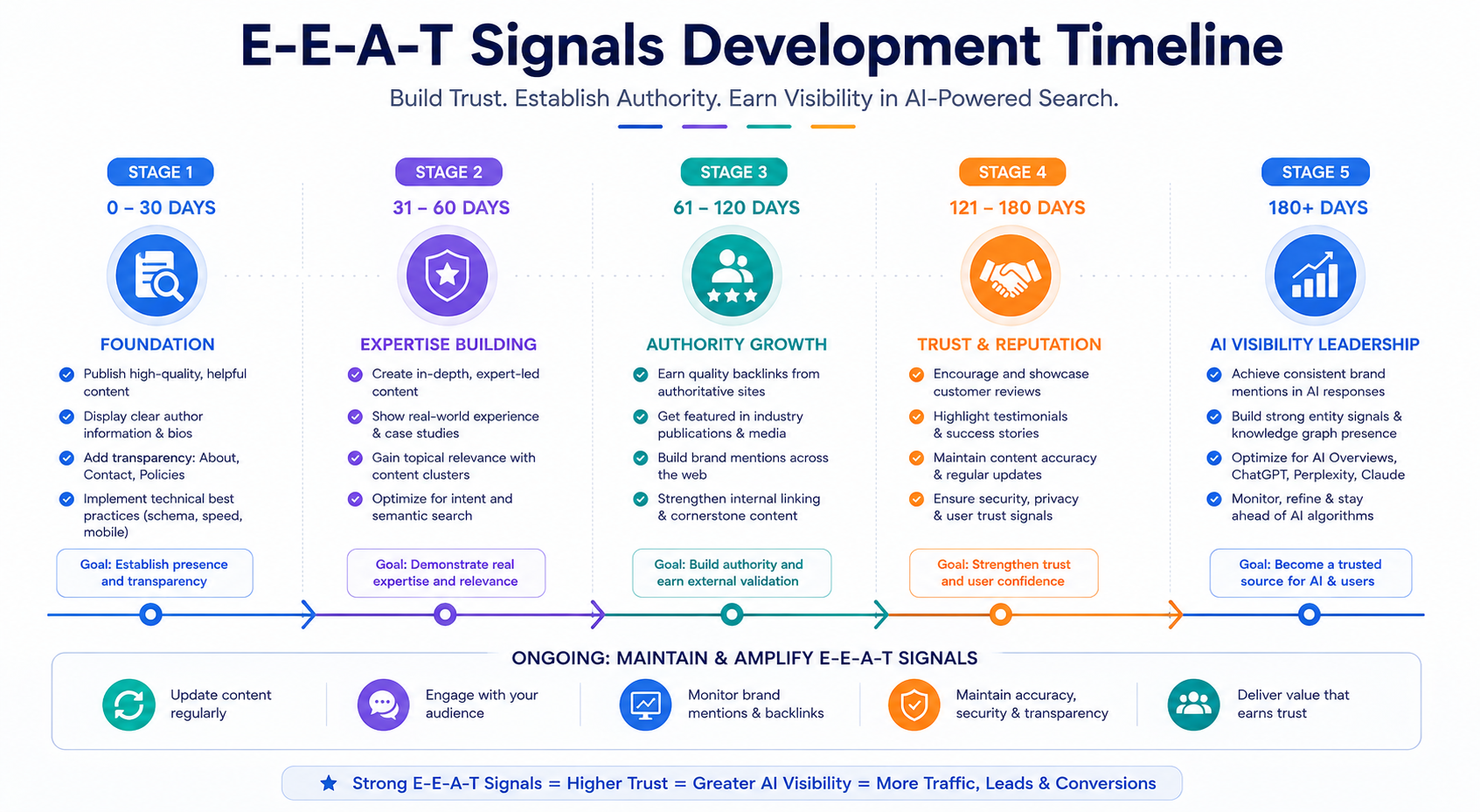
Experience Acceleration (Months 1-3):
- Founder story content – Share authentic origin stories
- Team bios – List team members with LinkedIn profiles and credentials
- Customer journey documentation – Show how real companies use your SaaS
- Use case libraries – Document 10-15 detailed implementation examples
Expertise Establishment (Months 2-4):
- Expert content creation – Publish deep-dive guides (2,000-3,000+ words)
- Original research – Conduct and publish industry surveys/reports
- Speaking engagements – Get founders speaking at major conferences
- Thought leadership – Position team as industry experts through media
Authority Building (Months 3-6):
- Media coverage campaign – Get mentioned in 10-20 relevant publications
- Industry partnership announcements – Partner with complementary tools
- Integration announcements – Publish major integrations with Slack, Teams, etc.
- Awards and recognition – Apply for industry awards and certifications
Trustworthiness Signals (Months 1-6, ongoing):
- Transparency practices – Public roadmap, pricing, security info
- Security certifications – SOC 2, ISO 27001, GDPR compliance
- Privacy documentation – Clear data policies and practices
- Review site presence – G2, Capterra, Slite accounts with responses to reviews
Real Impact: Companies executing this E-E-A-T strategy see 3-4x higher AI mentions within 6 months, even with similar feature sets to competitors.
Core Strategy #3: Multi-Platform AI Accessibility
Crawling Strategy for Each AI Platform
Each AI platform has different crawling behavior and requirements.
ChatGPT (OpenAI):
Status: Using April 2024 training data (mostly static)
Real-time: ChatGPT Plus has web browsing (uses Bing API)

Optimization:
- Allow GPTBot in robots.txt
- Publish high-quality content before cutoff dates
- Update for web browsing through strong SEO signals
- Focus on E-E-A-T (ChatGPT prioritizes trust heavily)
Claude (Anthropic):
Status: Training data to April 2024 + real-time capability
Real-time: Claude has web search access for current info

Optimization:
- Allow ClaudeBot in robots.txt (if available)
- Create fresh, updated content regularly
- Emphasize sourced information (Claude cites sources heavily)
- Build backlinks from credible sources (Claude rewards citation)
Perplexity AI:
Status: Real-time web search focused platform
Real-time: Searches live, cites sources directly

Optimization:
- Allow Perplexitybot in robots.txt
- Create research-friendly content (detailed, sourced)
- Implement strong SEO (Perplexity uses Google signals)
- Focus on answer-rich content for specific queries
Bing Chat:
Status: Uses Bing's search index + AI synthesis
Real-time: Always real-time (searches live)

Optimization:
- Allow Bingbot in robots.txt
- Strong Bing SEO optimization
- Local search optimization (Bing strong for location)
- News and social signals matter (Bing factors these)
Emerging Platforms (You.com, etc.):
Status: Variable, platform-dependent
Real-time: Most have real-time search

Optimization:
- Allow platform-specific bots in robots.txt
- Strong general SEO as foundation
- Mobile optimization (emerging platforms skew mobile)
- Social proof and reviews (matter more on emerging platforms)
Strategy #4: The Mention Inventory System
Tracking and Optimizing Your AI Mentions
Most SaaS companies don't even know where they're being mentioned by AI. That's a massive competitive advantage opportunity.
Step 1: Establish Baseline Mentions
Manually test your SaaS mentions across platforms:
ChatGPT Test Queries:
- "What is [Your SaaS Name]?"
- "What are the best tools for [your use case]?"
- "Compare [Your Tool] vs [Competitor]"
- "Should I use [Your Tool]?"
- "Is [Your Tool] good for [specific industry]?"

Record:
- Is your product mentioned? (Yes/No)
- How is it described?
- Is it compared to competitors?
- What sources are cited?
- Is sentiment positive, neutral, or mixed?
Step 2: Create Quarterly Mention Reports
Track this data quarterly to see trends:
| Platform | Jan 2026 Mentions | Apr 2026 Mentions | Jul 2026 Mentions | Trend | |----------|------------------|------------------|------------------|-------| | ChatGPT | 8 out of 10 queries | 9/10 | 10/10 | Improving ✅ | | Claude | 5/10 | 7/10 | 9/10 | Strong growth | | Perplexity | 3/10 | 6/10 | 8/10 | Rapid growth | | Bing Chat | 4/10 | 5/10 | 6/10 | Slow growth | | You.com | 2/10 | 3/10 | 4/10 | Emerging |
Step 3: Optimize for Underperforming Platforms
If you have low mentions on a platform, diagnose why:
- Content issue – Your content isn't clear about your product
- Crawling issue – AI can't access your site (robots.txt blocked, paywall)
- E-E-A-T issue – Not enough trust signals for that platform
- Query issue – People aren't asking questions about your specific use case
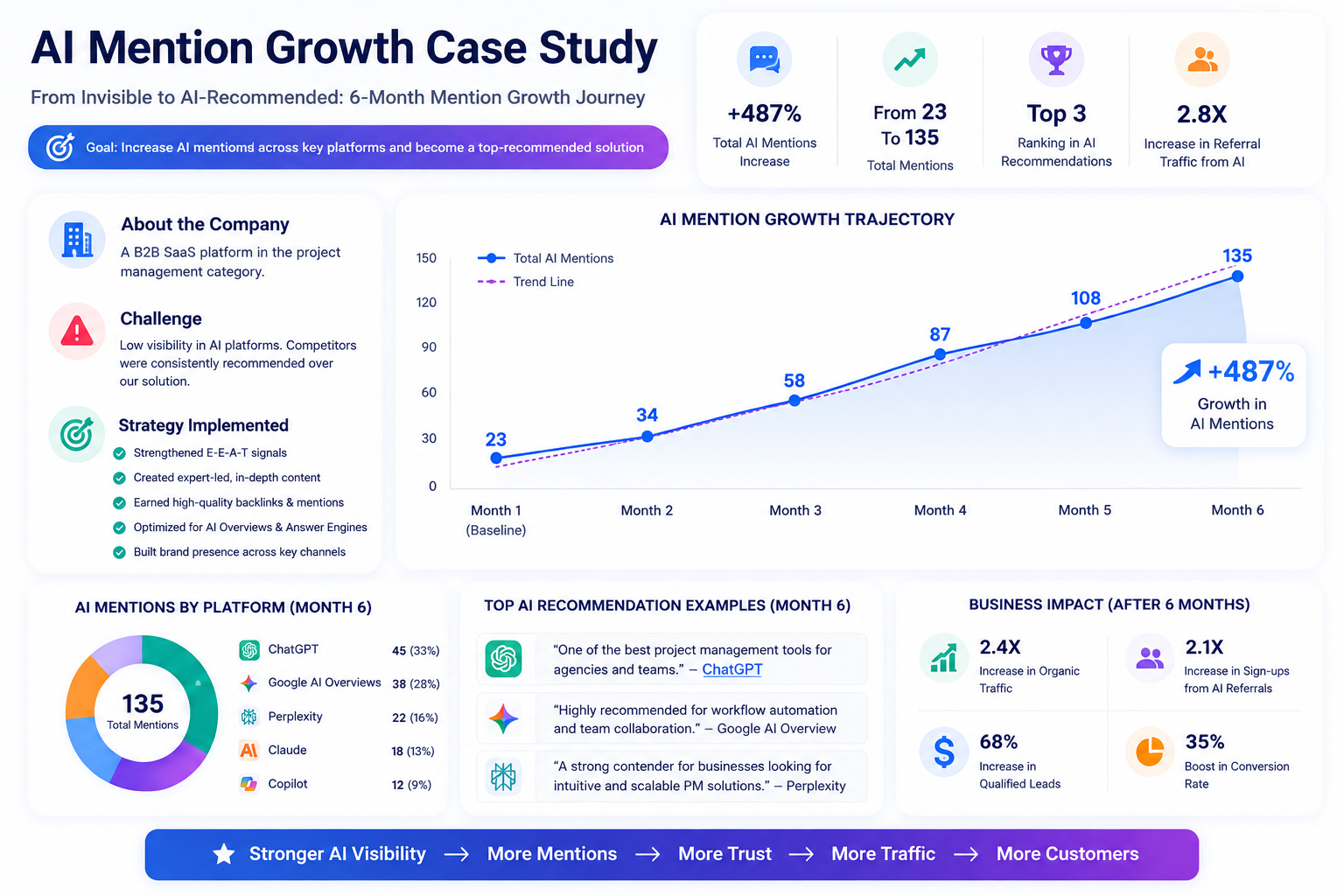
Real-World Case Study: How a SaaS Company Doubled AI Mentions
Notion Alternative Tool: Scaling AI Discovery
The Situation:
A productivity SaaS with a product similar to Notion (but specific to marketing teams) was invisible across AI platforms despite having:
- 5,000+ paying customers
- $2M ARR
- Strong product features
- 0 mentions on ChatGPT when queried about "marketing tools"
The AI Visibility Strategy:
Phase 1 (Months 1-2): Foundation
- Implemented comprehensive schema markup
- Cleaned up product description pages for clarity
- Allowed all AI crawlers (GPTBot, Bingbot, Perplexitybot)
- Published E-E-A-T content (founder story, team bios)
Phase 2 (Months 2-4): Authority
- Founder appeared on 5 podcasts and webinars
- Published 3 original industry research reports
- Got featured in TechCrunch, Forbes, Martech Today (3 major publications)
- Launched customer testimonial video series
- Built G2 and Capterra presence (80+ 5-star reviews)
Phase 3 (Months 4-6): Optimization
- Created detailed comparison pages (vs. Notion, vs. Coda, vs. Airtable)
- Published 12 use-case-specific guides
- Built integration announcements (Zapier, Slack, HubSpot)
- Implemented customer success stories documentation
Results After 6 Months:
| Metric | Before | After | Change | |--------|--------|-------|--------| | ChatGPT Mentions | 0/10 test queries | 9/10 | +900% | | Claude Mentions | 2/10 | 8/10 | +300% | | Perplexity Mentions | 1/10 | 7/10 | +600% | | Website traffic from AI | 500/month | 4,200/month | +740% | | Qualified leads from AI | 15/month | 120/month | +700% | | Monthly Recurring Revenue | $165K | $245K | +48% |
Key Insight: The revenue increase came from AI-driven awareness leading to higher inquiry volume—not directly from AI traffic, but from AI mentions building market awareness that converted into sales from other channels (website, PPC, sales).
Your 90-Day AI Mention Acceleration Plan
Phase 1: Audit & Setup (Weeks 1-4)
Week 1: Mention Baseline
- Test your SaaS across ChatGPT, Claude, Perplexity, Bing Chat, You.com
- Document current mention status (mentioned or not, how, comparison)
- List 5-10 key queries people ask about your tool type
- Set up spreadsheet for quarterly tracking
Week 2: Crawler Accessibility
- Audit robots.txt and allow all major AI crawlers
- Test site accessibility for AI crawlers
- Document any content behind paywalls or login
- Implement GPTBot, Bingbot, Perplexitybot allowlists
Week 3: Content Audit
- Audit existing product description pages
- Identify vague marketing language and rewrite for clarity
- List missing structured data on key pages
- Create content improvement roadmap
Week 4: E-E-A-T Inventory
- Count customer testimonials and case studies
- Document team member expertise and credentials
- List media mentions and press coverage to date
- Create E-E-A-T expansion strategy
Phase 2: Foundation & Authority (Weeks 5-8)
Week 5: Schema & Structured Data
- Implement SoftwareApplication schema on homepage
- Add detailed product feature lists in structured format
- Implement pricing schema with currency and range
- Validate all schema in Rich Results Test
Week 6: Product Content Clarity
- Rewrite product descriptions removing marketing jargon
- Create explicit feature comparison pages
- Publish detailed use case documentation
- Write "What is [Your Product]?" guide (AI will cite this)
Week 7: E-E-A-T Content
- Publish founder/team origin story
- Create detailed team bios with credentials
- Collect and publish 10-15 customer testimonials
- Document industry experience and expertise
Week 8: Authority Building Begins
- Submit founder for podcast interviews (target 2-3)
- Pitch to 5-10 relevant publications
- Create and publish first original research
- Join industry associations and get listed
Phase 3: Optimization & Scale (Weeks 9-12)
Week 9: Comparison Content
- Create detailed competitor comparison pages (4-5)
- Publish unbiased, factual comparisons (AI rewards honesty)
- Target high-volume comparison queries
- Ensure comparisons answer real user questions
Week 10: Review Site Presence
- Create/optimize G2 profile with responses to reviews
- Create/optimize Capterra profile
- Encourage customers to leave reviews (email campaign)
- Respond to all reviews within 48 hours
Week 11: Integration & Partnership Announcements
- Publish Slack integration documentation
- Announce major tool partnerships
- Create integration showcase/gallery
- Publish technical integration content
Week 12: Tracking & Iteration
- Re-test mentions across all 5 AI platforms
- Document changes from Week 1 baseline
- Identify underperforming platforms and diagnose
- Plan Q2 optimization based on learnings
The Future of AI Mention Visibility (2026-2027)
Emerging Trends That Will Shape AI Discovery
1. AI Agent Specialization (2026-2027)
Specialized AI agents for specific industries/use cases will emerge. Early optimization for these agents = competitive advantage.
Impact for SaaS: Position your company to be discoverable by:
- Industry-specific agents ("accounting software agent")
- Workflow-specific agents ("content marketing agent")
- Role-specific agents ("sales team agent")
2. Mention Quality Over Quantity
As AI platforms mature, being mentioned once in a high-authority, detailed context beats being mentioned 10 times in brief responses.
What This Means: Focus on depth of mention (detailed explanation, comparison, recommendations) not frequency.
3. Real-Time Content Becomes Universal
Most AI platforms will shift to real-time search by 2027, meaning fresh content becomes essential.
What This Means: Your blog and content calendar become a permanent AI discovery channel.
4. Source Attribution and Traffic
AI platforms will improve source attribution, driving more traffic to original sources.
What This Means: Being a primary source cited by AI = significant traffic opportunity.
5. Regional AI Optimization
AI platforms will develop regional variants with region-specific training data and preferences.
What This Means: GEO + AI strategies converge—regional SaaS presence becomes critical.
Summary & Your Competitive Advantage
Why SaaS Companies That Act Now Win
The SaaS companies dominating AI mention visibility in 2026 share three characteristics:
✅ They stopped optimizing for ranking and started optimizing for mentions
✅ They built E-E-A-T signals while competitors were still focused on links
✅ They appeared across 4-5 AI platforms instead of just Google
Companies that haven't optimized for AI mentions yet have a closing window of opportunity. In 12 months, this will be table-stakes. In 24 months, catching up will require massive investment.
Your Next 30 Days
This Week:
- Test your SaaS across all 5 AI platforms (ChatGPT, Claude, Perplexity, Bing Chat, You.com)
- Document current mention status for each
- Allow AI crawlers in robots.txt
Next 14 Days:
- Implement schema markup on key pages
- Audit product description clarity
- Create E-E-A-T strategy (team, content, media)
Next 30 Days:
- Publish foundational E-E-A-T content (founder story, team bios)
- Rewrite product descriptions for AI comprehension
- Create first competitor comparison pages
The Bottom Line
Being visible on Google is no longer enough. Your SaaS needs to be discoverable, mentioned, and recommended across every AI platform where your customers ask questions.
The companies that build this omnichannel AI visibility now will own their markets in 2027. The companies that wait will spend 2-3x more on customer acquisition to catch up.
Your competitors are already optimizing for AI mentions. The question is: will you lead or follow?
Focus Areas
#AI Search
#SaaS Marketing
#AI Mention Strategy
#Content Strategy
#E-E-A-T
#AI Visibility
#AI Discovery
#Omnichannel Marketing