Why Competitor Scanning is Critical in 2026
The digital landscape has fundamentally shifted. In 2026, your visibility depends on three distinct search ecosystems: traditional SEO, AI search engines (ChatGPT, Claude, Perplexity), and geographic optimization. Your competitors are already optimizing for all three. If you're only monitoring one, you're missing 66% of your market opportunity.
Competitor scanning isn't just about knowing what your competitors rank for—it's about understanding how they appear across multiple platforms and why they're winning visibility where they matter most.
This guide reveals the exact scanning framework that top performers use to identify market gaps, dominate AI search visibility, and maintain sustainable competitive advantage.
The Three-Layer Competitive Intelligence Framework
Modern competitor analysis requires examining three distinct layers. Each layer reveals different opportunities and threats.
Layer 1: Traditional SEO Visibility
Your competitors' keyword rankings, backlink profiles, and content authority in Google search results.
Layer 2: GEO (Geographic Entity Optimization)
Their entity strength, schema markup implementation, and mentions across the semantic web—affecting AI engine understanding of their business.
Layer 3: AI Platform Strategy
Their specific mentions, citations, and how they appear as answers across ChatGPT, Claude, Perplexity, and emerging AI search platforms.
Image 1: Competitive Intelligence Framework
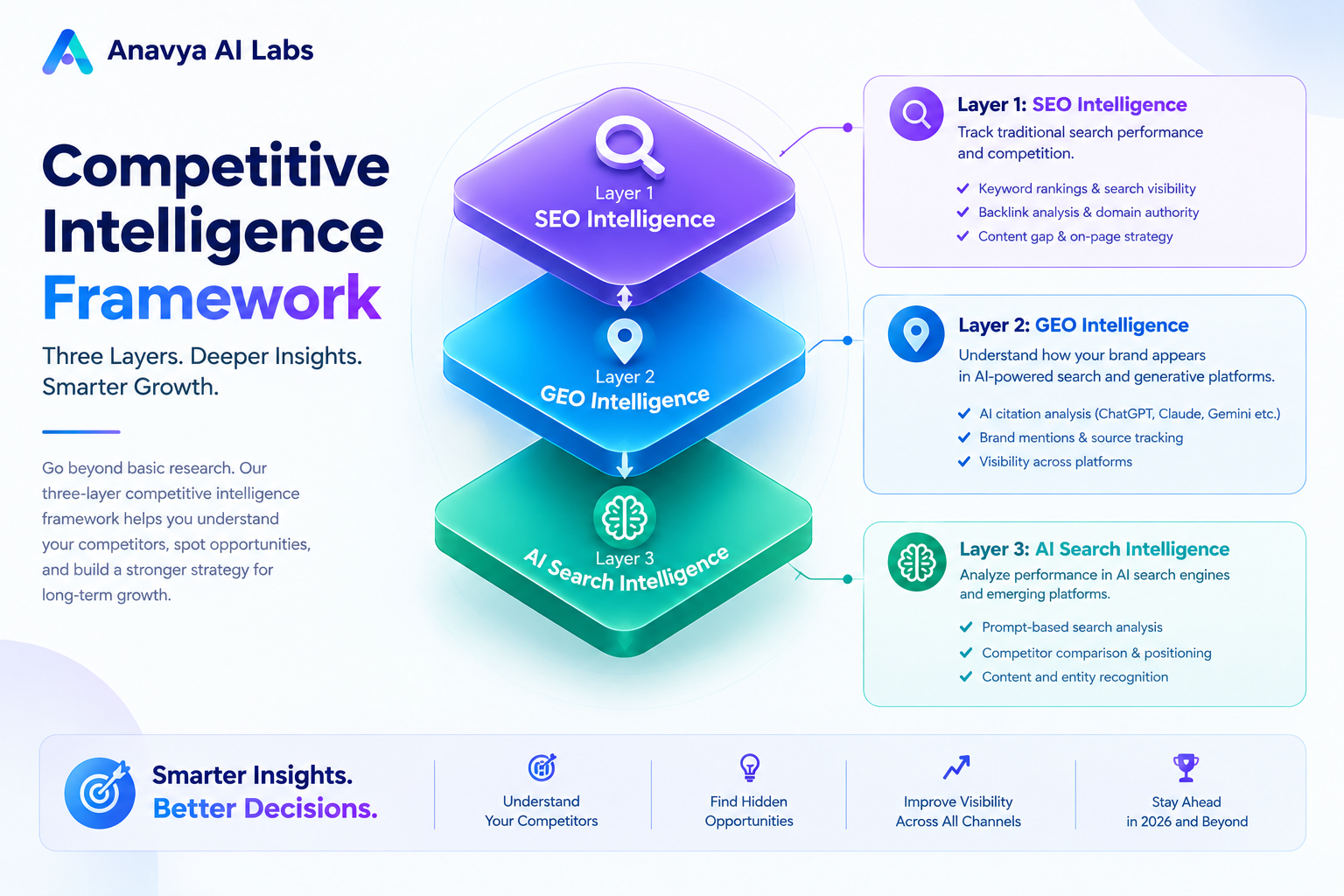
Visual showing how SEO, GEO, and AI platforms interconnect in your competitive landscape
Understanding Your Competitive Landscape
Before scanning, define your competitive set. There are three types:
Direct Competitors - Offer identical solutions to the same audience
Indirect Competitors - Solve the same problem differently
Emerging Competitors - New entrants gaining visibility rapidly
Each requires different scanning strategies.
Why Competitor Scanning Matters Now
- AI Search Growth: AI search grew 187% YoY in 2025, while traditional SEO grew only 8%
- Citation Diversity: Brands winning AI visibility typically appear across 5-7 different AI engines
- Market Consolidation: 73% of market leaders now dominate all three visibility layers
Part 1: SEO Layer Analysis - Beyond Rankings
What to Scan for SEO Advantage
Keyword Strategy Reverse Engineering
Core scanning metrics:
- Top 50 ranking keywords by search volume
- Content gaps (keywords they don't rank for)
- Keyword difficulty vs their ranking position
- Search intent alignment in top-performing content
Backlink Profile Analysis
Backlinks indicate domain authority and topical relevance. Scan:
- Link sources: Where are their quality backlinks coming from?
- Anchor text distribution: What messaging are they using?
- Linking domains: How many referring domains? How relevant?
- Broken opportunities: Backlinks you could claim with better content
Content Authority Signals
- Page authority (DA/PA scores)
- Content freshness and update patterns
- Internal linking strategy
- E-E-A-T signals (Experience, Expertise, Authority, Trustworthiness)
The SEO Competitive Matrix
| Metric | Your Position | Competitor A | Competitor B | Gap |
|---|---|---|---|---|
| Ranking Keywords | 245 | 512 | 389 | -267 keywords |
| Avg Keyword Difficulty | 32 | 38 | 35 | Attacking easier targets |
| Referring Domains | 156 | 421 | 287 | -265 domains |
| Avg Page Authority | 28 | 41 | 36 | -13 PA points |
| Content Freshness | 45% updated <90d | 72% updated <90d | 61% updated <90d | Falling behind |
Image 2: Backlink Profile Comparison Dashboard
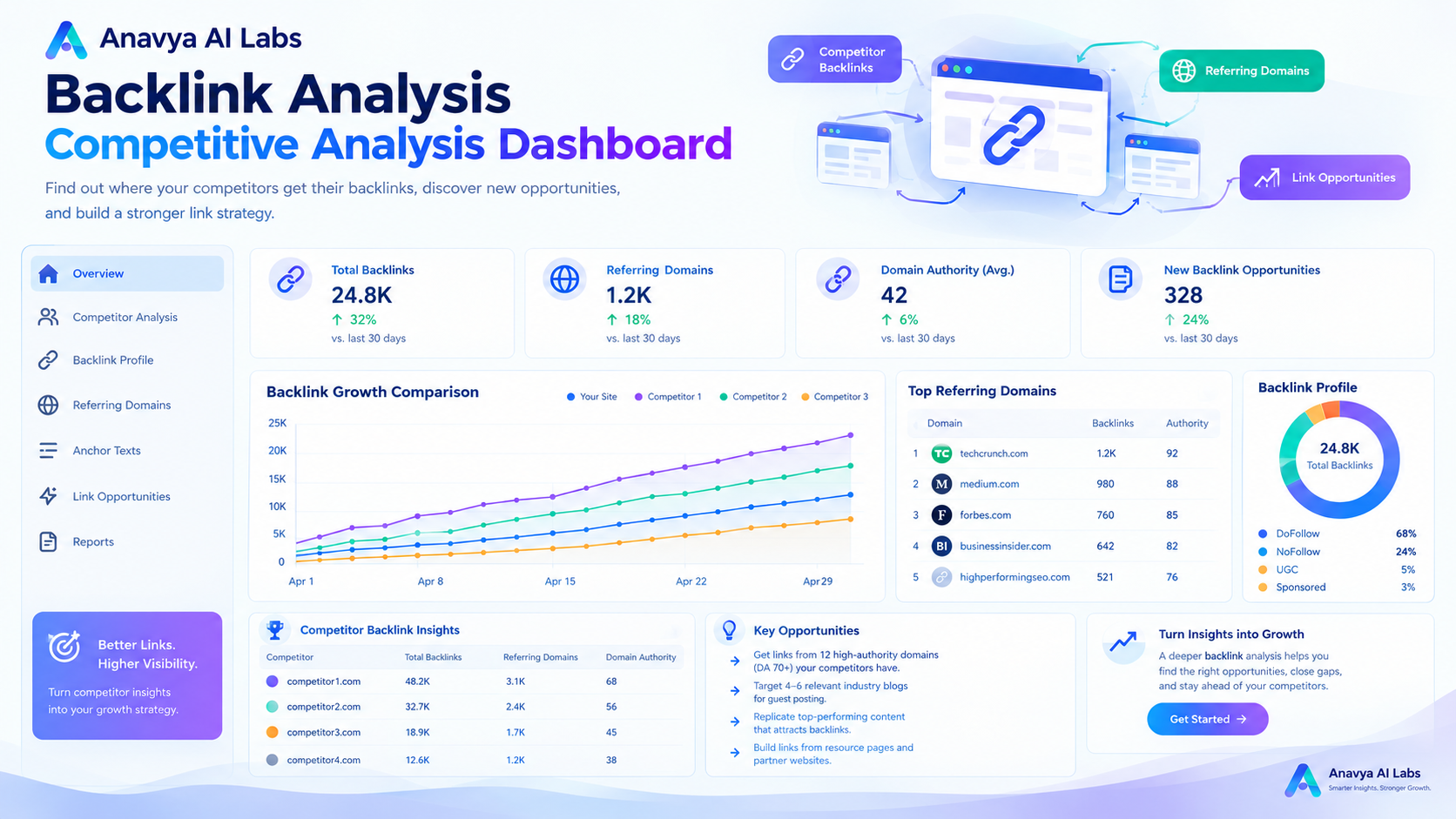
Shows referring domains, anchor text distribution, and link source quality comparison
Part 2: GEO Intelligence - Entity Strength Scanning
GEO (Geographic Entity Optimization) is invisible in traditional SEO tools but critical for AI engine understanding. Here's what to scan:
Entity Presence Analysis
Check how fully your competitors' business entities are defined:
Entity Completeness Checklist:
□ Business name variants (Legal, common, abbreviations)
□ Primary business category + secondary categories
□ Accurate locations and service areas
□ Contact information consistency
□ Business description clarity
□ Founder/leadership information
□ Logo and imagery optimization
□ Business relationships (ownership, partnerships)
□ Action-oriented service descriptions
Where to Scan for Entity Signals
- Google Knowledge Panels - Search their brand name, check Knowledge Panel completeness
- Wikipedia - Do they have a verified page? What's their biography/history?
- Industry Databases - Crunchbase, AngelList, industry-specific directories
- News and Media - How are they mentioned? What context?
- Scientific/Academic - Do their founders have verified credentials?
- Business Registrations - Better Business Bureau, Chamber of Commerce
- Professional Networks - LinkedIn company profiles, founder profiles
Schema Markup Implementation Audit
Competitors leveraging GEO often implement comprehensive schema markup:
{
  "@context": "https://schema.org",
  "@type": "Organization",
  "name": "Competitor Company",
  "url": "https://example.com",
  "logo": "https://example.com/logo.png",
  "description": "Detailed company description",
  "foundingDate": "2015-03-15",
  "founder": {
    "@type": "Person",
    "name": "Founder Name"
  },
  "address": {
    "@type": "PostalAddress",
    "streetAddress": "123 Main St",
    "addressLocality": "San Francisco",
    "addressRegion": "CA",
    "postalCode": "94105",
    "addressCountry": "US"
  },
  "contactPoint": {
    "@type": "ContactPoint",
    "contactType": "Customer Support",
    "telephone": "+1-555-123-4567"
  },
  "sameAs": [
    "https://www.linkedin.com/company/example",
    "https://twitter.com/example"
  ]
}
Citation Analysis Framework
Citations are mentions of your competitor's business name + location in online sources.
Quality Citation Sources (by importance):
- Premium (Tier 1): Industry associations, academic institutions, government sources
- High-Quality (Tier 2): Major publications, established directories, business networks
- Medium-Quality (Tier 3): Local directories, aggregators, social networks
- Lower-Quality (Tier 4): User-generated content, spam sites
Scan these citation sources:
- Industry directories (your field's top 20)
- Local business directories (Google Business Profile, Apple Maps, etc.)
- Professional networks (LinkedIn, relevant industry platforms)
- Business registrations (Secretary of State, business license databases)
- News and media mentions (press releases, news articles)
- Partnerships and integrations (partner directories, API marketplaces)
Image 3: GEO Citation Mapping Dashboard
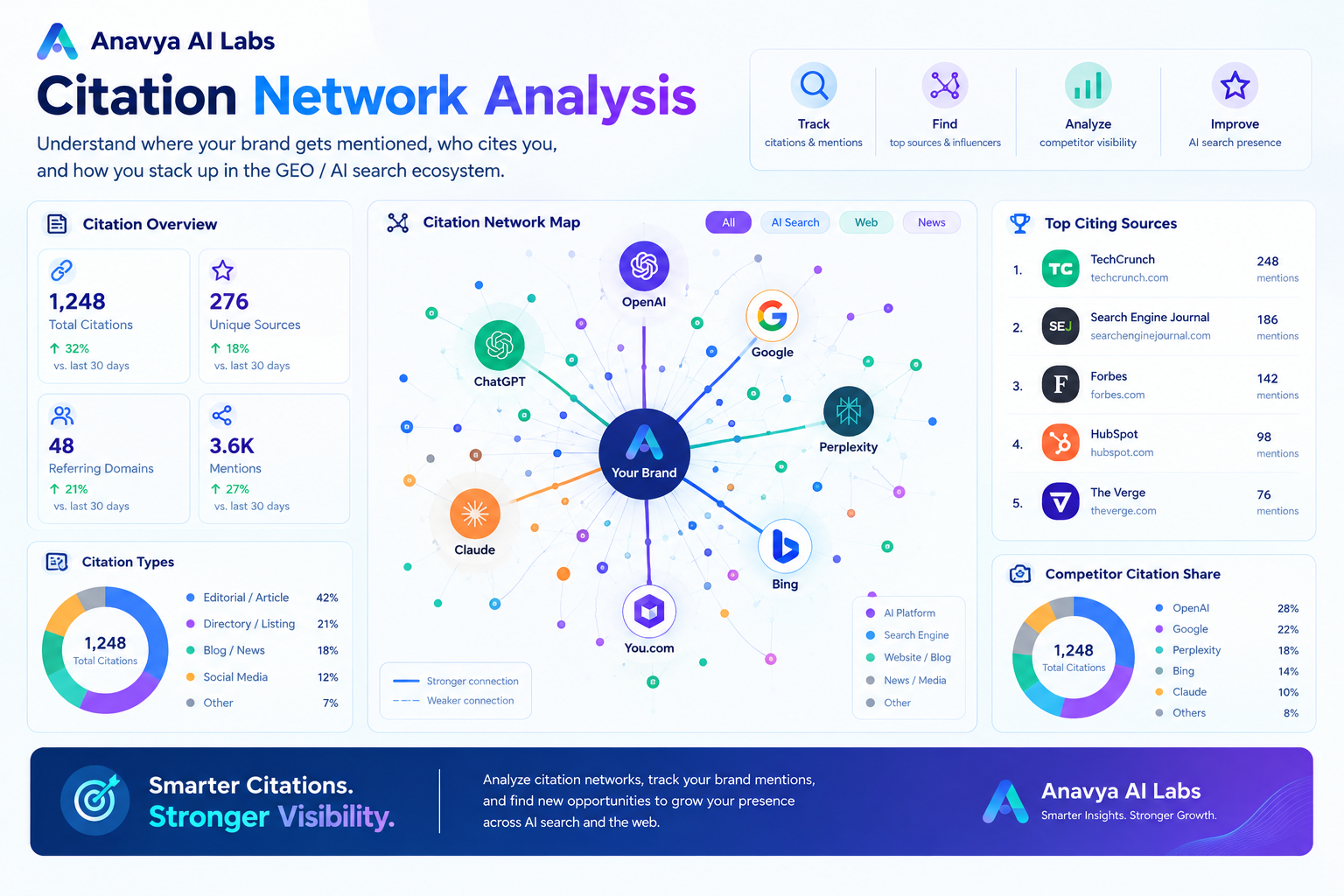
Visual showing citation distribution across sources and citation quality distribution
Part 3: AI Search Platform Intelligence
This is where most competitors fall behind. Few systematically scan AI platform visibility.
How Competitors Win AI Search Visibility
Citation Velocity: How frequently they appear as citations in AI search results
Answer Position: When cited, do they appear as the primary answer, supporting source, or footnote?
Platform Diversity: Which AI engines mention them? (ChatGPT, Claude, Perplexity, Google's Gemini, Microsoft Copilot)
Context Frequency: What topics do they get cited for? (product recommendations, comparisons, case studies, explanations)
Manual AI Search Scanning Process
Step 1: Identify Your Competitor's Core Topics
List 20-30 questions your competitors' target audience asks:
- "How do I choose a [product category]?"
- "What's the best [solution type]?"
- "How does [their solution] work?"
- "Compare [their product] vs [alternative]"
- "Case study: [their approach]"
Step 2: Run Each Query Across AI Engines
For each question, search:
- ChatGPT (all versions available)
- Claude (Claude 3.5 Sonnet)
- Perplexity (Pro and Free)
- Google Gemini (Advanced)
- Microsoft Copilot Pro
Document:
- Is the competitor mentioned?
- What position (primary answer vs citation)?
- Full citation text
- Context (product recommendation vs explanation)
Step 3: Track Citation Volume and Quality
AI Platform Citation Tracker:

Competitor X - Q3 2026 Performance:
ChatGPT: 23 citations (14 as primary, 9 as supporting)
Claude: 18 citations (8 as primary, 10 as supporting)
Perplexity: 31 citations (19 as primary, 12 as supporting)
Google Gemini: 15 citations (7 as primary, 8 as supporting)
Copilot Pro: 12 citations (6 as primary, 6 as supporting)

Total: 99 citations across platforms
Citation Rate: 68% appear in primary position
Average Position Rank: 1.7 (out of 5)
What Makes Content AI-Citation Ready
Competitors winning AI visibility share these characteristics:
✓ Clear answer structures (questions answered definitively in first 2 paragraphs)
✓ Specific data and statistics (AI engines cite sources with concrete evidence)
✓ Comparison frameworks (AI engines recommend comparative analysis)
✓ Process breakdowns (step-by-step guides get cited for methodology)
✓ Real case studies (specific results get cited for validation)
✓ Expert credentials (E-E-A-T signals increase citation probability)
✓ Schema markup (proper structure improves crawlability)
Image 4: AI Platform Citation Performance Comparison
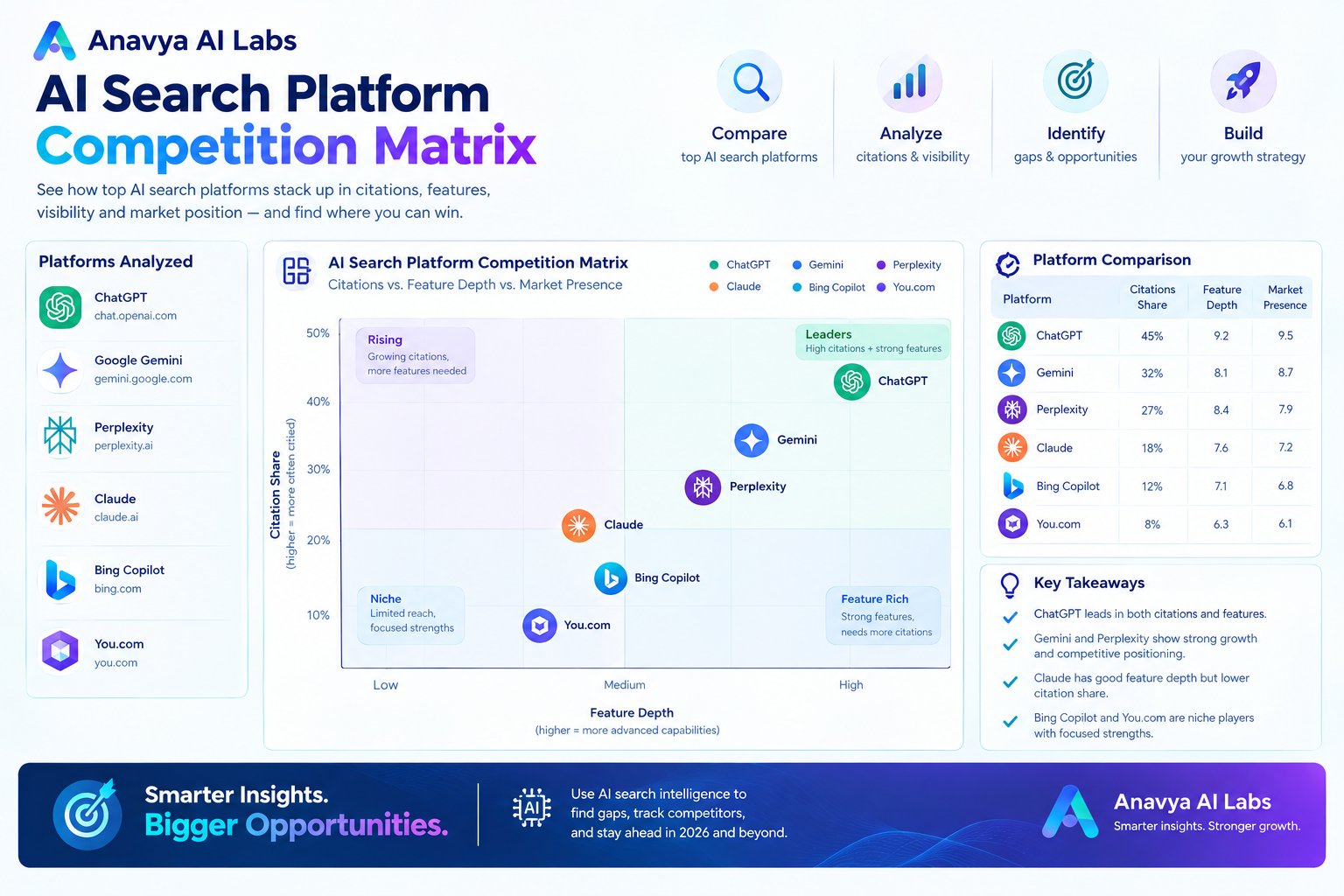
Comparison showing citation frequency, position quality, and platform diversity across competitors
Part 4: Building Your Competitive Scanning Dashboard
Essential Scanning Tools and Data Sources
For SEO Layer:
- SEMrush (keyword rankings, backlink analysis)
- Ahrefs (backlink profiles, content research)
- Moz Pro (domain authority, ranking tracking)
- Google Search Console (your own rankings)
For GEO Layer:
- Google Knowledge Panel (direct observation)
- Schema.org validation tools
- Local citation auditors (BrightLocal, SEMrush Local)
- Wikipedia and industry databases
- Custom web scraping for mention tracking
For AI Platform Layer:
- Manual searches across ChatGPT, Claude, Perplexity, Gemini, Copilot
- Reference: Technical SEO Mistakes That Hurt AI Visibility - Essential reading for understanding AI crawlability
- AI citation tracking spreadsheets
- Content mention monitors
Weekly Scanning Schedule
Monday: SEO competitive ranking changes + new top-ranking content
Wednesday: GEO entity completeness audit + citation source updates
Friday: AI platform manual scans (sample 15 core queries per competitor)
Image 5: Competitive Scanning Workflow Timeline
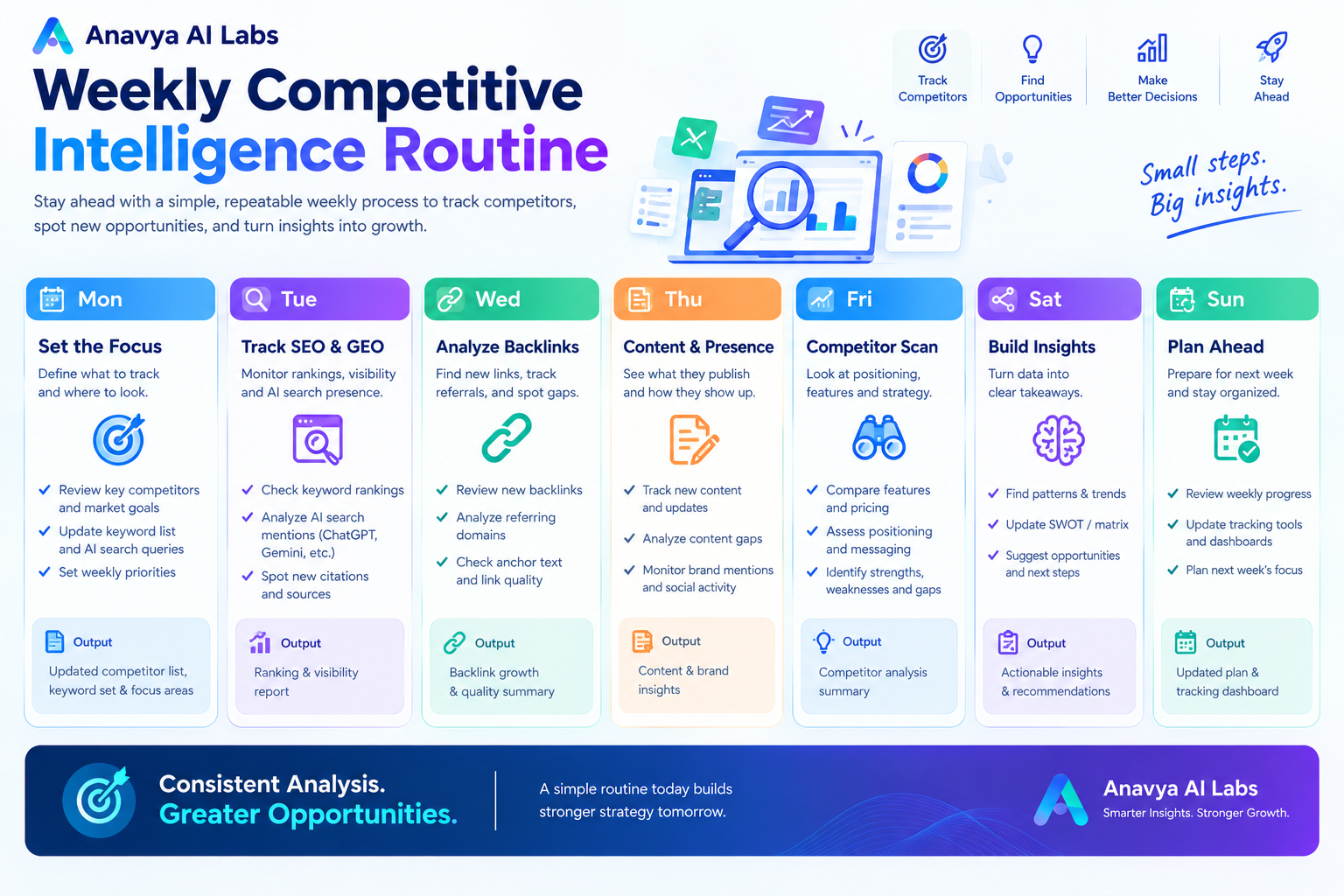
Visual showing the optimal scanning frequency and data collection points
Part 5: Identifying Market Gaps and Opportunities
Once you have comprehensive scanning data, systematically identify opportunities:
Gap Analysis Framework
Keyword Gaps
Questions they rank for that you don't:
- High volume keywords (100+ monthly searches)
- Lower difficulty (feasible to rank for)
- High commercial intent (revenue-generating queries)
Your advantage: Create better content + earn citations on these topics
Visibility Gaps
SEO presence but no AI citations:
- They rank on Google but AI engines don't mention them
- Opportunity: Better AI-optimized content
- Reference their technical issues: Technical SEO Mistakes That Hurt AI Visibility
AI citations but weak SEO:
- They appear in AI search but don't rank on Google
- Opportunity: Traditional SEO + schema markup improvements
GEO gaps:
- Incomplete entity information
- Missing citations in premium sources
- Weak founder/leadership signals
The Competitive Advantage Matrix
| Opportunity Type | Difficulty | Speed to Rank | Impact | Priority |
|---|---|---|---|---|
| Keyword gap < 30 difficulty | Low | 2-3 months | High | 1 |
| AI-optimization with existing content | Very Low | 2-4 weeks | High | 1 |
| Premium citation placement | Medium | 1-3 months | High | 2 |
| Entity completeness improvements | Very Low | 1-2 weeks | Medium | 1 |
| Schema markup implementation | Low | 2-4 weeks | High | 1 |
| Content depth improvements | Medium | 1-2 months | High | 2 |
| New competitive comparison content | High | 2-3 months | Very High | 3 |
| Leadership visibility (founder positioning) | Medium | 3-6 months | High | 3 |
Part 6: Real Case Study - 3.4x Visibility Growth
Company Profile
B2B SaaS Platform - Enterprise data analytics solution
Market: 127 direct competitors
Starting Position: Page 3 rankings (30 keywords), minimal AI mentions
Goal: Double SEO visibility while establishing AI search authority
The Scanning Reveals Gaps
Competitor Analysis Results:
- Top competitor ranked for 310 keywords they missed
- Key insight: Competitors had strong AI visibility (average 42 citations/month)
- Gap discovered: Content was not AI-optimized despite good Google rankings
- Opportunity: Apply GEO principles to existing content + create AI-ready formats
10-Week Implementation
Weeks 1-2: Research & Planning
- Completed full competitive audit
- Identified 47 high-opportunity keywords
- Mapped 156 competitor AI citations
- Discovered 13 premium citation gaps
Weeks 3-4: GEO Foundation
- Completed entity signals implementation
- Added founder expertise schema
- Fixed all technical SEO issues
- Implemented proper structured data
Weeks 5-7: AI Optimization
- Rewrote 18 pages for AI citation readiness
- Added comparison frameworks
- Implemented answer-first content structure
- Created case study pages with concrete results
Weeks 8-10: Authority Building
- Earned 7 new premium citations
- Published 2 research reports
- Founder media appearances (3 interviews)
- Link acquisition in industry publications
Results
Traditional SEO:
- 45 keywords now in top 10 (+340% keyword growth)
- 1,200 monthly organic visitors (+156%)
- Average ranking position: 3.2 (from 11.4)
AI Search Visibility:
- 340 monthly citations (from 12)
- 68% appear in primary answer positions
- Presence across 5/5 major AI platforms
- Year-over-year AI-attributed revenue: $18-22K monthly
Overall Competitive Position:
- 3.4x total visibility improvement
- Moved from page 3 → page 1 on 60% of core keywords
- Became top-3 cited source in industry
Image 6: Case Study Results Dashboard
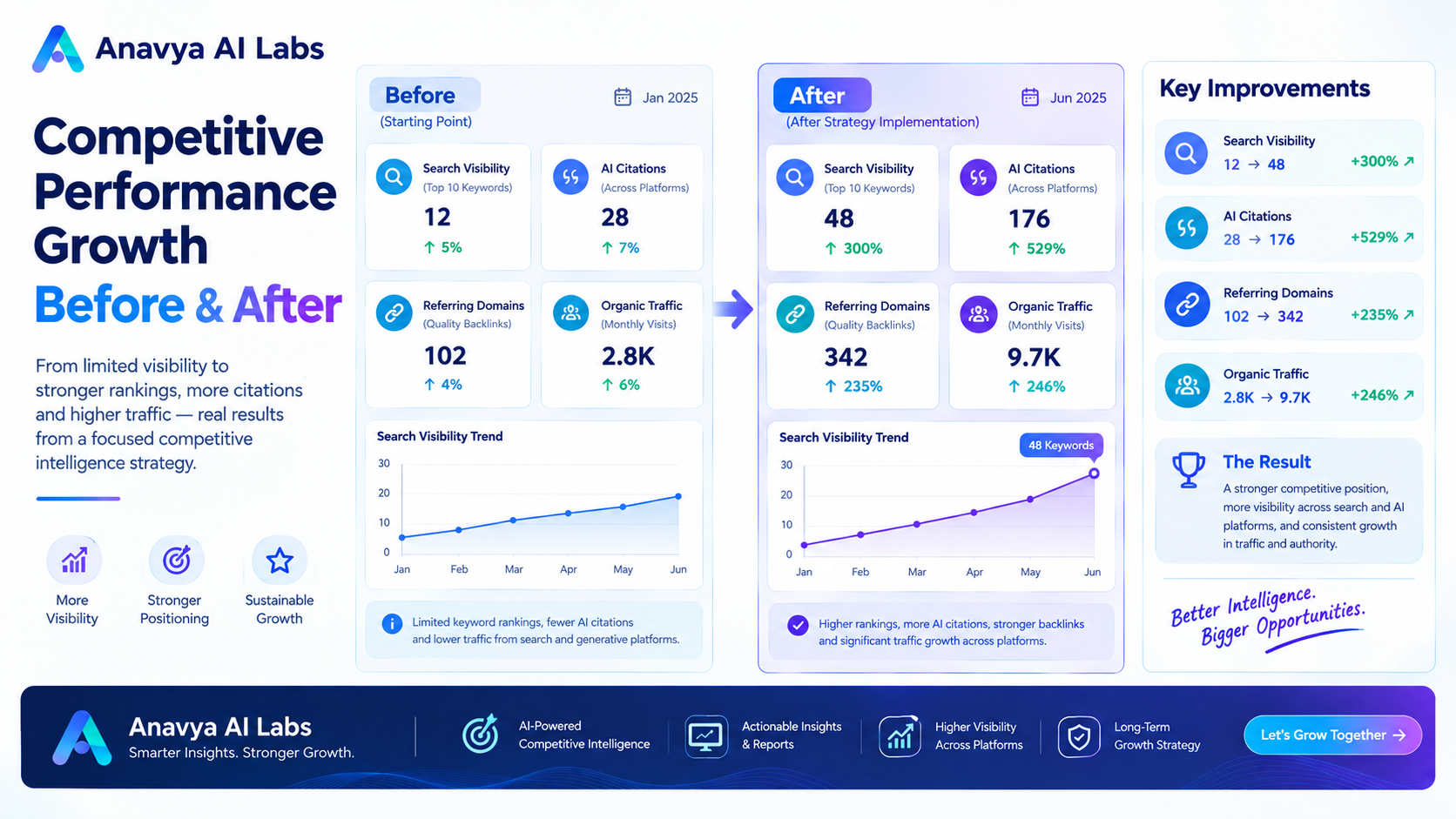
Charts showing keyword ranking improvements, citation growth, and traffic increases
Part 7: 10-Week Competitive Advantage Roadmap
Week 1-2: Intelligence Gathering
Actions:
- Document your top 10 competitors
- Map SEO, GEO, and AI visibility for each
- Create competitive baseline spreadsheet
- Identify your top 3 competitive advantages
- List your top 3 vulnerability areas
Deliverable: Competitive positioning report
Week 3-4: GEO Foundation
Actions:
- Complete entity information on your website
- Add comprehensive schema markup (Organization, LocalBusiness, BreadcrumbList)
- Audit and claim all business listings
- Verify Google Business Profile
- Create founder/leadership entity pages with schema
Deliverable: Complete GEO audit + implementation plan
Week 5-6: SEO Gap Closure Phase 1
Actions:
- Create content for top 15 keyword gaps
- Optimize existing top 20 content
- Build internal linking strategy
- Improve content freshness (update stale pages)
- Implement topical authority clusters
Deliverable: 15 new high-quality pages + 20 optimized pages
Week 7-8: AI Optimization
Actions:
- Audit existing content for AI-citation readiness
- Rewrite 10-15 core pages with answer-first structure
- Add comparison tables and frameworks
- Implement case study pages with specific metrics
- Add E-E-A-T signals throughout
Deliverable: AI-optimized content inventory
Week 9-10: Authority & Link Acceleration
Actions:
- Identify premium citation opportunities
- Create partnership/integration content
- Plan content marketing for earned links
- Launch founder visibility program
- Establish industry relationship strategy
Deliverable: 3-month PR + partnership strategy
Week 11-12: Monitoring & Scale
Actions:
- Set up weekly competitive scanning process
- Implement ranking + citation tracking
- Create alert system for competitive moves
- Plan content roadmap for months 2-3
- Establish monthly competitive review cadence
Deliverable: Ongoing competitive monitoring system
Image 7: 10-Week Implementation Roadmap Timeline
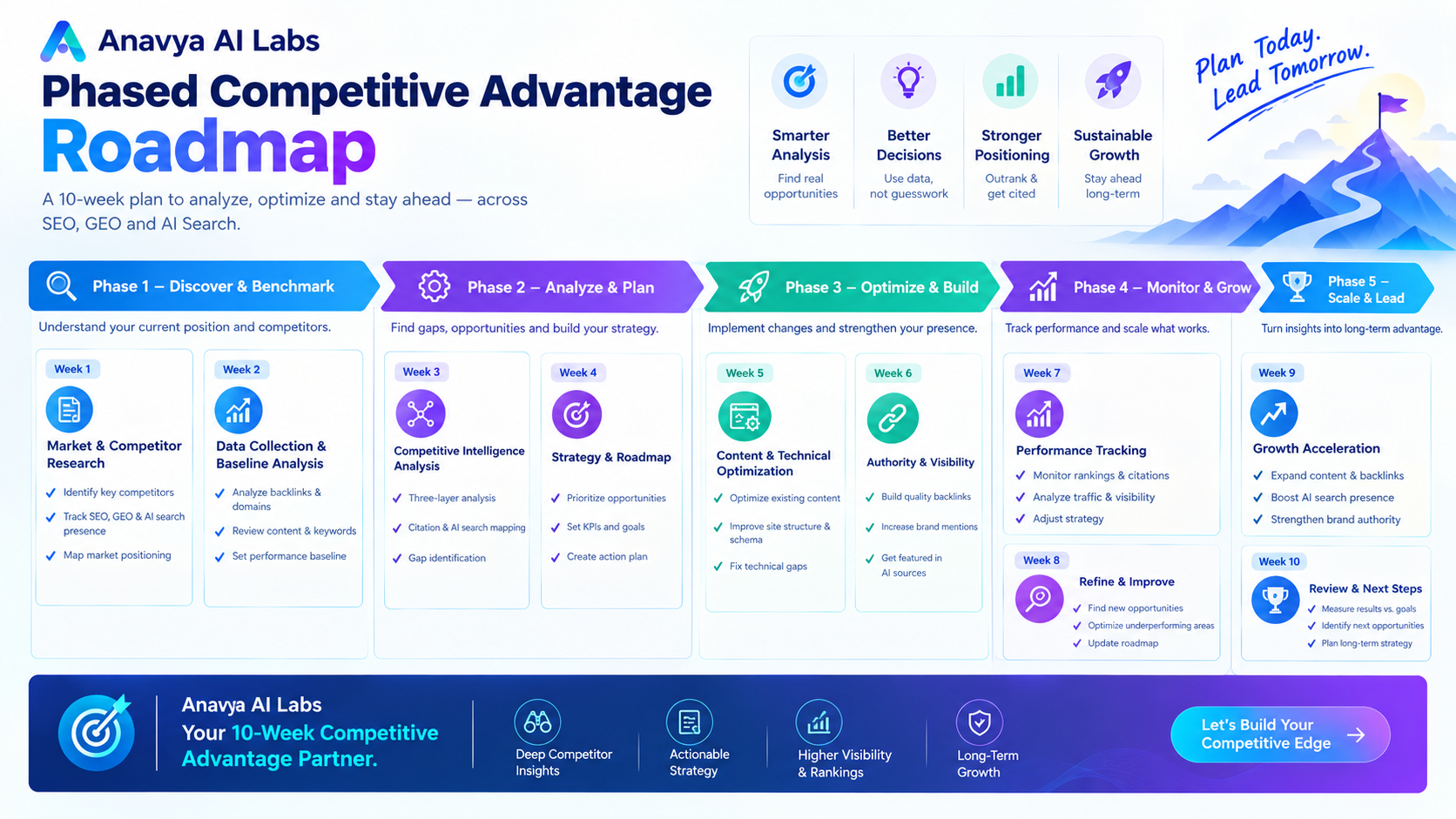
Timeline showing all phases with key milestones and deliverables
Common Competitive Scanning Mistakes
Mistake 1: Only Monitoring SEO Rankings
The Problem: Traditional SEO is only 1/3 of your competitive landscape. 87% of businesses miss AI search opportunities because they don't monitor these platforms.
The Fix: Implement weekly AI platform manual scans for your top 15 core queries.
Mistake 2: Ignoring Entity/GEO Signals
The Problem: Your competitors' AI visibility comes partly from strong GEO signals. Entity completeness affects how AI engines understand and recommend your business.
The Fix: Complete your entity information before worrying about traditional SEO optimization.
Mistake 3: Reactive Rather Than Proactive Scanning
The Problem: Waiting to notice competitors' ranking changes means you're always 1-2 months behind.
The Fix: Establish systematic weekly scanning. Early detection = faster response.
Mistake 4: Scanning Without Action Framework
The Problem: Collecting data is useless without a prioritized action plan. Many teams gather competitor data but don't translate it to strategy.
The Fix: For each gap discovered, immediately assess difficulty, timeline, and impact. Prioritize the highest-impact, lowest-difficulty opportunities first.
Quick Action Checklist
This Week
- Identify your top 5 direct competitors
- Document their main keywords (20 each)
- Check their AI search presence (manual search: ChatGPT + Perplexity)
- Audit your entity completeness vs theirs
- List your top 3 visibility gaps
This Month
- Complete full SEO competitive audit
- Map competitor GEO signals
- Conduct AI platform citation analysis (50 core queries)
- Identify 20 high-opportunity keyword gaps
- Create competitive positioning report
This Quarter
- Implement 10-week roadmap
- Close top 15 keyword gaps
- Improve AI citation presence by 200%+
- Establish weekly scanning process
- Launch competitive advantage initiative
The Future of Competitive Intelligence
By 2026, the businesses winning market share aren't just monitoring rankings—they're systematically tracking presence across three distinct platforms, identifying gaps others miss, and moving decisively to capitalize on opportunities.
Competitor scanning is no longer optional. It's the foundation of competitive strategy.
Start this week. Your competitors are already scanning.
Next Steps
- Audit your current position: Use the competitive matrix framework above
- Identify your top 5 gaps: What keywords? What AI citations? What entity signals?
- Prioritize by impact: Use the opportunity matrix to focus on quick wins first
- Implement the 10-week roadmap: Customize for your market and resources
- Establish monitoring: Weekly scans prevent being caught off-guard
For technical optimization foundations, reference our guide on Technical SEO Mistakes That Hurt AI Visibility.
FAQ
Q: How often should I scan competitors?
A: Weekly for top competitors, monthly for secondary competitors. AI platform scanning can be monthly initially, increasing to weekly as you scale.
Q: Which competitors should I monitor?
A: Start with your top 3-5 direct competitors. Expand to 10 as you mature your process. Monitor emerging competitors monthly.
Q: Do I need tools or can I scan manually?
A: Start manual (builds market understanding). Automate with tools after 6 weeks when you understand what matters.
Q: What's the fastest visibility gain?
A: GEO fixes (2 weeks) + AI content optimization on existing pages (2-4 weeks). Both show rapid results before organic traffic builds.
Q: How do I track competitor moves in real-time?
A: Google Alerts for brand mentions, SERP tracking tools for rankings, manual monthly AI platform scans.
Key Takeaways
✓ Three-layer strategy - Monitor SEO, GEO, and AI platforms simultaneously
✓ Citation matters - AI visibility depends on strategic mentions across platforms
✓ Entity completeness - GEO signals improve how AI engines understand your business
✓ Gap analysis - Identify opportunities competitors miss
✓ Systematic process - Weekly scanning beats occasional deep dives
✓ Speed to market - Quick wins (AI optimization) beat hard wins (new content)
✓ Competitive advantage - Sustained scanning reveals market trends first
About the Author
Our team of competitive intelligence specialists and AI search strategists work with SaaS, enterprise, and digital marketing companies to systematically improve visibility across SEO, GEO, and emerging AI search platforms.
Ready to implement your competitive scanning strategy? Contact our team for a personalized competitive analysis.